Li Chunyu, Hofmeister Elisabeth, Krivtsov Igor, Mitoraj Dariusz, Adler Christiane, Beranek Radim, Dietzek Benjamin
Department Functional Interfaces, Leibniz Institute of Photonic Technology Jena (IPHT), Albert-Einstein-Straße 9, 07745, Jena, Germany.
Institute of Physical Chemistry, Friedrich-Schiller University Jena, Helmholtzweg 4, 07743, Jena, Germany.
ChemSusChem. 2021 Apr 9;14(7):1728-1736. doi: 10.1002/cssc.202002921. Epub 2021 Feb 25.
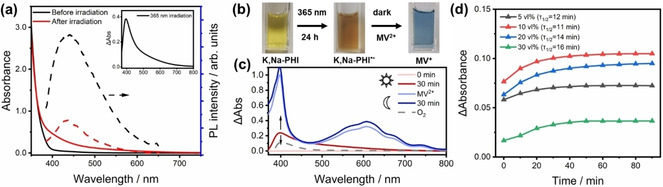
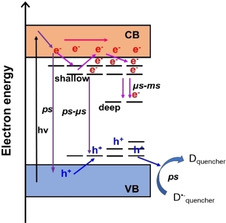
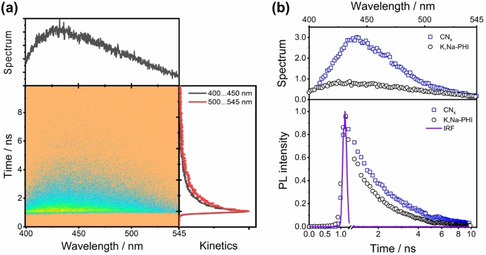
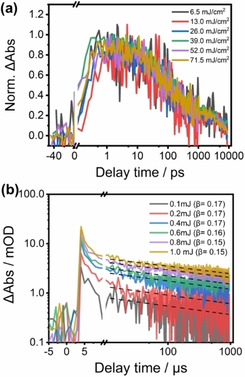
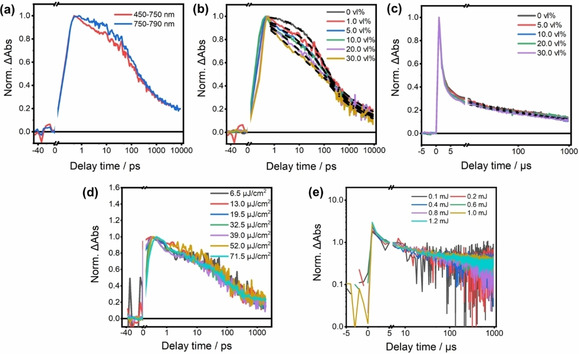
Charge accumulation in photoactive molecules and materials holds great promise in solar energy conversion as it allows for decoupling solar-driven charging from (dark) redox reactions. In this contribution, light-driven charge accumulation was investigated for a recently reported novel water-soluble carbon nitride [K,Na-poly(heptazine imide); K,Na-PHI] photocatalyst, which exhibits excellent activity and stability in highly selective photocatalytic oxidation of alcohols and concurrent reduction of dioxygen to H O under quasi-homogeneous conditions. An excellent charge storage ability of the K,Na-PHI material was demonstrated, showing an optimal density of accumulated electrons (32.2 μmol of electrons per gram) in the presence of 10 vol % MeOH as a sacrificial electron donor. The long-lived electrons accumulated under anaerobic conditions as K,Na-PHI radical ions were utilized in interfacial electron transfer to O or methyl viologen in a subsequent dark reaction. Ultrafast time-resolved spectroscopy was employed to reveal the kinetics of charge-carrier recombination and methanol oxidation. Geminate recombination of electrons and holes within approximately 100 ps was followed by trap-assisted recombination. The presence of methanol as a sacrificial electron donor accelerated the decay of the transient absorption signal when a static sample was used. This behavior was ascribed to the faster charge recombination in the presence of the radical anions generated after hole extraction. The work suggests that photodriven electron storage in the water-soluble carbon nitride is enabled by localized trap states, and highlights the importance of the effective electron donor for creating long-lived photo-generated carbon nitride radicals.
光活性分子和材料中的电荷积累在太阳能转换方面具有巨大潜力,因为它能使太阳能驱动的充电过程与(暗)氧化还原反应解耦。在本论文中,我们研究了一种最近报道的新型水溶性氮化碳[K,Na-聚(七嗪酰亚胺);K,Na-PHI]光催化剂的光驱动电荷积累情况,该催化剂在准均相条件下对醇类进行高选择性光催化氧化以及同时将氧气还原为H₂O的过程中表现出优异的活性和稳定性。结果表明K,Na-PHI材料具有出色的电荷存储能力,在存在10 vol%甲醇作为牺牲电子供体的情况下,积累电子的最佳密度为每克32.2 μmol电子。在厌氧条件下积累的长寿命电子以K,Na-PHI自由基离子的形式在随后的暗反应中用于向O₂或甲基紫精的界面电子转移。采用超快时间分辨光谱来揭示电荷载流子复合和甲醇氧化的动力学过程。电子和空穴在大约100 ps内的成对复合之后是陷阱辅助复合。当使用静态样品时,甲醇作为牺牲电子供体的存在加速了瞬态吸收信号的衰减。这种行为归因于空穴提取后产生的自由基阴离子存在时电荷复合更快。这项工作表明水溶性氮化碳中的光驱动电子存储是由局部陷阱态实现的,并突出了有效电子供体对于产生长寿命光生氮化碳自由基的重要性。