Alice Lee Centre for Nursing Studies, Yong Loo Lin School of Medicine, National University of Singapore, Singapore, Singapore.
Paediatric Oncology, Department of Paediatrics, Khoo Teck Puat National University Children's Medical Institute, Singapore, Singapore.
Cancer Rep (Hoboken). 2021 Jun;4(3):e1336. doi: 10.1002/cnr2.1336. Epub 2021 Feb 15.
Prevalent symptoms that affect children and adolescents throughout the process of cancer diagnosis and treatment include nausea and vomiting, fatigue, pain, mucositis, and anxiety.
To examine the effect of a home-based multimodal symptom-management program for alleviation of nausea and vomiting, fatigue, pain, mucositis, and anxiety in children and adolescents undergoing chemotherapy for hematological malignancies or solid tumors.
In an exploratory pilot randomized study with qualitative interview, patients between 10 and 18 years of age were randomly assigned to either the symptom-management program plus usual care (intervention group) or usual care (control group). The program consisted of multiple nonpharmacological interventional components. The targeted symptoms were measured at baseline (after diagnosis), at the first 2 weeks of each cycle of chemotherapy, and at 6 months after baseline, using the Memorial Symptom Assessment Scale 10-18 and the State Anxiety Scale for Children.
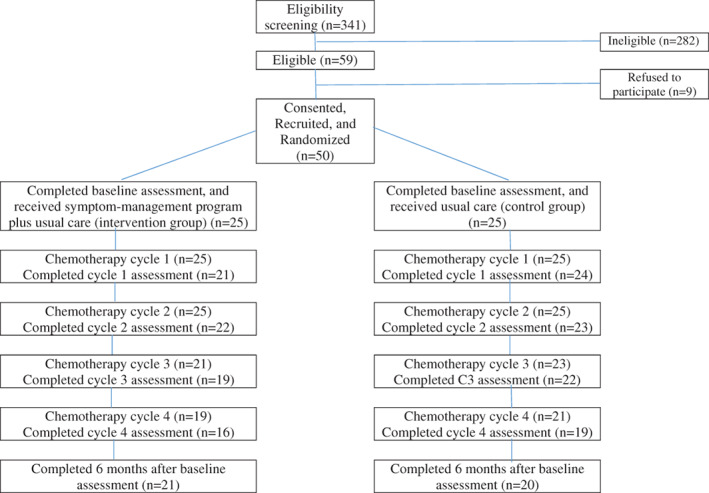
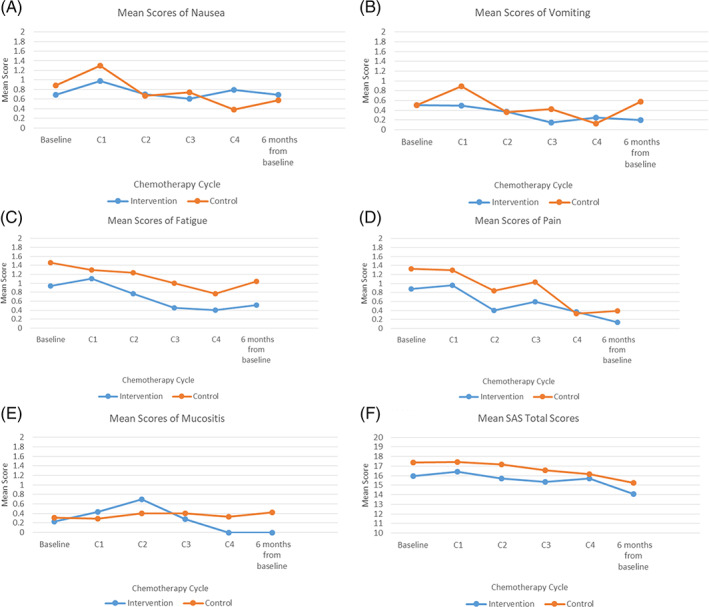
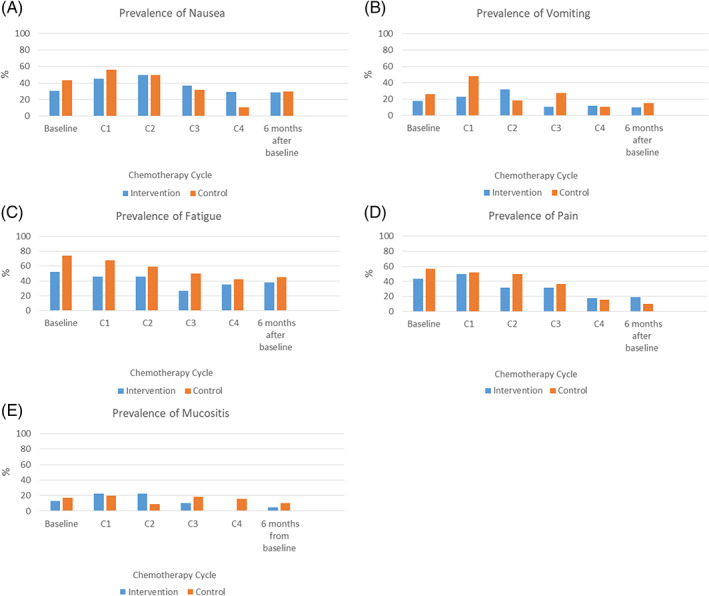
Fifty children (31 boys; mean age, 13.7 years) were randomized either to the intervention group or the control group (25 each) and underwent baseline assessment. A comparison between the groups showed that the intervention group had a significant less fatigue over time (P < .05). However, no differences were found with respect to nausea and vomiting, pain, mucositis, and anxiety between groups. Both children and parents reported a positive experience with the symptom-management program.
The home-based symptom-management program may have helped to reduce fatigue in children and adolescents undergoing chemotherapy. In addition, qualitative data support the importance of improving children and parents' knowledge, coping skills, and psychological preparation for symptoms associated with chemotherapy.
在癌症诊断和治疗过程中,普遍影响儿童和青少年的症状包括恶心和呕吐、疲劳、疼痛、黏膜炎和焦虑。
研究一种基于家庭的多模式症状管理方案对缓解接受血液系统恶性肿瘤或实体瘤化疗的儿童和青少年的恶心和呕吐、疲劳、疼痛、黏膜炎和焦虑的效果。
在一项探索性随机试验中,采用定性访谈方法,将 10 至 18 岁的患者随机分配到症状管理方案加常规护理(干预组)或常规护理(对照组)。该方案包括多种非药物干预措施。使用 10-18 岁的 Memorial 症状评估量表和儿童状态焦虑量表,在基线(诊断后)、每个化疗周期的前 2 周和基线后 6 个月测量目标症状。
共有 50 名儿童(31 名男孩;平均年龄 13.7 岁)被随机分配到干预组或对照组(每组 25 名)并进行基线评估。组间比较显示,干预组随着时间的推移疲劳程度显著降低(P<.05)。然而,两组之间在恶心和呕吐、疼痛、黏膜炎和焦虑方面没有差异。儿童和家长均报告症状管理方案体验良好。
基于家庭的症状管理方案可能有助于减轻接受化疗的儿童和青少年的疲劳。此外,定性数据支持提高儿童和家长对与化疗相关症状的知识、应对技能和心理准备的重要性。