Rocca Paola, Brasso Claudio, Montemagni Cristiana, Bellino Silvio, Rossi Alessandro, Bertolino Alessandro, Gibertoni Dino, Aguglia Eugenio, Amore Mario, Andriola Ileana, Bellomo Antonello, Bucci Paola, Buzzanca Antonino, Carpiniello Bernardo, Cuomo Alessandro, Dell'Osso Liliana, Favaro Angela, Giordano Giulia Maria, Marchesi Carlo, Monteleone Palmiero, Oldani Lucio, Pompili Maurizio, Roncone Rita, Rossi Rodolfo, Siracusano Alberto, Vita Antonio, Zeppegno Patrizia, Galderisi Silvana, Maj Mario
Department of Neuroscience, Section of Psychiatry, University of Turin, Turin, Italy.
Section of Psychiatry, Department of Biotechnological and Applied Clinical Sciences, University of L'Aquila, L'Aquila, Italy.
NPJ Schizophr. 2021 Feb 15;7(1):11. doi: 10.1038/s41537-021-00140-9.
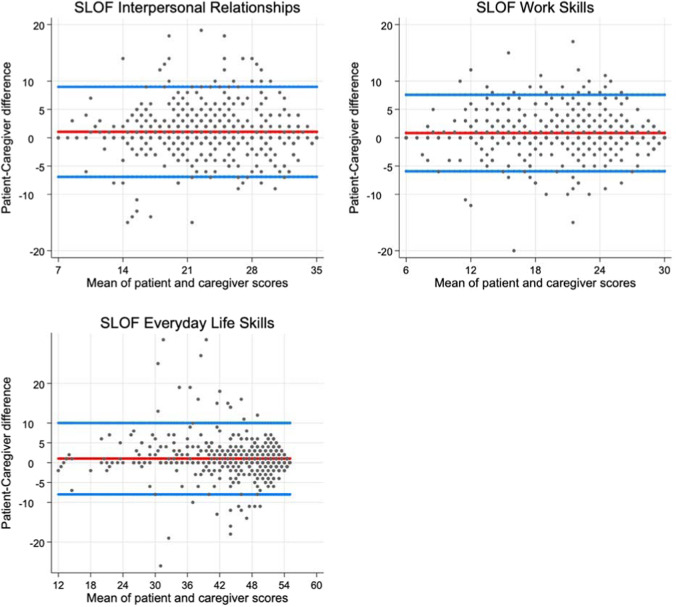
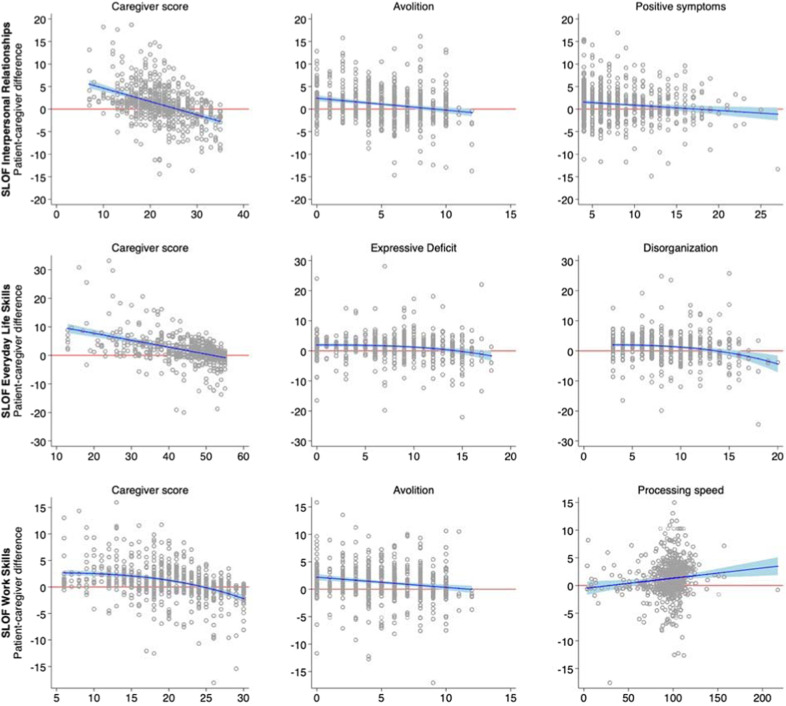
A consensus has not yet been reached regarding the accuracy of people with schizophrenia in self-reporting their real-life functioning. In a large (n = 618) cohort of stable, community-dwelling schizophrenia patients we sought to: (1) examine the concordance of patients' reports of their real-life functioning with the reports of their key caregiver; (2) identify which patient characteristics are associated to the differences between patients and informants. Patient-caregiver concordance of the ratings in three Specific Level of Functioning Scale (SLOF) domains (interpersonal relationships, everyday life skills, work skills) was evaluated with matched-pair t tests, the Lin's concordance correlation, Somers' D, and Bland-Altman plots with limits of agreement (LOA). Predictors of the patient-caregiver differences in SLOF ratings were assessed with a linear regression with multivariable fractional polynomials. Patients' self-evaluation of functioning was higher than caregivers' in all the evaluated domains of the SLOF and 17.6% of the patients exceeded the LOA, thus providing a self-evaluation discordant from their key caregivers. The strongest predictors of patient-caregiver discrepancies were caregivers' ratings in each SLOF domain. In clinically stable outpatients with a moderate degree of functional impairment, self-evaluation with the SLOF scale can become a useful, informative and reliable clinical tool to design a tailored rehabilitation program.
关于精神分裂症患者自我报告其现实生活功能的准确性,尚未达成共识。在一个由618名稳定的社区精神分裂症患者组成的大型队列中,我们试图:(1)检查患者对其现实生活功能的报告与其主要照顾者报告之间的一致性;(2)确定哪些患者特征与患者和信息提供者之间的差异相关。使用配对t检验、林氏一致性相关性、萨默斯D以及带有一致性界限(LOA)的布兰德-奥特曼图,评估了三个特定功能水平量表(SLOF)领域(人际关系、日常生活技能、工作技能)评分的患者-照顾者一致性。通过多变量分数多项式线性回归评估SLOF评分中患者-照顾者差异的预测因素。在SLOF的所有评估领域中,患者对功能的自我评估均高于照顾者,17.6%的患者超出了LOA,因此其自我评估与其主要照顾者不一致。患者-照顾者差异的最强预测因素是每个SLOF领域中照顾者的评分。在功能损害程度中等的临床稳定门诊患者中,使用SLOF量表进行自我评估可成为设计量身定制康复计划的有用、信息丰富且可靠的临床工具。