Department of Epidemiology, Rollins School of Public Health, Emory University, Atlanta, GA, United States; National Center for Environmental Health, Centers for Disease Control and Prevention, Atlanta, GA, United States; Oak Ridge Institute for Science and Education, Oak Ridge, TN, United States.
Department of Epidemiology, Rollins School of Public Health, Emory University, Atlanta, GA, United States.
Environ Pollut. 2021 May 1;276:116705. doi: 10.1016/j.envpol.2021.116705. Epub 2021 Feb 9.
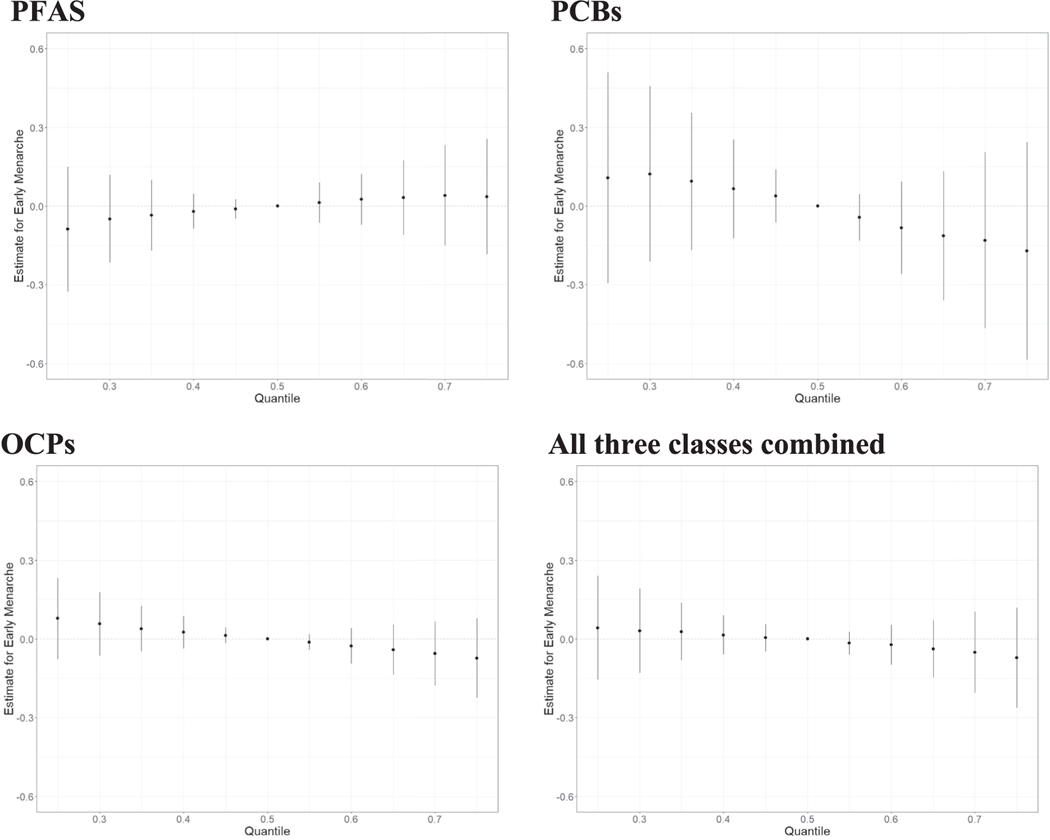
Exposure to endocrine disrupting chemicals (EDCs) is ubiquitous. EDC exposure, especially during critical periods of development like the prenatal window, may interfere with the body's endocrine system, which can affect growth and developmental outcomes such as puberty. Most studies have examined one EDC at a time in relation to disease; however, humans are exposed to many EDCs. By studying mixtures, the human experience can be more closely replicated. We investigated the association of prenatal exposure to persistent EDCs (poly- and perfluoroalkyl substances (PFAS), polychlorinated biphenyls (PCBs), and organochlorine pesticides (OCPs)) as mixtures with early menarche among female offspring in a nested case-control study within the Avon Longitudinal Study of Parents and Children (ALSPAC) recruited in the United Kingdom in 1991-1992. Concentrations of 52 EDCs were quantified in maternal serum samples collected during pregnancy. Daughter's age at menarche was ascertained through mailed questionnaires sent annually. We used repeated holdout weighted quantile sum (WQS) regression and Bayesian kernel machine regression (BKMR) to examine the association between prenatal exposure to multiple EDCs and early menarche (<11.5 (n = 218) vs. ≥11.5 years (n = 230)) for each chemical class separately (PFAS, PCBs, and OCPs) and for all three classes combined. Models adjusted for maternal age at menarche, maternal education, parity, pre-pregnancy body mass index, maternal age, prenatal smoking, and gestational week at sample collection. Mixture models showed null associations between prenatal exposure to EDC mixtures and early menarche. Using WQS regression, the odds ratio for early menarche for a one-decile increase in chemical concentrations for all three classes combined was 0.89 (95% CI: 0.76, 1.05); using BKMR, the odds ratio when all exposures were at the 60th percentile compared to the median was 0.98 (95% CI: 0.91, 1.05). Results suggest the overall effect of prenatal exposure to persistent EDC mixtures is not associated with early menarche.
暴露于内分泌干扰化学物质(EDC)是普遍存在的。EDC 暴露,特别是在产前窗等关键发育时期,可能会干扰身体的内分泌系统,从而影响生长和发育结果,如青春期。大多数研究都一次研究一种 EDC 与疾病的关系;然而,人类暴露于许多 EDC。通过研究混合物,可以更接近地复制人类的经验。我们研究了产前暴露于持久性 EDC(多氟和全氟烷基物质(PFAS)、多氯联苯(PCBs)和有机氯农药(OCPs))混合物与女性后代初潮之间的关联,这是在英国于 1991-1992 年招募的阿冯纵向研究父母和孩子(ALSPAC)中的嵌套病例对照研究中进行的。在怀孕期间采集的母亲血清样本中定量了 52 种 EDC。女儿的初潮年龄通过每年邮寄的问卷确定。我们使用重复预留加权分位数总和(WQS)回归和贝叶斯核机器回归(BKMR)来分别检查每个化学物质类别(PFAS、PCBs 和 OCPs)以及所有三个类别组合的产前暴露于多种 EDC 与初潮早(<11.5 岁(n=218)与≥11.5 岁(n=230))之间的关联。模型调整了母亲的初潮年龄、母亲的教育程度、产次、孕前体重指数、母亲年龄、产前吸烟和样本采集时的妊娠周数。混合物模型显示,产前暴露于 EDC 混合物与初潮早之间没有关联。使用 WQS 回归,所有三个类别组合的化学浓度每增加十分之一,初潮早的优势比为 0.89(95%CI:0.76,1.05);使用 BKMR,当所有暴露均处于第 60 百分位与中位数相比时,优势比为 0.98(95%CI:0.91,1.05)。结果表明,产前暴露于持久性 EDC 混合物的总体影响与初潮早无关。