Sharma Ritu, Seth Shikha, Sharma Rakhee, Yadav Sanju, Mishra Pinky, Mukhopadhyay Sujaya
Department of Obstetrics & Gynecology, Government Institute of Medical Sciences, Greater Noida, Uttar Pradesh, India.
Department of Pediatrics, Government Institute of Medical Sciences, Greater Noida, Uttar Pradesh, India.
Clin Exp Pediatr. 2021 May;64(5):239-246. doi: 10.3345/cep.2020.01704. Epub 2021 Feb 16.
The consequences of severe acute respiratory syndrome corona virus 2 on mother and fetus remain unknown due to a lack of robust evidence from prospective studies.
This study evaluated the effect of coronavirus disease 2019 (COVID-19) on neonatal outcomes and the scope of vertical transmission.
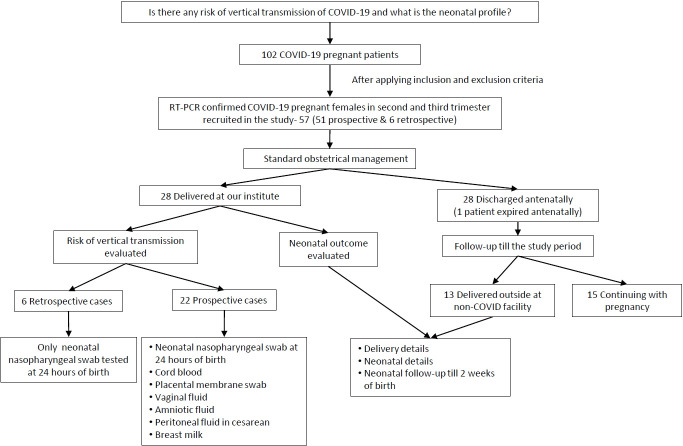
This ambispective observational study enrolled pregnant women with COVID-19 in North India from April 1 to August 31, 2020 to evaluate neonatal outcomes and the risk of vertical transmission.
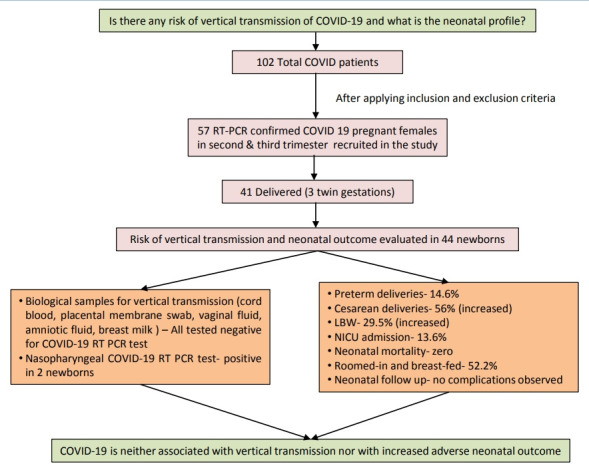
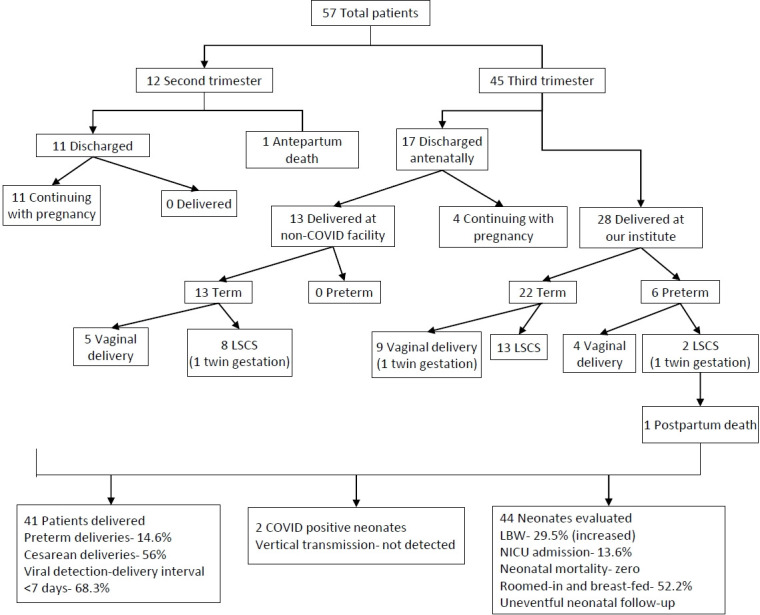
A total of 44 neonates born to 41 COVID-19-positive mothers were evaluated. Among them, 28 patients (68.3%) (2 sets of twins) were delivered within 7 days of testing positive for COVID-19, 23 patients (56%) (2 sets of twins) were delivered by cesarean section; 13 newborns (29.5%) had low birth weight; 7 (15.9%) were preterm; and 6 (13.6%) required neonatal intensive care unit admission, reflecting an increased incidence of cesarean delivery and low birth weight but zero neonatal mortality. Samples of cord blood, placental membrane, vaginal fluid, amniotic fluid, peritoneal fluid (in case of cesarean section), and breast milk for COVID-19 reverse transcription-polymerase chain reaction tested negative in 22 prospective delivery cases. Nasopharyngeal swabs of 2 newborns tested positive for COVID-19: one at 24 hours and the other on day 4 of life. In the former case, biological samples were not collected as the mother was asymptomatic and her COVID-19 report was available postdelivery; hence, the source of infection remained inconclusive. In the latter case, all samples tested negative, ruling out the possibility of vertical transmission. All neonates remained asymptomatic on follow-up.
COVID-19 does not have direct adverse effects on the fetus per se. The possibility of vertical transmission is almost negligible, although results from larger trials are required to confirm our findings.
由于前瞻性研究缺乏有力证据,严重急性呼吸综合征冠状病毒2对母亲和胎儿的影响尚不清楚。
本研究评估了2019冠状病毒病(COVID-19)对新生儿结局的影响以及垂直传播的范围。
这项双向观察性研究纳入了2020年4月1日至8月31日在印度北部感染COVID-19的孕妇,以评估新生儿结局和垂直传播风险。
共评估了41例COVID-19阳性母亲所生的44例新生儿。其中,28例患者(68.3%)(2对双胞胎)在COVID-19检测呈阳性后7天内分娩,23例患者(56%)(2对双胞胎)通过剖宫产分娩;13例新生儿(29.5%)出生体重低;7例(15.9%)早产;6例(13.6%)需要入住新生儿重症监护病房,这反映出剖宫产和低出生体重的发生率增加,但新生儿死亡率为零。在22例前瞻性分娩病例中,脐带血、胎盘膜、阴道液、羊水、腹腔液(剖宫产时)和母乳的COVID-19逆转录-聚合酶链反应检测均为阴性。2例新生儿的鼻咽拭子COVID-19检测呈阳性:1例在出生后24小时,另1例在出生后第4天。在前一种情况下,由于母亲无症状且其COVID-19报告在分娩后才获得,未采集生物样本;因此,感染源仍不确定。在后一种情况下,所有样本检测均为阴性,排除了垂直传播的可能性。所有新生儿在随访中均无症状。
COVID-19本身对胎儿没有直接不良影响。垂直传播的可能性几乎可以忽略不计,尽管需要更大规模试验的结果来证实我们的发现。