Department of Obstetrics, Perinatal Medical Center, TOYOTA Memorial Hospital, 1-1 Heiwa-cho, Toyota, Aichi, 471-8513, Japan.
Department of Obstetrics and Gynecology, Nagoya University Graduate School of Medicine, 65 Tsurumai-cho, Showa-ku, Nagoya, Aichi, 466-8550, Japan.
BMC Pregnancy Childbirth. 2021 Feb 16;21(1):141. doi: 10.1186/s12884-021-03624-9.
Although infection and inflammation within the genital tract during pregnancy is considered a major risk factor for spontaneous preterm birth (PTB), there are few studies on association between vaginal microorganisms in the early stage of pregnancy and PTB. The aim of this study was to investigate relationship between vaginal Group B streptococcus (GBS) colonization, a leading cause of infection during pregnancy, in the early stage of pregnancy and PTB.
This single-center, retrospective cohort study utilized data from 2009 to 2017 obtained at TOYOTA Memorial Hospital. Women with singleton pregnancies who underwent vaginal culture around 14 weeks of gestation during their routine prenatal check-up were included. Vaginal sampling for Gram staining and culture was performed regardless of symptoms. GBS colonization was defined as positive for GBS latex agglutination assay. Statistical analysis was performed to determine the factors associated with PTB.
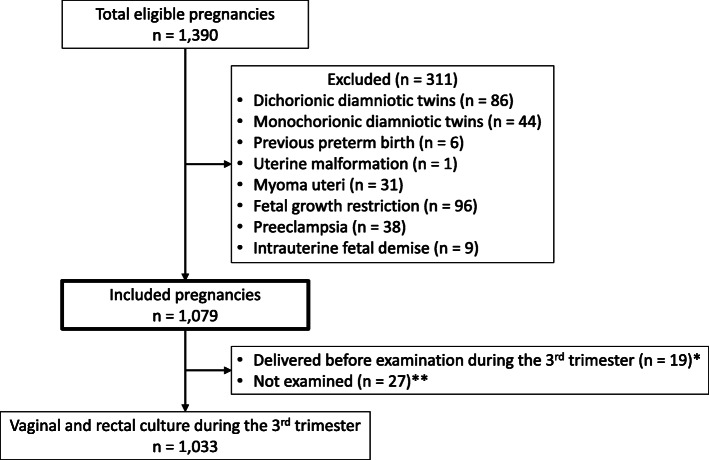
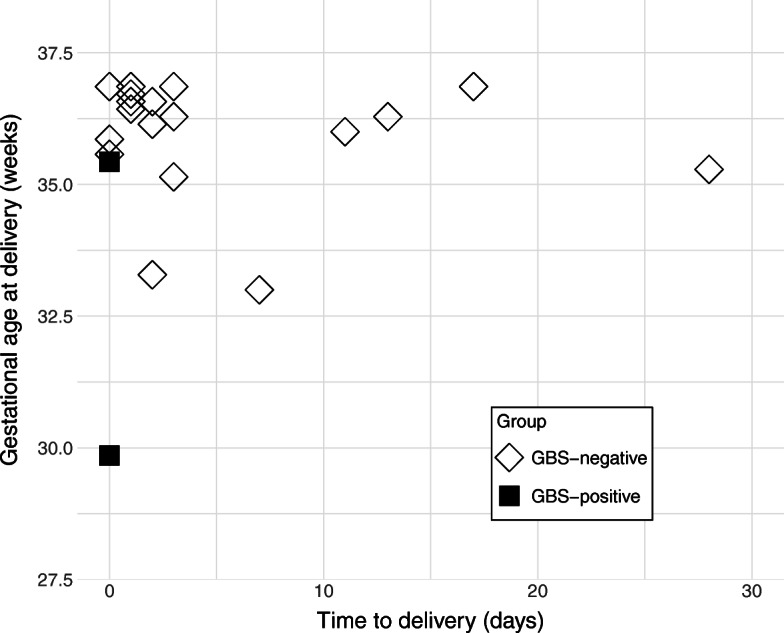
Overall 1079 singleton pregnancies were included. GBS (5.7%) and Candida albicans (5.5%) were the most frequently observed microorganisms. The incidence of PTB (before 34 and before 37 weeks of gestation) were significantly higher in the GBS-positive group than in the GBS-negative group (6.6% vs 0.5%, p = 0.001 and 9.8% vs 4.3%, p = 0.047). Our multivariable logistic regression analysis revealed that GBS colonization was a factor associated with PTB before 34 and before 37 weeks of gestation (Odds ratio [OR] 15.17; 95% confidence interval [CI] 3.73-61.74), and OR 2.42; 95%CI 1.01-5.91, respectively).
The present study found that vaginal GBS colonization in the early stage of pregnancy was associated with PTB. Our study indicates that patients at a high risk for PTB can be extracted by a simple method using conventional culture method.
虽然生殖道感染和炎症被认为是自发性早产(PTB)的主要危险因素,但关于妊娠早期阴道微生物与 PTB 之间的关联的研究较少。本研究旨在探讨妊娠早期阴道 B 群链球菌(GBS)定植(妊娠期间感染的主要原因)与 PTB 之间的关系。
这是一项单中心、回顾性队列研究,利用了 2009 年至 2017 年丰田纪念医院的数据。纳入了在常规产前检查中于妊娠 14 周左右进行阴道培养的单胎妊娠妇女。无论有无症状,均进行阴道革兰氏染色和培养取样。GBS 定植的定义为 GBS 胶乳凝集试验阳性。进行统计分析以确定与 PTB 相关的因素。
共有 1079 例单胎妊娠纳入研究。GBS(5.7%)和白色念珠菌(5.5%)是最常见的微生物。GBS 阳性组的早产发生率(<34 周和<37 周)明显高于 GBS 阴性组(6.6%比 0.5%,p=0.001 和 9.8%比 4.3%,p=0.047)。多变量逻辑回归分析显示,GBS 定植是与<34 周和<37 周早产相关的因素(优势比[OR]15.17;95%置信区间[CI]3.73-61.74)和 OR 2.42;95%CI 1.01-5.91)。
本研究发现妊娠早期阴道 GBS 定植与 PTB 相关。我们的研究表明,可以通过使用常规培养方法的简单方法提取具有较高 PTB 风险的患者。