Bolyai Institute, University of Szeged, Aradi vértanúk tere 1., Szeged, 6720, Hungary.
Department of Mathematics, Faculty of Science, Mansoura University, Mansoura, 35516, Egypt.
Bull Math Biol. 2021 Feb 17;83(4):27. doi: 10.1007/s11538-020-00844-6.
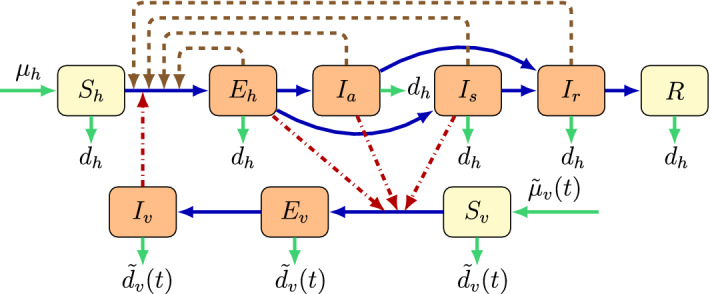
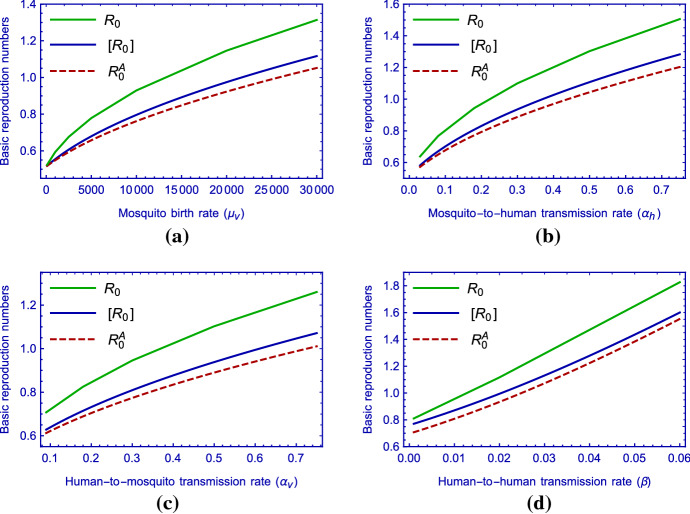
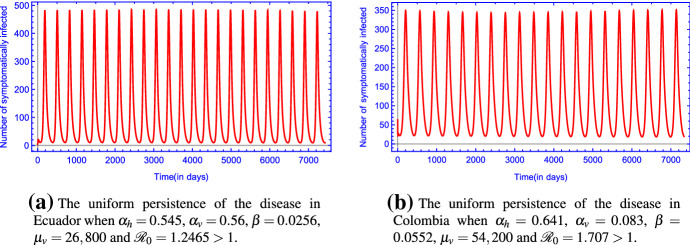
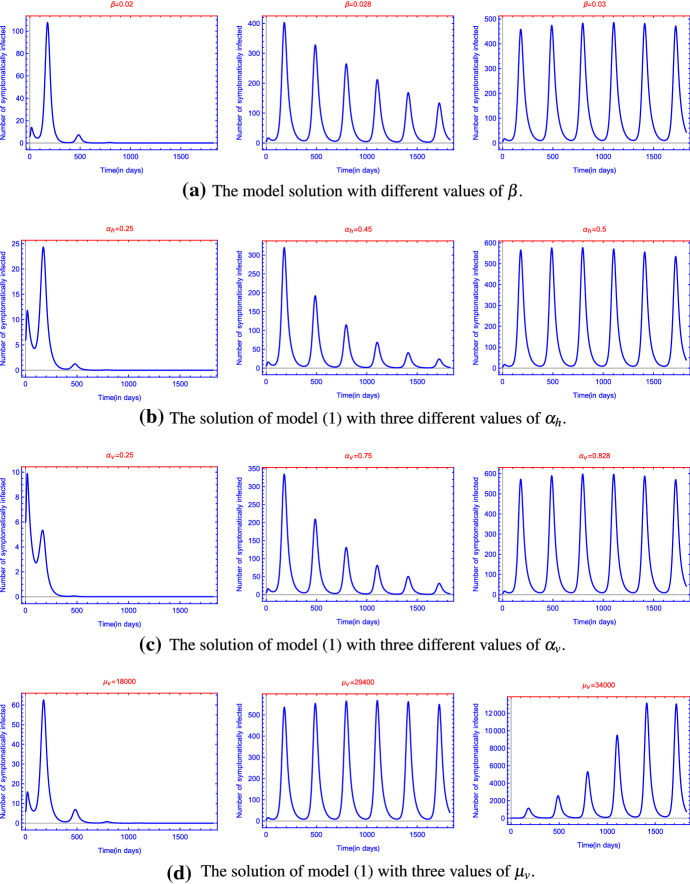
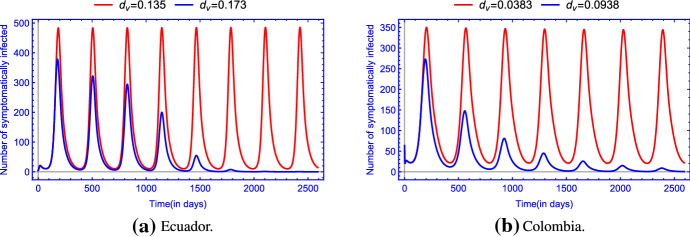
We present a compartmental population model for the spread of Zika virus disease including sexual and vectorial transmission as well as asymptomatic carriers. We apply a non-autonomous model with time-dependent mosquito birth, death and biting rates to integrate the impact of the periodicity of weather on the spread of Zika. We define the basic reproduction number [Formula: see text] as the spectral radius of a linear integral operator and show that the global dynamics is determined by this threshold parameter: If [Formula: see text] then the disease-free periodic solution is globally asymptotically stable, while if [Formula: see text] then the disease persists. We show numerical examples to study what kind of parameter changes might lead to a periodic recurrence of Zika.
我们提出了一个关于寨卡病毒病传播的房室人群模型,包括性传播和媒介传播以及无症状携带者。我们应用了一个非自治模型,其中蚊子的出生、死亡和叮咬率随时间变化,以整合天气周期性对寨卡传播的影响。我们将基本繁殖数 [Formula: see text] 定义为线性积分算子的谱半径,并表明全局动力学由这个阈值参数决定:如果 [Formula: see text],则无病周期解全局渐近稳定,而如果 [Formula: see text],则疾病持续存在。我们展示了数值示例,以研究什么样的参数变化可能导致寨卡病毒的周期性复发。