Key Laboratory of Cognitive Radio and Information Processing, Ministry of Education (Guilin University of Electronic Technology), Guilin, 541004, China.
School of Mathematics and Computing Science, Guilin University of Electronic Technology, Guilin, 541004, China.
Sci Rep. 2024 Mar 28;14(1):7424. doi: 10.1038/s41598-024-58025-7.
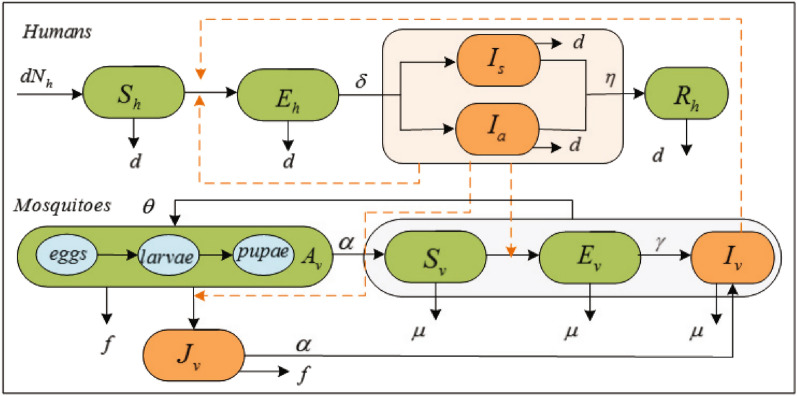
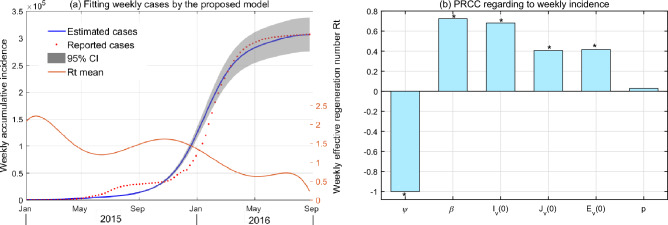
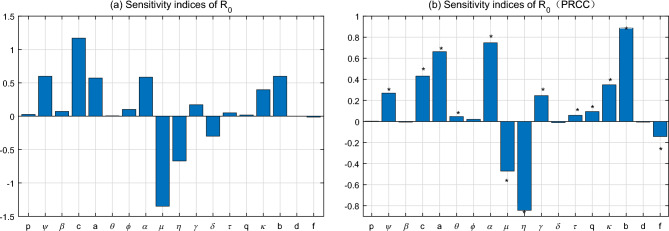
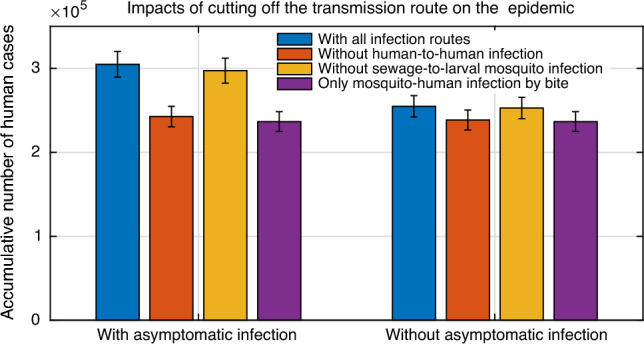
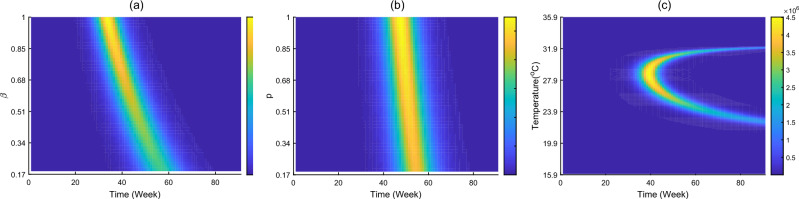
The Zika virus (ZIKV) is a serious global public health crisis. A major control challenge is its multiple transmission modes. This paper aims to simulate the transmission patterns of ZIKV using a dynamic process-based epidemiological model written in ordinary differential equations, which incorporates the human-to-mosquito infection by bites and sewage, mosquito-to-human infection by bites, and human-to-human infection by sex. Mathematical analyses are carried out to calculate the basic reproduction number and backward bifurcation, and prove the existence and stability of the equilibria. The model is validated with infection data by applying it to the 2015-2016 ZIKV epidemic in Brazil. The results indicate that the reproduction number is estimated to be 2.13, in which the contributions by mosquito bite, sex and sewage account for 85.7%, 3.5% and 10.8%, respectively. This number and the morbidity rate are most sensitive to parameters related to mosquito ecology, rather than asymptomatic or human-to-human transmission. Multiple transmission routes and suitable temperature exacerbate ZIKV infection in Brazil, and the vast majority of human infection cases were prevented by the intervention implemented. These findings may provide new insights to improve the risk assessment of ZIKV infection.
寨卡病毒(ZIKV)是一场严重的全球公共卫生危机。一个主要的控制挑战是其多种传播模式。本文旨在使用基于微分方程的动态过程流行病学模型模拟 ZIKV 的传播模式,该模型结合了蚊虫叮咬和污水中的人感染、蚊虫叮咬中的人感染以及性行为中的人感染。进行了数学分析以计算基本繁殖数和向后分歧,并证明了平衡点的存在和稳定性。通过将该模型应用于 2015-2016 年巴西的寨卡病毒流行,用感染数据进行了验证。结果表明,繁殖数估计为 2.13,其中蚊虫叮咬、性行为和污水的贡献分别占 85.7%、3.5%和 10.8%。这个数字和发病率对与蚊子生态学相关的参数最敏感,而不是无症状或人与人之间的传播。多种传播途径和适宜的温度加剧了寨卡病毒在巴西的感染,干预措施预防了绝大多数的人类感染病例。这些发现可能为改善寨卡病毒感染的风险评估提供新的见解。