Department of Nephrology, School of Medicine, Renji Hospital, Shanghai Jiaotong University, Shanghai, China.
Department of Urology, School of Medicine, Renji Hospital, Shanghai Jiaotong University, Shanghai, China.
Cell Prolif. 2021 Apr;54(4):e13005. doi: 10.1111/cpr.13005. Epub 2021 Feb 16.
We investigated the role of farnesoid X receptor (FXR), a ligand-dependent transcription factor, in renal ischaemia-reperfusion (I/R) injury.
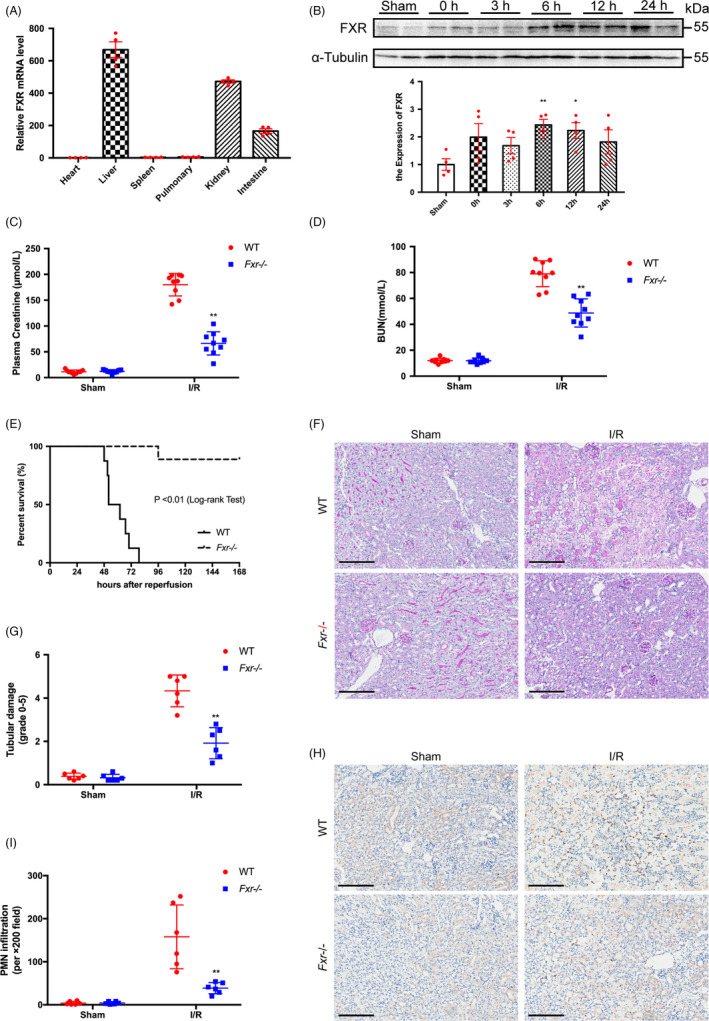
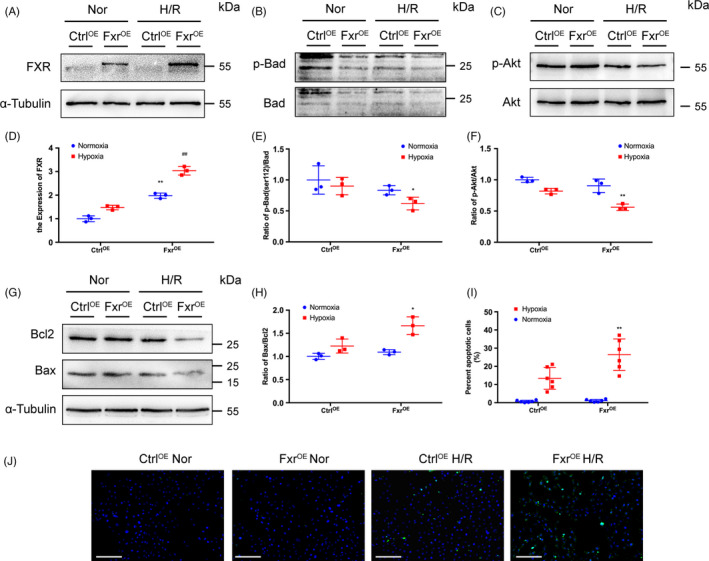
We performed unilateral renal I/R model in FXR knockout (Fxr ) and wild-type (WT) mice in vivo and a hypoxia-reoxygenation (H/R) model in vitro. The pathways by which FXR induces apoptosis were detected using a proteome profiler array. The effects of FXR on apoptosis were evaluated using immunoblotting, TUNEL assays and flow cytometry.
Compared with WT mice, Fxr mice showed improved renal function and reduced tubular injury scores and apoptosis. Consistent with the in vivo results, the silencing of FXR decreased the number of apoptotic HK-2 cells after H/R, while FXR overexpression aggravated apoptosis. Notably, bone marrow transplantation (BMT) and immunohistochemistry experiments revealed the involvement of FXR in the tubular epithelium rather than in inflammatory cells. Furthermore, in vivo and in vitro studies demonstrated that FXR deficiency increased phosphorylated Bcl-2 agonist of cell death (p-Bad) expression levels and the ratio of Bcl-2/Bcl-xL to Bax expression in the kidney. Treatment with wortmannin, which reduced p-Bad expression, inhibited the effects of FXR deficiency and eliminated the tolerance of Fxr mouse kidneys to I/R injury.
These results established the pivotal importance of FXR inactivation in tubular epithelial cells after I/R injury. FXR may promote the apoptosis of renal tubular epithelial cells by inhibiting PI3k/Akt-mediated Bad phosphorylation to cause renal I/R damage.
我们研究了法尼醇 X 受体(FXR)作为配体依赖性转录因子在肾缺血再灌注(I/R)损伤中的作用。
我们在体内进行了 FXR 敲除(Fxr)和野生型(WT)小鼠的单侧肾 I/R 模型以及体外缺氧再复氧(H/R)模型。使用蛋白质组谱分析检测 FXR 诱导细胞凋亡的途径。通过免疫印迹、TUNEL 检测和流式细胞术评估 FXR 对细胞凋亡的影响。
与 WT 小鼠相比,Fxr 小鼠的肾功能改善,肾小管损伤评分和细胞凋亡减少。与体内结果一致,H/R 后 FXR 沉默减少了 HK-2 细胞的凋亡细胞数,而过表达 FXR 则加重了凋亡。值得注意的是,骨髓移植(BMT)和免疫组化实验表明 FXR 参与了肾小管上皮细胞,而不是炎症细胞。此外,体内和体外研究表明,FXR 缺失增加了肾脏中磷酸化 Bcl-2 凋亡促进因子(p-Bad)的表达水平和 Bcl-2/Bcl-xL 与 Bax 的比值。用 wortmannin 处理,降低了 p-Bad 的表达,抑制了 FXR 缺失的作用,并消除了 Fxr 小鼠肾脏对 I/R 损伤的耐受。
这些结果确立了 FXR 失活在 I/R 损伤后肾小管上皮细胞中的关键重要性。FXR 可能通过抑制 PI3k/Akt 介导的 Bad 磷酸化来促进肾小管上皮细胞的凋亡,从而导致肾 I/R 损伤。