Center for Innovations in Quality, Effectiveness and Safety, Michael E. DeBakey Veterans Affairs Medical Center, Houston, TX, USA
Baylor College of Medicine, Houston, Texas, USA.
BMJ Qual Saf. 2021 Dec;30(12):996-1001. doi: 10.1136/bmjqs-2020-011593. Epub 2021 Feb 17.
Patient complaints are associated with adverse events and malpractice claims but underused in patient safety improvement.
To systematically evaluate the use of patient complaint data to identify safety concerns related to diagnosis as an initial step to using this information to facilitate learning and improvement.
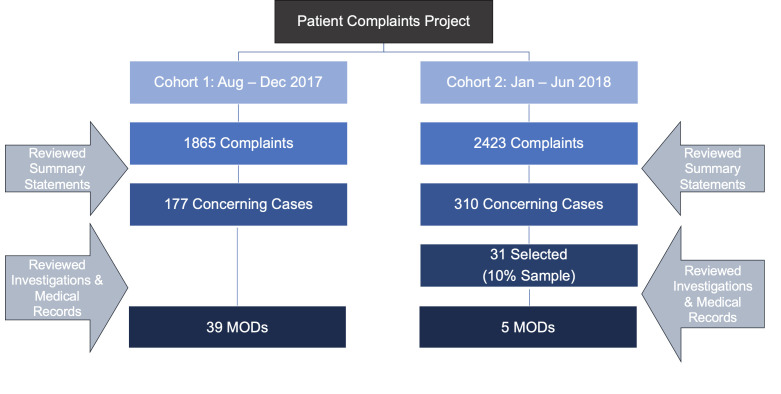
We reviewed patient complaints submitted to Geisinger, a large healthcare organisation in the USA, from August to December 2017 (cohort 1) and January to June 2018 (cohort 2). We selected complaints more likely to be associated with diagnostic concerns in Geisinger's existing complaint taxonomy. Investigators reviewed all complaint summaries and identified cases as 'concerning' for diagnostic error using the National Academy of Medicine's definition of diagnostic error. For all 'concerning' cases, a clinician-reviewer evaluated the associated investigation report and the patient's medical record to identify any missed opportunities in making a correct or timely diagnosis. In cohort 2, we selected a 10% sample of 'concerning' cases to test this smaller pragmatic sample as a proof of concept for future organisational monitoring.
In cohort 1, we reviewed 1865 complaint summaries and identified 177 (9.5%) concerning reports. Review and analysis identified 39 diagnostic errors. Most were categorised as 'Clinical Care issues' (27, 69.2%), defined as concerns/questions related to the care that is provided by clinicians in any setting. In cohort 2, we reviewed 2423 patient complaint summaries and identified 310 (12.8%) concerning reports. The 10% sample (n=31 cases) contained five diagnostic errors. Qualitative analysis of cohort 1 cases identified concerns about return visits for persistent and/or worsening symptoms, interpersonal issues and diagnostic testing.
Analysis of patient complaint data and corresponding medical record review identifies patterns of failures in the diagnostic process reported by patients and families. Health systems could systematically analyse available data on patient complaints to monitor diagnostic safety concerns and identify opportunities for learning and improvement.
患者投诉与不良事件和医疗事故索赔有关,但在患者安全改进中未得到充分利用。
系统评估使用患者投诉数据来识别与诊断相关的安全问题,作为利用这些信息促进学习和改进的初始步骤。
我们回顾了 2017 年 8 月至 12 月(队列 1)和 2018 年 1 月至 6 月(队列 2)期间向美国大型医疗保健组织盖辛格(Geisinger)提交的患者投诉。我们选择了在盖辛格现有投诉分类法中更有可能与诊断问题相关的投诉。调查人员审查了所有投诉摘要,并使用国家医学院对诊断错误的定义,将病例确定为与诊断错误“相关”。对于所有“相关”病例,临床医生审查员评估了相关调查报告和患者的病历,以确定在做出正确或及时诊断方面是否存在错失的机会。在队列 2 中,我们选择了 10%的“相关”病例作为较小的实用样本进行测试,作为未来组织监测的概念验证。
在队列 1 中,我们审查了 1865 份投诉摘要,并确定了 177 份(9.5%)相关报告。审查和分析确定了 39 个诊断错误。大多数被归类为“临床护理问题”(27,69.2%),定义为与任何环境中临床医生提供的护理有关的问题/疑问。在队列 2 中,我们审查了 2423 份患者投诉摘要,并确定了 310 份(12.8%)相关报告。10%的样本(n=31 例)包含 5 个诊断错误。对队列 1 病例的定性分析确定了对持续和/或恶化症状、人际问题和诊断测试的担忧。
分析患者投诉数据和相应的病历审查可识别患者和家属报告的诊断过程中的失败模式。医疗系统可以系统地分析可用的患者投诉数据,以监测诊断安全问题,并确定学习和改进的机会。