Wahdan Sara Fareed Mohamed, Heintz-Buschart Anna, Sansupa Chakriya, Tanunchai Benjawan, Wu Yu-Ting, Schädler Martin, Noll Matthias, Purahong Witoon, Buscot François
Department of Soil Ecology, Helmholtz Centre for Environmental Research-UFZ, Halle (Saale), Germany.
Department of Biology, Leipzig University, Leipzig, Germany.
Front Microbiol. 2021 Feb 1;12:629169. doi: 10.3389/fmicb.2021.629169. eCollection 2021.
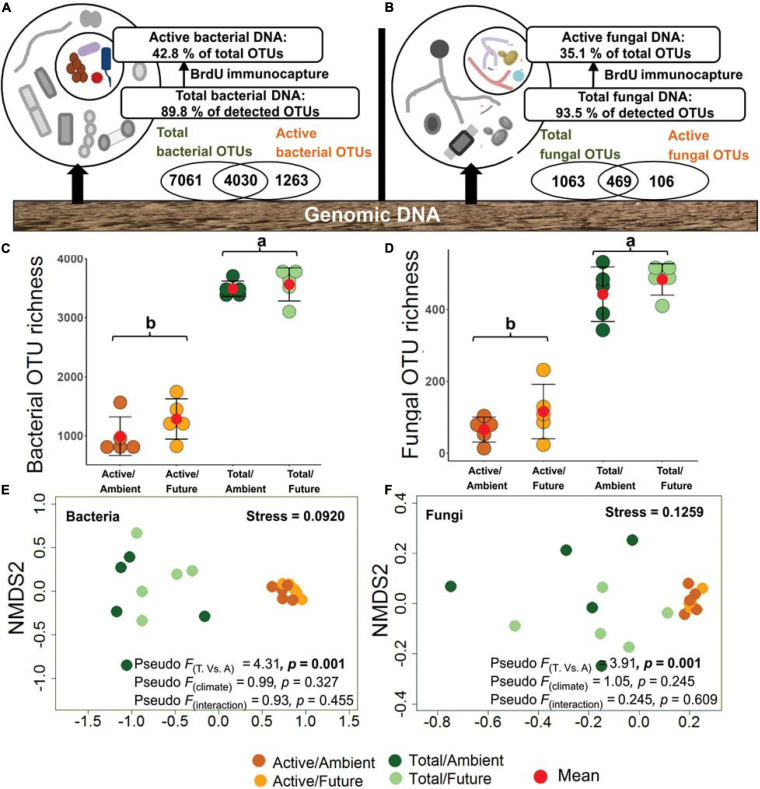
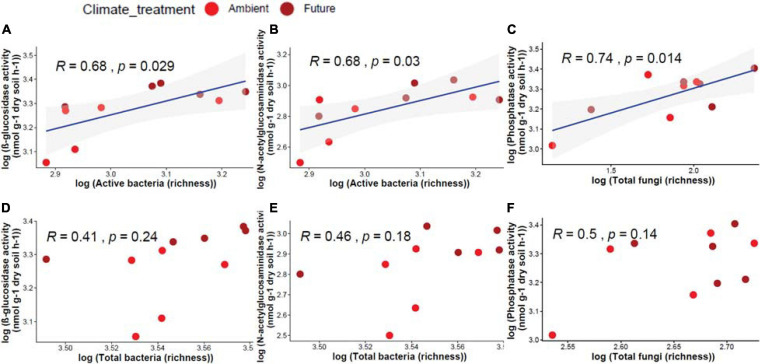
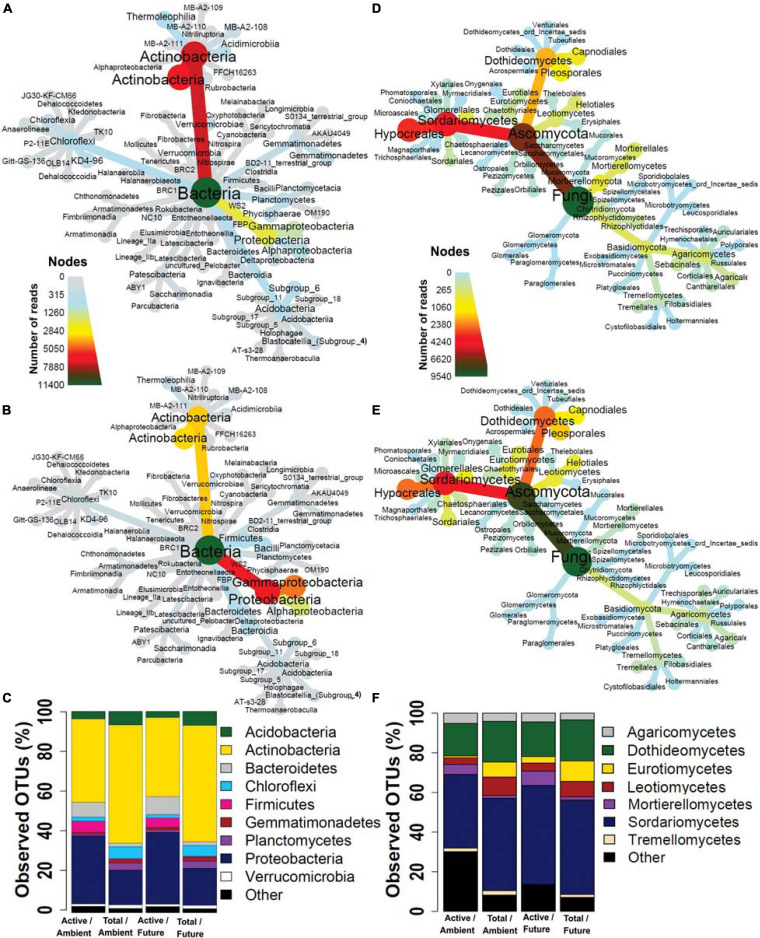
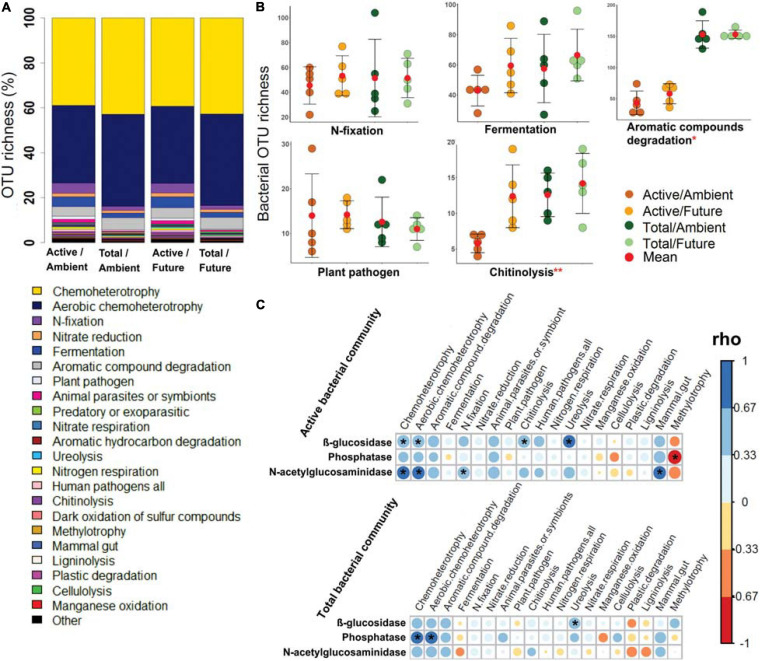
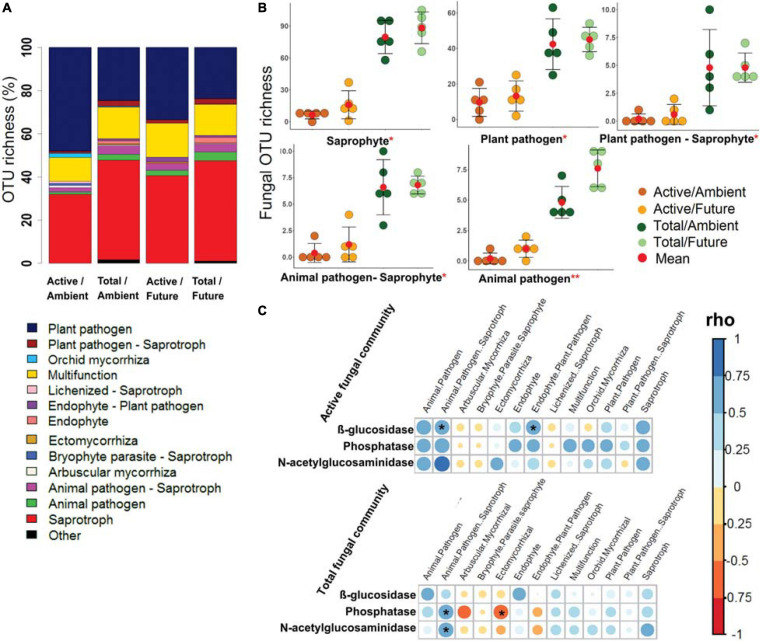
The relationship between biodiversity and ecosystem functioning (BEF) is a central issue in soil and microbial ecology. To date, most belowground BEF studies focus on the diversity of microbes analyzed by barcoding on total DNA, which targets both active and inactive microbes. This approach creates a bias as it mixes the part of the microbiome currently steering processes that provide actual ecosystem functions with the part not directly involved. Using experimental extensive grasslands under current and future climate, we used the bromodeoxyuridine (BrdU) immunocapture technique combined with pair-end Illumina sequencing to characterize both total and active microbiomes (including both bacteria and fungi) in the rhizosphere of . Rhizosphere function was assessed by measuring the activity of three microbial extracellular enzymes (β-glucosidase, N-acetyl-glucosaminidase, and acid phosphatase), which play central roles in the C, N, and P acquisition. We showed that the richness of overall and specific functional groups of active microbes in rhizosphere soil significantly correlated with the measured enzyme activities, while total microbial richness did not. Active microbes of the rhizosphere represented 42.8 and 32.1% of the total bacterial and fungal taxa, respectively, and were taxonomically and functionally diverse. Nitrogen fixing bacteria were highly active in this system with 71% of the total operational taxonomic units (OTUs) assigned to this group detected as active. We found the total and active microbiomes to display different responses to variations in soil physicochemical factors in the grassland, but with some degree of resistance to a manipulation mimicking future climate. Our findings provide critical insights into the role of active microbes in defining soil ecosystem functions in a grassland ecosystem. We demonstrate that the relationship between biodiversity-ecosystem functioning in soil may be stronger than previously thought.
生物多样性与生态系统功能(BEF)之间的关系是土壤和微生物生态学的核心问题。迄今为止,大多数地下BEF研究都集中在通过对总DNA进行条形码分析来研究微生物的多样性,这种方法针对的是活跃和不活跃的微生物。这种方法存在偏差,因为它将目前控制着提供实际生态系统功能的过程的微生物群落部分与未直接参与的部分混在了一起。利用当前和未来气候条件下的实验性广袤草原,我们采用溴脱氧尿苷(BrdU)免疫捕获技术结合双端Illumina测序,来表征[具体植物]根际中的总微生物群落和活跃微生物群落(包括细菌和真菌)。通过测量三种微生物细胞外酶(β-葡萄糖苷酶、N-乙酰葡萄糖胺酶和酸性磷酸酶)的活性来评估根际功能,这些酶在碳、氮和磷的获取中起着核心作用。我们发现,根际土壤中活跃微生物的总体和特定功能组的丰富度与测得的酶活性显著相关,而总微生物丰富度则不然。根际中的活跃微生物分别占细菌和真菌总分类单元的42.8%和32.1%,在分类学和功能上具有多样性。固氮细菌在该系统中高度活跃,在分配到该组的总可操作分类单元(OTU)中有71%被检测为活跃。我们发现总微生物群落和活跃微生物群落在草原土壤理化因子变化时表现出不同的响应,但对模拟未来气候的处理具有一定程度的抗性。我们的研究结果为活跃微生物在定义草原生态系统土壤生态系统功能中的作用提供了关键见解。我们证明,土壤中生物多样性与生态系统功能之间的关系可能比以前认为的更强。