Bagnasco Diego, Povero Massimiliano, Pradelli Lorenzo, Brussino Luisa, Rolla Giovanni, Caminati Marco, Menzella Francesco, Heffler Enrico, Canonica Giorgio Walter, Paggiaro Pierluigi, Senna Gianenrico, Milanese Manlio, Lombardi Carlo, Bucca Caterina, Manfredi Andrea, Canevari Rikki Frank, Passalacqua Giovanni
Allergy and Respiratory Diseases, IRCCS Policlinico San Martino - University of Genoa, Italy.
AdRes, Turin, Italy.
World Allergy Organ J. 2021 Jan 27;14(2):100509. doi: 10.1016/j.waojou.2021.100509. eCollection 2021 Feb.
Severe asthma is burdened by frequent exacerbations and use of oral corticosteroids (OCS) which worsen patients' health and increase healthcare spending. Aim of this study was to assess the clinical and economic effect of adding mepolizumab (MEP) for the treatment of these patients.
Patients >18 years old, referred to 8 asthma clinics, starting MEP between May 2017 and December 2018, were enrolled and followed-up for 12 months. Information in the 12 months before mepolizumab were collected retrospectively. The evaluation parameters included: OCS use, number of exacerbations/hospitalizations, concomitant therapies, comorbidity, and annual number of working days lost due to the disease. The primary objective was to compare the annual total cost per patient pre- and post-MEP. Secondary outcomes included rates of exacerbations and number of OCS-dependent patients.
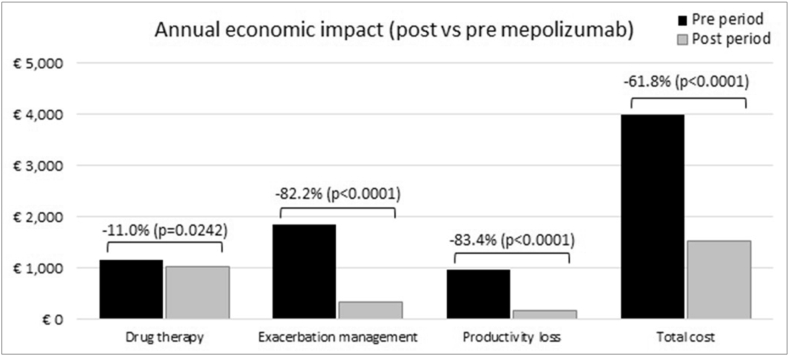
106 patients were enrolled in the study: 46 male, median age 58 years. Mean annual cost pre- and post-MEP (cost of biologic excluded) was €3996 and €1,527, respectively. Total savings due to MEP resulted in €2469 (95%CI 1945-2993), 62% due to exacerbations reduction and 33% due to productivity increase. Such savings could fund about 22% of the total cost of MEP for one year. The introduction of MEP induced a clinical benefit by reducing both OCS-dependent patients (OR = 0.12, 95%CI 0.06-0.23) and exacerbation rate (RR = 0.19, 95%CI 0.15-0.24).
Patients with severe eosinophilic asthma experienced a clinical benefit in asthma control adding MEP to standard therapy. Biologic therapy can be, partially, funded by the savings produced by patients' improvement.
重度哮喘常伴有频繁发作,且需使用口服糖皮质激素(OCS),这不仅会加重患者健康问题,还会增加医疗支出。本研究旨在评估添加美泊利珠单抗(MEP)治疗此类患者的临床及经济效果。
纳入年龄大于18岁、于2017年5月至2018年12月期间开始使用MEP并在8家哮喘诊所就诊的患者,随访12个月。回顾性收集使用美泊利珠单抗前12个月的信息。评估参数包括:OCS使用情况、发作/住院次数、联合治疗、合并症以及因疾病导致的年度工作日损失数。主要目的是比较每位患者使用MEP前后的年度总成本。次要结局包括发作率和OCS依赖患者数量。
106例患者纳入研究,其中46例男性,中位年龄58岁。使用MEP前后(不包括生物制剂成本)的年均成本分别为3996欧元和1527欧元。MEP带来的总节省为2469欧元(95%CI 1945 - 2993),其中62%归因于发作减少,33%归因于生产力提高。这些节省可支付MEP一年总成本的约22%。引入MEP通过减少OCS依赖患者(OR = 0.12,95%CI 0.06 - 0.23)和发作率(RR = 0.19,95%CI 0.15 - 0.24)带来了临床益处。
重度嗜酸性粒细胞性哮喘患者在标准治疗中添加MEP后,哮喘控制方面获得了临床益处。生物治疗部分费用可由患者病情改善所产生的节省来支付。