Parisi Melania, Verrillo Mariavittoria, Luciano Maria Antonietta, Caiazzo Giuseppina, Quaranta Maria, Scognamiglio Francesco, Di Meo Vincenzo, Villani Alessia, Cantelli Mariateresa, Gallo Lucia, Altobelli Giovanna G, Poggi Serena, Spaccini Riccardo, Fabbrocini Gabriella
Section of Dermatology, Department of Clinical Medicine and Surgery, University of Naples Federico II, Via Pansini 5, 80131 Naples, Italy.
Centro Interdipartimentale di Ricerca per la Risonanza Magnetica Nucleare per l'Ambiente, l'Agroalimentare, ed i Nuovi Materiali (CERMANU), Università di Napoli Federico II, Via Università 100, 80055 Portici, Italy.
Plants (Basel). 2023 Feb 13;12(4):840. doi: 10.3390/plants12040840.
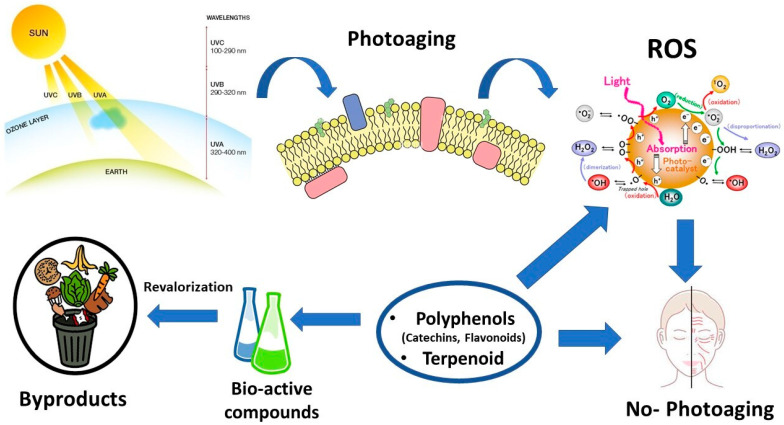
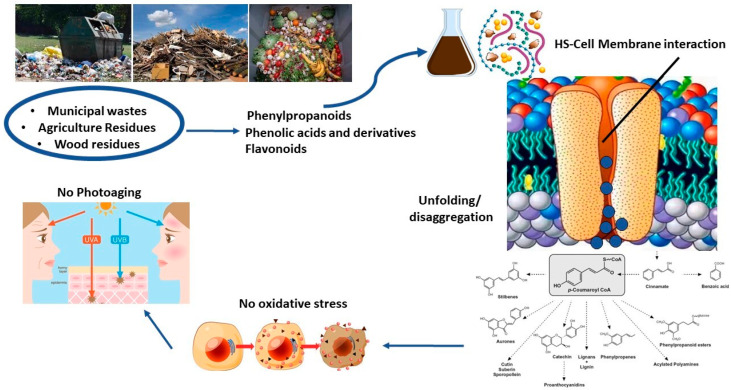
Photoaging is the premature aging of the skin caused by repeated exposure to ultraviolet (UV) rays. The harmful effects of UV rays-from the sun or from artificial sources-alter normal skin structures and cause visible damage, especially in the most exposed areas. Fighting premature aging is one of the most important challenges of the medical landscape. Additionally, consumers are looking for care products that offer multiple benefits with reduced environmental and economic impact. The growing requests for bioactive compounds from aromatic plants for pharmaceutical and cosmetic applications have to find new sustainable methods to increase the effectiveness of new active formulations derived from eco-compatible technologies. The principle of sustainable practices and the circular economy favor the use of bioactive components derived from recycled biomass. The guidelines of the European Commission support the reuse of various types of organic biomass and organic waste, thus transforming waste management problems into economic opportunities. This review aims to elucidate the main mechanisms of photoaging and how these can be managed using natural renewable sources and specific bioactive derivatives, such as humic extracts from recycled organic biomass, as potential new actors in modern medicine.
光老化是由于反复暴露于紫外线(UV)而导致的皮肤过早老化。来自太阳或人工光源的紫外线的有害影响会改变正常的皮肤结构并造成可见损伤,尤其是在暴露最多的部位。对抗过早老化是医学领域最重要的挑战之一。此外,消费者正在寻找具有多种功效且对环境和经济影响较小的护理产品。对用于制药和化妆品应用的芳香植物生物活性化合物的需求不断增长,必须找到新的可持续方法来提高源自生态兼容技术的新型活性配方的有效性。可持续实践和循环经济原则有利于使用源自可再生生物质的生物活性成分。欧盟委员会的指导方针支持各类有机生物质和有机废物的再利用,从而将废物管理问题转化为经济机遇。本综述旨在阐明光老化的主要机制,以及如何利用天然可再生资源和特定生物活性衍生物(如来自可再生有机生物质的腐殖质提取物)作为现代医学中的潜在新要素来加以应对。