MOX, Dipartimento di Matematica, Politecnico di Milano, Milan, Italy.
Int J Numer Method Biomed Eng. 2021 Jun;37(6):e3450. doi: 10.1002/cnm.3450. Epub 2021 May 7.
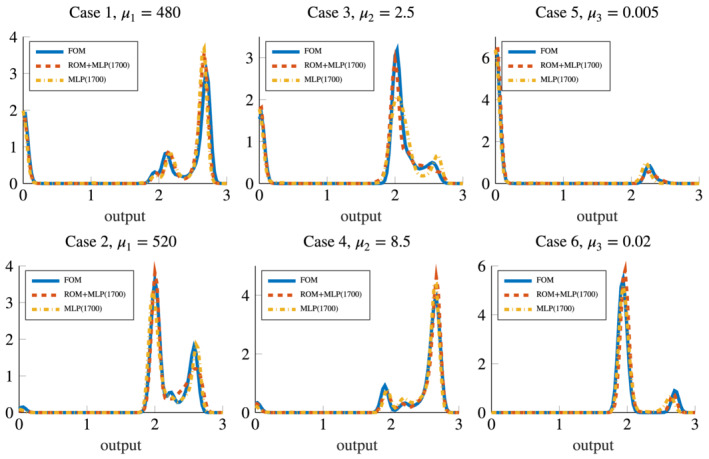
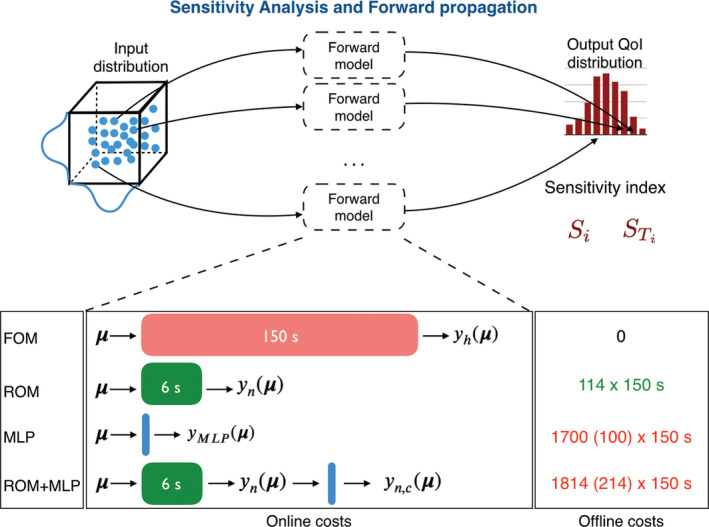
We present a new, computationally efficient framework to perform forward uncertainty quantification (UQ) in cardiac electrophysiology. We consider the monodomain model to describe the electrical activity in the cardiac tissue, coupled with the Aliev-Panfilov model to characterize the ionic activity through the cell membrane. We address a complete forward UQ pipeline, including both: (i) a variance-based global sensitivity analysis for the selection of the most relevant input parameters, and (ii) a way to perform uncertainty propagation to investigate the impact of intra-subject variability on outputs of interest depending on the cardiac potential. Both tasks exploit stochastic sampling techniques, thus implying overwhelming computational costs because of the huge amount of queries to the high-fidelity, full-order computational model obtained by approximating the coupled monodomain/Aliev-Panfilov system through the finite element method. To mitigate this computational burden, we replace the full-order model with computationally inexpensive projection-based reduced-order models (ROMs) aimed at reducing the state-space dimensionality. Resulting approximation errors on the outputs of interest are finally taken into account through artificial neural network (ANN)-based models, enhancing the accuracy of the whole UQ pipeline. Numerical results show that the proposed physics-based ROMs outperform regression-based emulators relying on ANNs built with the same amount of training data, in terms of both numerical accuracy and overall computational efficiency.
我们提出了一种新的、计算效率高的框架,用于在心脏电生理学中进行正向不确定性量化 (UQ)。我们考虑使用单域模型来描述心脏组织中的电活动,并结合 Aliev-Panfilov 模型来通过细胞膜来描述离子活动。我们解决了完整的正向 UQ 管道,包括:(i)基于方差的全局敏感性分析,用于选择最相关的输入参数,以及 (ii)一种不确定性传播的方法,用于研究由于心脏电位引起的感兴趣输出的个体内变异性的影响。这两个任务都利用了随机采样技术,因此由于需要对通过有限元方法近似耦合的单域/Aliev-Panfilov 系统获得的高保真度、全阶计算模型进行大量查询,因此会带来巨大的计算成本。为了减轻这种计算负担,我们用计算成本低的基于投影的降阶模型 (ROM) 代替全阶模型,旨在降低状态空间的维度。最后,通过基于人工神经网络 (ANN) 的模型来考虑对感兴趣的输出的近似误差,从而提高整个 UQ 管道的准确性。数值结果表明,在所提出的基于物理的 ROM 中,基于 ANN 的回归模拟器在数值准确性和整体计算效率方面都优于基于 ANN 的回归模拟器,而基于 ANN 的回归模拟器则依赖于相同数量的训练数据。