The Second Affiliated Hospital of Zhejiang Chinese Medical University, Hangzhou, Zhejiang, China.
Zhejiang Provincial Center for Disease Control and Prevention, Hangzhou, Zhejiang, China.
Aging (Albany NY). 2021 Feb 18;13(4):6066-6075. doi: 10.18632/aging.202567.
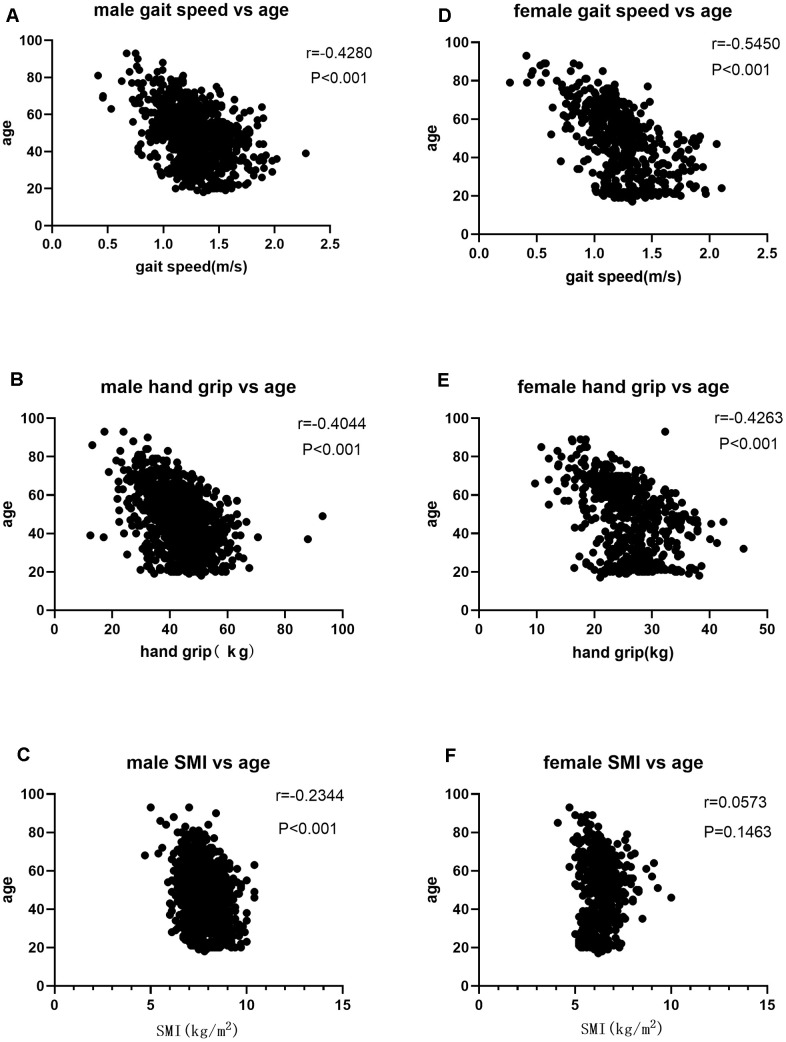
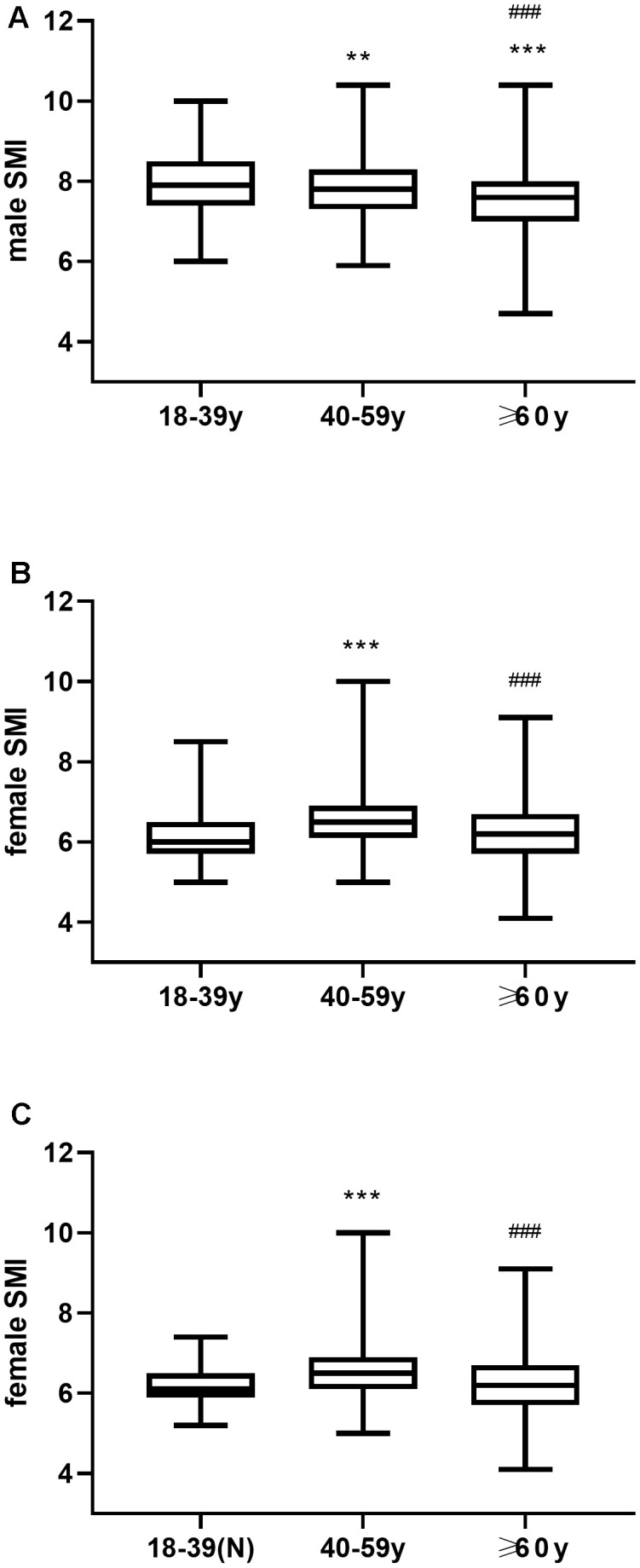
In this study, we analyzed sarcopenia prevalence and the cut-off points for skeletal muscle mass index (SMI), gait speed, and handgrip strength in young (18-39 years), middle-aged (40-59 years), and elderly (>60 years) individuals (n=1685) from Zhejiang Province in China. The prevalence of sarcopenia among individuals above 65 years was 2.21%, 4.87%, 5.31%, 14.16%, and 16.37% according to five diagnostic criteria (AWGS2019, AWGS2014, EWGSOP1, EWGSOP2, and local standard). The mean SMI (Kg/m) was 7.961±0.7966, 7.801±0.7276, and 7.544±0.7493, respectively, in young, middle-aged, and elderly males. The mean SMI in young, middle-aged, and elderly females was 6.1570±0.5658, 6.604±0.5658, and 6.248±0.7483, respectively. SMI correlated negatively with age (r=-0.2344, P<0.001), but was not associated with age in females (r=0.0573, P=0.1463). The cut-off point of SMI for sarcopenia was ≤6.3678 kg/m in males and ≤5.0254 kg/m in females. These findings shows that the prevalence of sarcopenia increased gradually with age and varied significantly based on the diagnostic criteria used for this analysis. The mean SMI of young women was lower than in middle-aged women, making them an unsuitable reference population for determining cut-off values for sarcopenia diagnosis.
在这项研究中,我们分析了中国浙江省年轻(18-39 岁)、中年(40-59 岁)和老年(>60 岁)人群中肌少症的患病率以及骨骼肌质量指数(SMI)、步态速度和握力的截断值(n=1685)。根据五种诊断标准(AWGS2019、AWGS2014、EWGSOP1、EWGSOP2 和当地标准),65 岁以上人群的肌少症患病率分别为 2.21%、4.87%、5.31%、14.16%和 16.37%。男性青年、中年和老年的平均 SMI(Kg/m)分别为 7.961±0.7966、7.801±0.7276 和 7.544±0.7493。女性青年、中年和老年的平均 SMI 分别为 6.1570±0.5658、6.604±0.5658 和 6.248±0.7483。SMI 与年龄呈负相关(r=-0.2344,P<0.001),但与女性年龄无关(r=0.0573,P=0.1463)。SMI 用于肌少症的截断值为男性≤6.3678 kg/m,女性≤5.0254 kg/m。这些发现表明,肌少症的患病率随着年龄的增长而逐渐增加,并且根据用于分析的诊断标准有显著差异。年轻女性的平均 SMI 低于中年女性,使她们成为确定肌少症诊断截断值的不合适参考人群。