Department of Rehabilitation, Xinhua Hospital Affiliated to Shanghai Jiaotong University School of Medicine, Shanghai, People's Republic of China.
Department of Rehabilitation, Xinhua Hospital Chongming Branch, Shanghai, People's Republic of China.
Clin Interv Aging. 2022 Nov 29;17:1707-1727. doi: 10.2147/CIA.S388319. eCollection 2022.
This study aimed to explore the prevalence and impact of related factors for sarcopenia among community-dwelling older people in Chongming district, China, according to the diagnostic criteria of the Asia Working Group for Sarcopenia-2019.
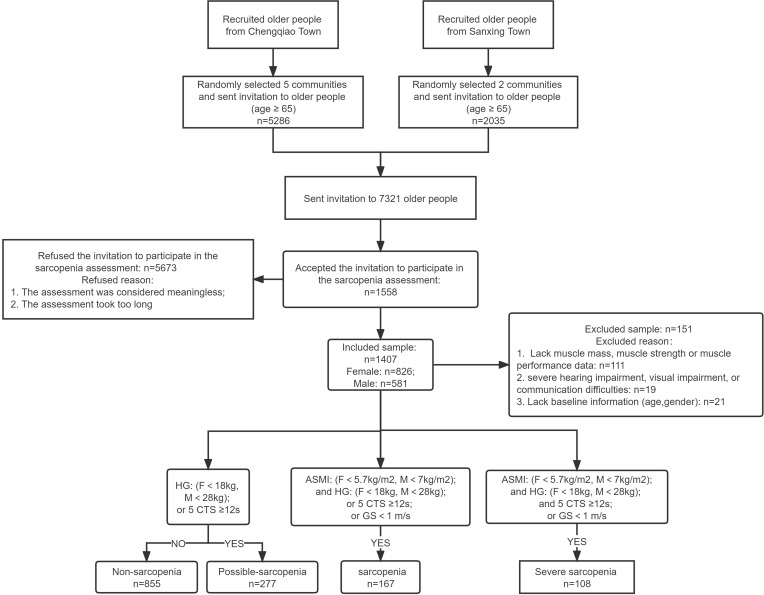
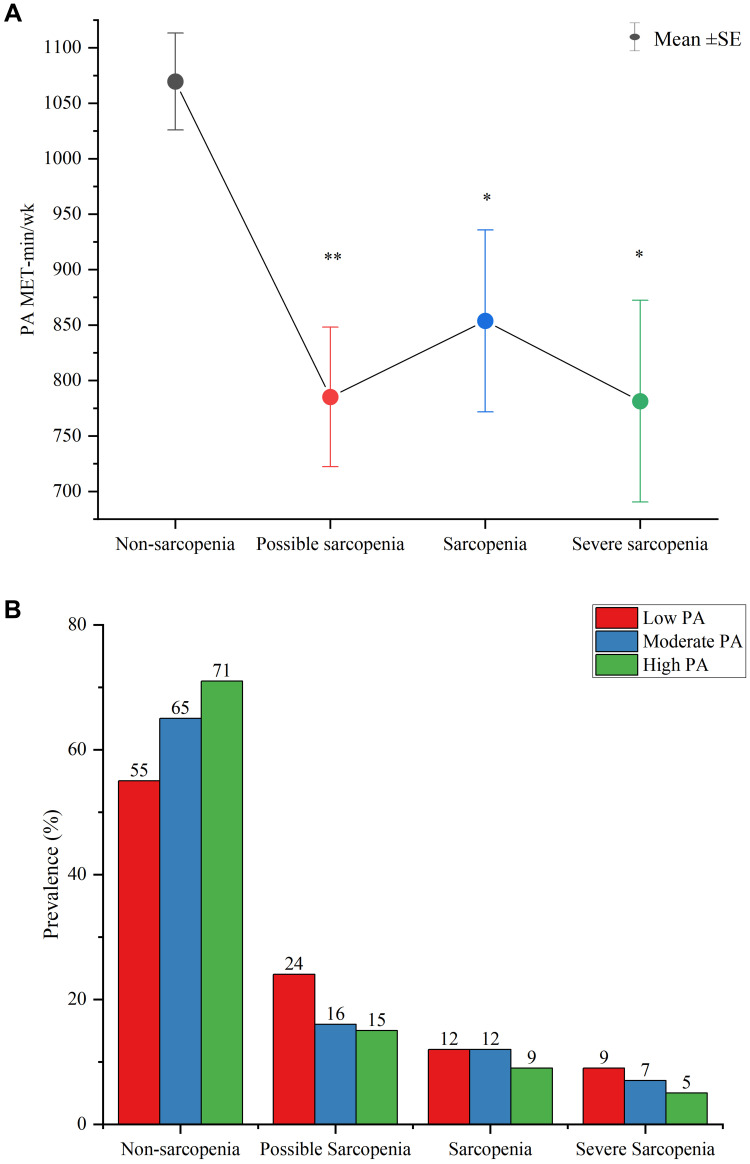
We conducted a cross-sectional study from April 2021 to December 2021. Diagnosis of sarcopenia (non-sarcopenia, possible sarcopenia, sarcopenia, and severe sarcopenia) was based on appendicular skeletal muscle mass index, handgrip strength, gait speed, and the 5-time chair stand test. Staff collected all subjects' clinical and sociodemographic characteristics, cardiovascular disease (CVD) risk factors, inflammatory markers, physical activity (PA), and daily lifestyle activities to identify sarcopenia-related factors.
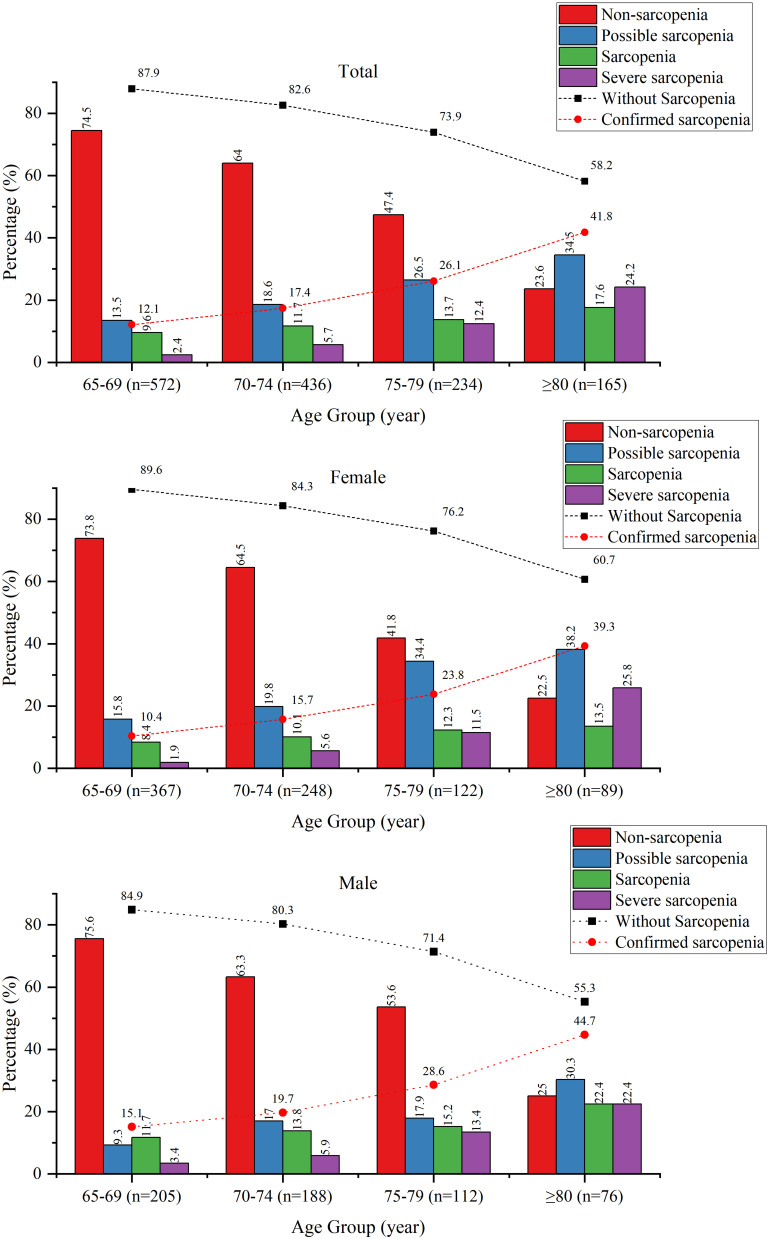
A total of 1407 older people aged ≥ 65 years were enrolled into the study (58.7% female). The prevalence of confirmed sarcopenia was 19.6% (17.1% in females and 23.1% in males). The prevalence of possible sarcopenia, sarcopenia, and severe sarcopenia were 19.7% (22.2% in females, 16.2% in males), 11.9% (10.1% in females, 14.5% in males), and 7.7% (7% in females, 8.6% in males), respectively. Increasing age, gender, depression status, and high-fat mass were associated with an increased likelihood of sarcopenia in all subjects. In females, living alone, high-fat mass, lower body mass index (BMI), lower body weight, and have no time spent doing housework increased the likelihood of sarcopenia. In males, depression status, high-fat mass, higher neutrophils-to-lymphocytes ratio (NLR), lower BMI, lower body weight increased the likelihood of sarcopenia.
Our study showed a high prevalence of sarcopenia among community-dwelling older people in the Chongming district. Detection, prevention, and treatment efforts are needed to reduce the impact of sarcopenia in older, rural communities in China.
本研究旨在根据 2019 年亚洲肌肉减少症工作组的诊断标准,探讨中国崇明区社区老年人中肌肉减少症的患病率及其相关因素的影响。
我们进行了一项横断面研究,时间为 2021 年 4 月至 2021 年 12 月。根据四肢骨骼肌质量指数、握力、步速和 5 次坐站试验,诊断为肌肉减少症(非肌肉减少症、可能的肌肉减少症、肌肉减少症和严重的肌肉减少症)。工作人员收集所有受试者的临床和社会人口统计学特征、心血管疾病(CVD)危险因素、炎症标志物、身体活动(PA)和日常生活活动,以确定肌肉减少症相关因素。
共纳入 1407 名年龄≥65 岁的老年人(58.7%为女性)。确诊肌肉减少症的患病率为 19.6%(女性为 17.1%,男性为 23.1%)。可能的肌肉减少症、肌肉减少症和严重肌肉减少症的患病率分别为 19.7%(女性为 22.2%,男性为 16.2%)、11.9%(女性为 10.1%,男性为 14.5%)和 7.7%(女性为 7%,男性为 8.6%)。年龄增长、性别、抑郁状态和高脂肪量与所有受试者肌肉减少症的发生几率增加相关。在女性中,独居、高脂肪量、较低的体重指数(BMI)、较低的体重和没有时间做家务会增加肌肉减少症的发生几率。在男性中,抑郁状态、高脂肪量、较高的中性粒细胞与淋巴细胞比值(NLR)、较低的 BMI、较低的体重会增加肌肉减少症的发生几率。
本研究表明,中国崇明区社区老年人肌肉减少症的患病率较高。需要进行检测、预防和治疗工作,以减少中国农村老年人群中肌肉减少症的影响。