Department of Obstetrics and Gynecology, Ningbo No. 7 Hospital, Ningbo, Zhejiang, 315200, China.
Shanghai Obstetrics and Gynecology Hospital, Fudan University, 419 Fangxie Road, Shanghai, 200011, China.
Reprod Biol Endocrinol. 2021 Feb 19;19(1):25. doi: 10.1186/s12958-021-00711-6.
Accumulating data indicate that sensory nerve derived neuropeptides such as substance P and calcitonin gene related-protein (CGRP) can accelerate the progression of endometriosis via their respective receptors, so can agonists to their respective receptors receptor 1 (NK1R), receptor activity modifying protein 1 (RAMP-1) and calcitonin receptor-like receptor (CRLR). Adrenergic β2 receptor (ADRB2) agonists also can facilitate lesional progression. In contrast, women with endometriosis appear to have depressed vagal activity, concordant with reduced expression of α7 nicotinic acetylcholine receptor (α7nAChR). The roles of these receptors in adenomyosis are completely unknown.
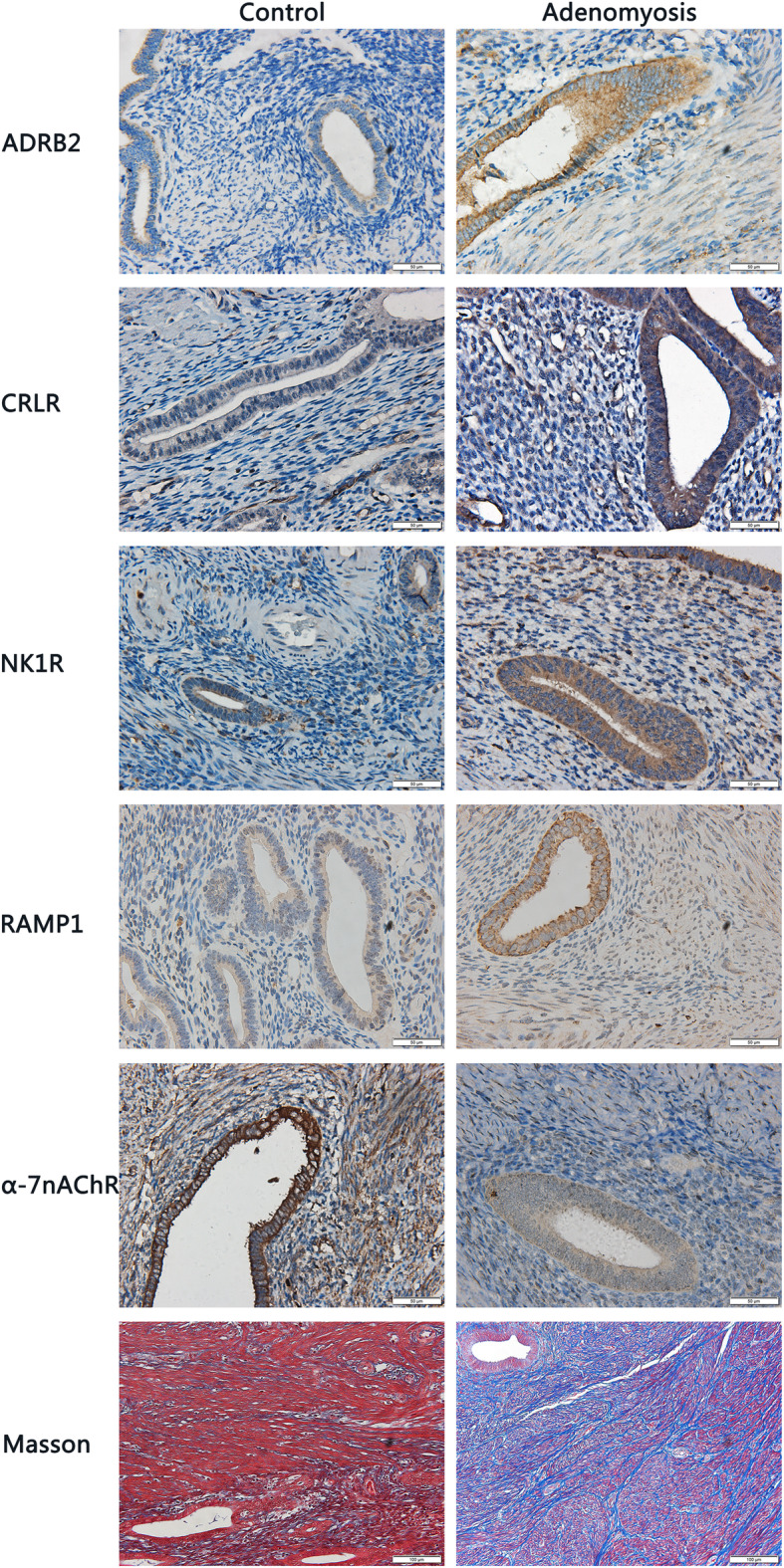
Adenomyotic tissue samples from 30 women with adenomyosis and control endometrial tissue samples from 24 women without adenomyosis were collected and subjected to immunohistochemistry analysis of RAMP1, CRLR, NK1R, ADRB2 and α7nAChR, along with their demographic and clinical information. The extent of tissue fibrosis was evaluated by Masson trichrome staining.
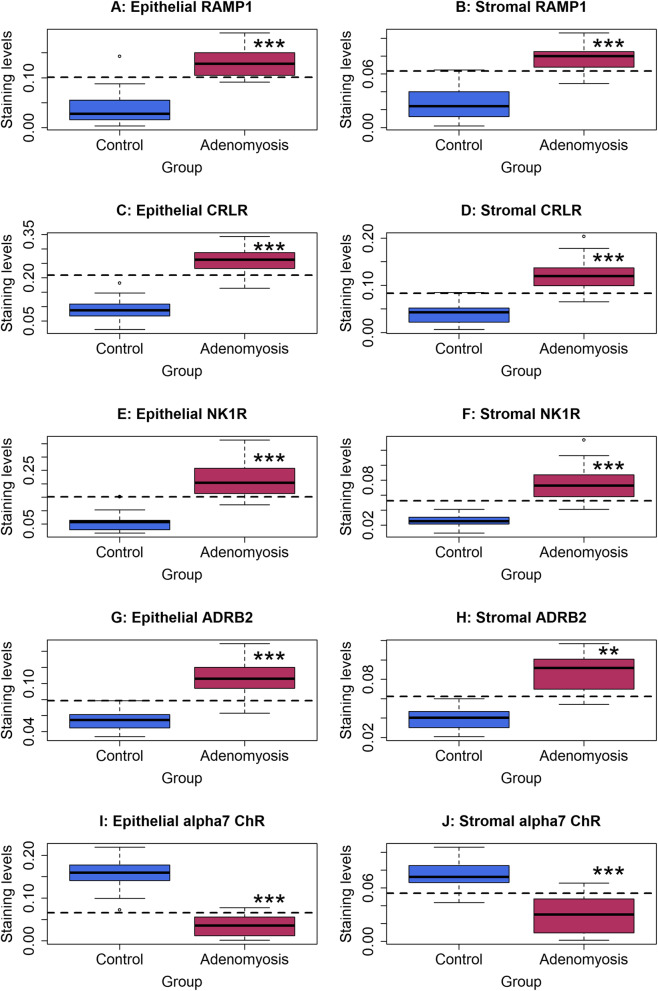
We found that the staining levels of NK1R, CRLR, RAMP1 and ADRB2 were all significantly elevated in adenomyotic lesions as compared with control endometrium. In contrast, α7nAChR staining levels were significantly reduced. The severity of dysmenorrhea correlated positively with lesional ADRB2 staining levels.
Our results suggest that SP, CGRP and noradrenaline may promote, while acetylcholine may stall, the progression of adenomyosis through their respective receptors on adenomyotic lesions. Additionally, through the activation of the hypothalamic-pituitary-adrenal (HPA)-sympatho-adrenal-medullary (SAM) axes and the lesional overexpression of ADRB2, adenomyosis-associated dysmenorrhea and adenomyotic lesions may be mutually promotional, forming a viscous feed-forward cycle.
越来越多的数据表明,感觉神经衍生的神经肽,如 P 物质和降钙素基因相关肽(CGRP),可以通过各自的受体加速子宫内膜异位症的进展,因此它们各自的受体 1(NK1R)、受体活性修饰蛋白 1(RAMP-1)和降钙素受体样受体(CRLR)的激动剂也可以促进病变的进展。肾上腺素能β2 受体(ADRB2)激动剂也可以促进病变进展。相比之下,患有子宫内膜异位症的女性似乎表现出迷走神经活动减弱,与α7 烟碱型乙酰胆碱受体(α7nAChR)表达减少相一致。这些受体在子宫腺肌病中的作用尚完全未知。
收集 30 例子宫腺肌病患者的腺肌病组织样本和 24 例无子宫腺肌病患者的对照子宫内膜组织样本,进行 RAMP1、CRLR、NK1R、ADRB2 和 α7nAChR 的免疫组织化学分析,并结合其人口统计学和临床信息。通过 Masson 三色染色评估组织纤维化程度。
我们发现,与对照子宫内膜相比,NK1R、CRLR、RAMP1 和 ADRB2 的染色水平在腺肌病病变中均显著升高。相反,α7nAChR 的染色水平显著降低。痛经的严重程度与病变部位 ADRB2 染色水平呈正相关。
我们的结果表明,SP、CGRP 和去甲肾上腺素可能通过腺肌病病变上各自的受体促进子宫内膜异位症的进展,而乙酰胆碱可能会阻碍其进展。此外,通过激活下丘脑-垂体-肾上腺(HPA)-交感神经-肾上腺髓质(SAM)轴和病变部位 ADRB2 的过度表达,与子宫腺肌病相关的痛经和腺肌病病变可能相互促进,形成一个粘性的正向反馈循环。