Phua Qian Hua, Han Hua Alexander, Soh Boon-Seng
Disease Modeling and Therapeutics Laboratory, A*STAR Institute of Molecular and Cell Biology, 61 Biopolis Drive Proteos, Singapore, 138673, Singapore.
Department of Biological Sciences, National University of Singapore, 14 Science Drive 4, Singapore, 117543, Singapore.
J Transl Med. 2021 Feb 18;19(1):83. doi: 10.1186/s12967-021-02752-2.
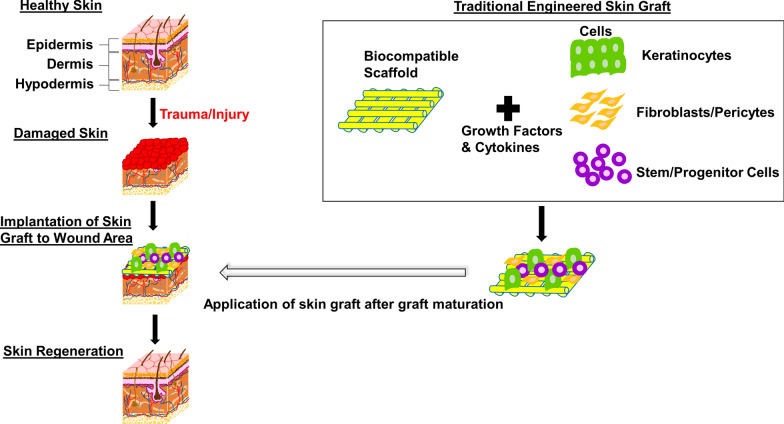
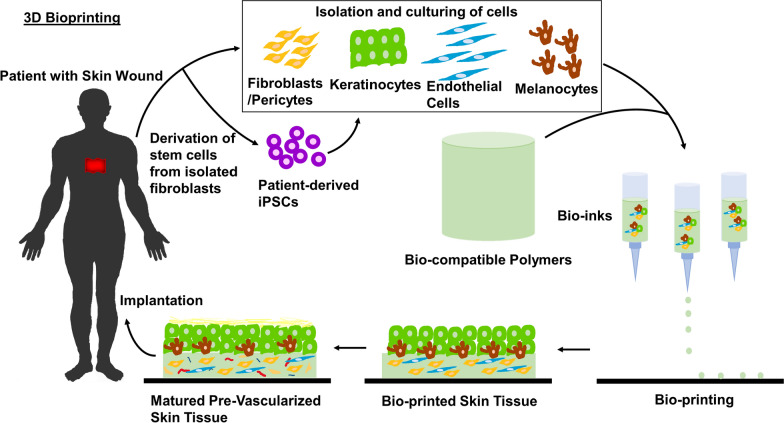
The skin is made up of a plethora of cells arranged in multiple layers with complex and intricate vascular networks, creating a dynamic microenvironment of cells-to-matrix interactions. With limited donor sites, engineered skin substitute has been in high demand for many therapeutic purposes. Over the years, remarkable progress has occurred in the skin tissue-engineering field to develop skin grafts highly similar to native tissue. However, the major hurdle to successful engraftment is the incorporation of functional vasculature to provide essential nutrients and oxygen supply to the embedded cells. Limitations of traditional tissue engineering have driven the rapid development of vascularized skin tissue production, leading to new technologies such as 3D bioprinting, nano-fabrication and micro-patterning using hydrogel based-scaffold. In particular, the key hope to bioprinting would be the generation of interconnected functional vessels, coupled with the addition of specific cell types to mimic the biological and architectural complexity of the native skin environment. Additionally, stem cells have been gaining interest due to their highly regenerative potential and participation in wound healing. This review briefly summarizes the current cell therapies used in skin regeneration with a focus on the importance of vascularization and recent progress in 3D fabrication approaches to generate vascularized network in the skin tissue graft.
皮肤由大量排列成多层的细胞组成,具有复杂且精细的血管网络,形成了细胞与基质相互作用的动态微环境。由于供体部位有限,工程化皮肤替代物在许多治疗目的方面一直有很高的需求。多年来,皮肤组织工程领域在开发与天然组织高度相似的皮肤移植物方面取得了显著进展。然而,成功植入的主要障碍是整合功能性血管,为植入的细胞提供必需的营养和氧气供应。传统组织工程的局限性推动了血管化皮肤组织生产的快速发展,催生了诸如使用水凝胶基支架的3D生物打印、纳米制造和微图案化等新技术。特别是,生物打印的关键希望在于生成相互连接的功能性血管,并添加特定细胞类型以模拟天然皮肤环境的生物学和结构复杂性。此外,干细胞因其高度的再生潜力和参与伤口愈合而受到关注。本综述简要总结了目前用于皮肤再生的细胞疗法,重点关注血管化的重要性以及在皮肤组织移植物中生成血管化网络的3D制造方法的最新进展。