Center for Pre-Speech Development & Developmental Disorders, University Hospital, University of Würzburg, Pleicherwall 2, 97070, Würzburg, Germany.
Department of Communication Sciences and Disorders, Pennsylvania State University, State College, USA.
Sci Rep. 2021 Feb 18;11(1):4137. doi: 10.1038/s41598-021-83564-8.
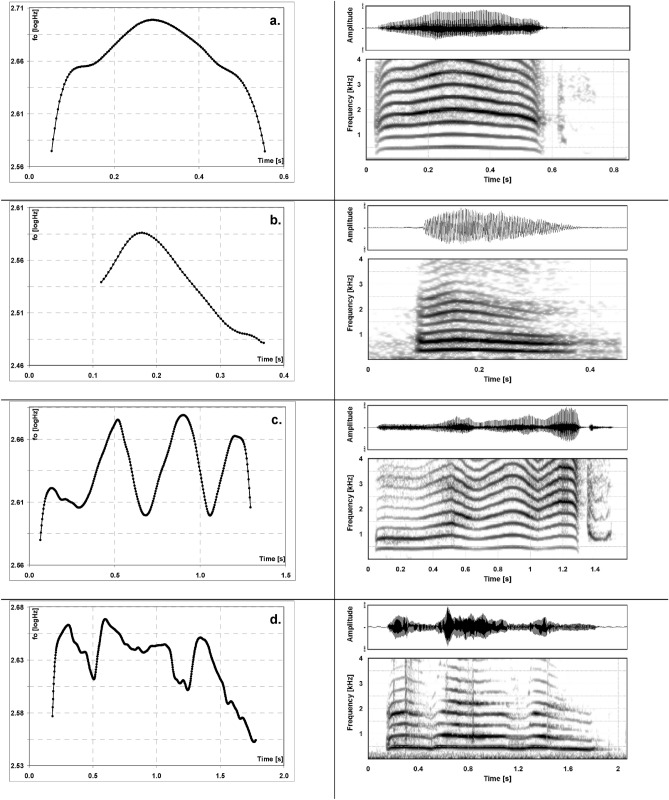
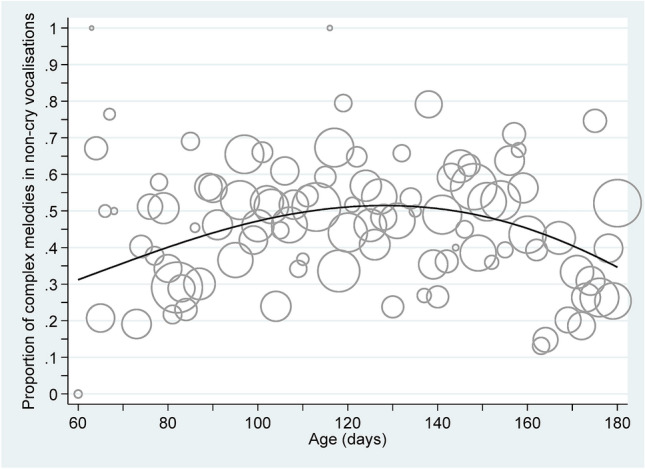
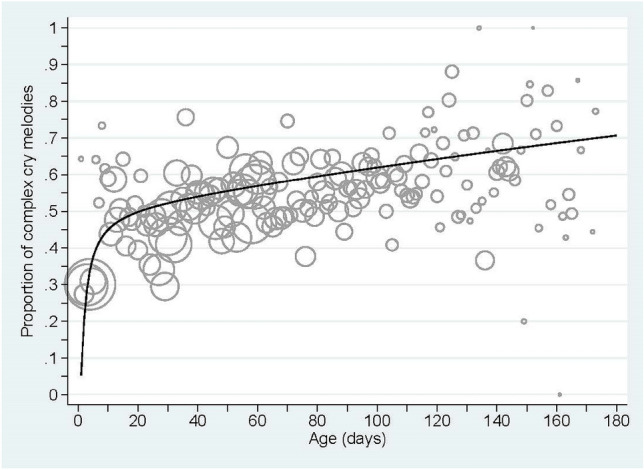
In early infancy, melody provides the most salient prosodic element for language acquisition and there is huge evidence for infants' precocious aptitudes for musical and speech melody perception. Yet, a lack of knowledge remains with respect to melody patterns of infants' vocalisations. In a search for developmental regularities of cry and non-cry vocalisations and for building blocks of prosody (intonation) over the first 6 months of life, more than 67,500 melodies (fundamental frequency contours) of 277 healthy infants from monolingual German families were quantitatively analysed. Based on objective criteria, vocalisations with well-identifiable melodies were grouped into those exhibiting a simple (single-arc) or complex (multiple-arc) melody pattern. Longitudinal analysis using fractional polynomial multi-level mixed effects logistic regression models were applied to these patterns. A significant age (but not sex) dependent developmental pattern towards more complexity was demonstrated in both vocalisation types over the observation period. The theoretical concept of melody development (MD-Model) contends that melody complexification is an important building block on the path towards language. Recognition of this developmental process will considerably improve not only our understanding of early preparatory processes for language acquisition, but most importantly also allow for the creation of clinically robust risk markers for developmental language disorders.
在婴儿早期,旋律为语言习得提供了最显著的韵律元素,并且有大量证据表明婴儿在音乐和言语旋律感知方面具有早熟的能力。然而,对于婴儿发声的旋律模式,我们仍然知之甚少。为了寻找婴儿哭声和非哭声的发声发展规律,以及寻找韵律(语调)的构成要素,我们对 277 名来自讲德语的单语家庭的健康婴儿的超过 67500 个旋律(基频轮廓)进行了定量分析,这些婴儿的年龄在 6 个月以下。根据客观标准,具有可识别旋律的发声被分为具有简单(单弧)或复杂(多弧)旋律模式的发声。使用分数多项式多水平混合效应逻辑回归模型对这些模式进行了纵向分析。在观察期内,这两种发声类型都表现出了显著的年龄(而非性别)依赖性的复杂程度发展模式。旋律发展的理论概念(MD 模型)认为,旋律复杂化是语言发展道路上的一个重要构建块。认识到这一发展过程不仅将极大地提高我们对语言习得早期预备过程的理解,而且最重要的是,还可以为发育性语言障碍的临床稳健风险标志物的创建提供支持。