Lin Yen-You, Chen Nan-Fu, Yang San-Nan, Jean Yen-Hsuan, Kuo Hsiao-Mei, Chen Pei-Chin, Feng Chien-Wei, Liu Yu-Wei, Lai Yu-Cheng, Wen Zhi-Hong
Department of Sports Medicine, China Medical University, Taichung 40402, Taiwan, R.O.C.
Division of Neurosurgery, Department of Surgery, Kaohsiung Armed Forces General Hospital, Kaohsiung 80284, Taiwan, R.O.C.
Exp Ther Med. 2021 Mar;21(3):222. doi: 10.3892/etm.2021.9653. Epub 2021 Jan 18.
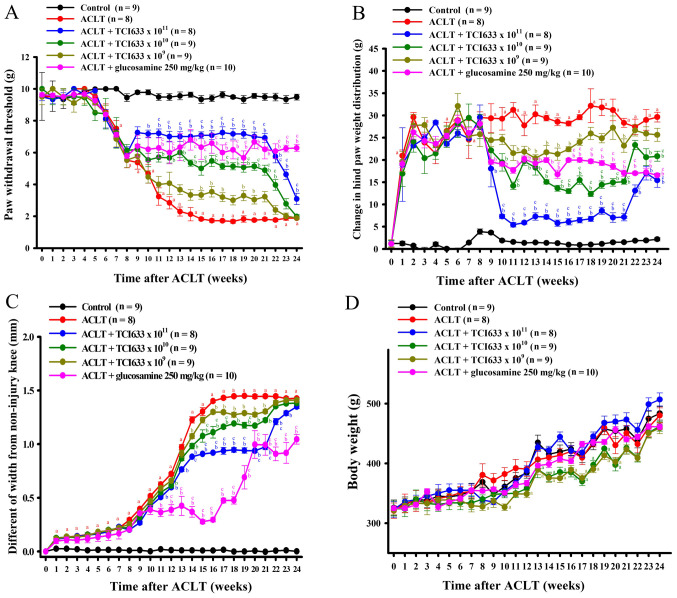
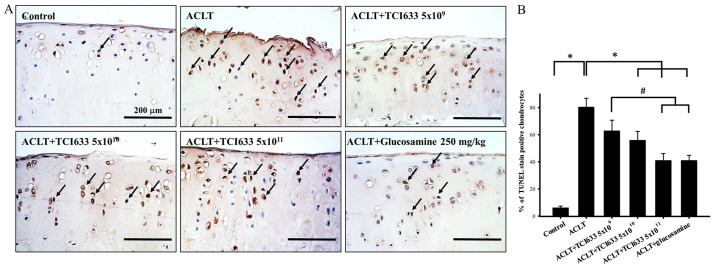
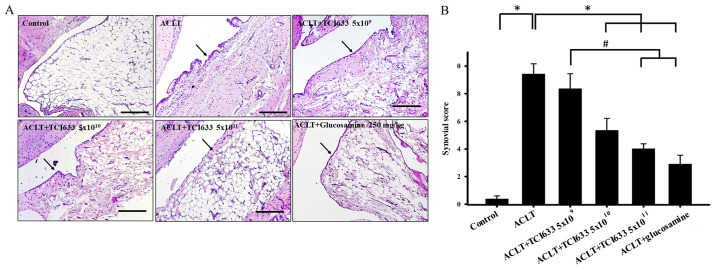
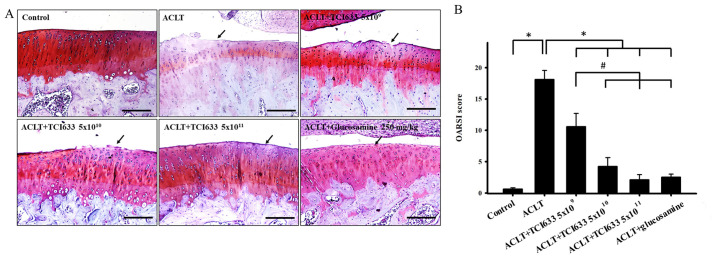
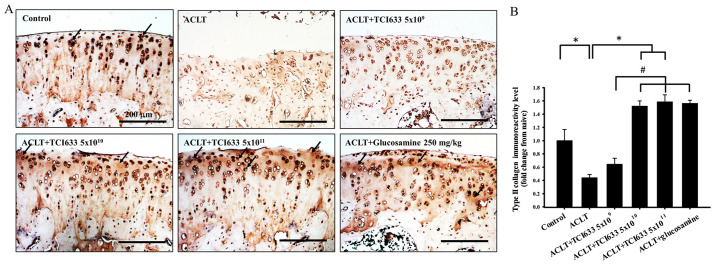
Osteoarthritis (OA) is the most common joint disorder and is classically defined as a progressively degenerative disease of articular cartilage. It manifests as joint pain and disability and currently has no comprehensive treatments. The primary purpose of the present study was to test the effects of probiotics, (TCI633), on anterior cruciate ligament transection (ACLT)-induced experimental osteoarthritis (OA) in rats. In the current study, the experimental groups were given TCI633 (5x10, 5x10 and 5x10 CFU/kg/day) and glucosamine sulfate (250 mg/kg) between week 8 and 20 following ACLT. The results showed that oral administration of TCI633 and glucosamine had significant therapeutic effects on pain behaviors and knee swelling. Dose-dependent effects of TCI633 were also observed in ACLT-treated rats. Histopathological analysis demonstrated that ACLT+TCI633 (5x10, 5x10 and 5x10 CFU/kg/day) improved the synovial inflammation and cartilage damage of ACLT rats. Histology evaluation using the Osteoarthritis Research Society International system and synovial inflammatory score analysis showed the dose-dependent inhibition of TCI633 on synovial inflammation and cartilage damage. Immunohistochemical staining and TUNEL apoptosis staining showed that TCI633 could effectively increase the expression of type II collagen and reduce the amount of chondrocyte apoptosis in cartilage. Therefore, the present study demonstrated that oral intake of TCI633 could significantly suppressing pain behavior, reduce joint swelling and synovial tissue inflammation and increase type II collagen expression in cartilage. There was also a reduction in chondrocyte apoptosis and decreased progression of OA in ACLT-treated rats.
骨关节炎(OA)是最常见的关节疾病,传统上被定义为一种关节软骨的进行性退行性疾病。它表现为关节疼痛和功能障碍,目前尚无综合治疗方法。本研究的主要目的是测试益生菌(TCI633)对前交叉韧带横断(ACLT)诱导的大鼠实验性骨关节炎(OA)的影响。在本研究中,实验组在ACLT后的第8周和第20周之间给予TCI633(5×10⁸、5×10⁹和5×10¹⁰CFU/kg/天)和硫酸氨基葡萄糖(250mg/kg)。结果表明,口服TCI633和氨基葡萄糖对疼痛行为和膝关节肿胀有显著治疗作用。在ACLT处理的大鼠中也观察到了TCI633的剂量依赖性效应。组织病理学分析表明,ACLT+TCI633(5×10⁸、5×10⁹和5×10¹⁰CFU/kg/天)改善了ACLT大鼠的滑膜炎症和软骨损伤。使用国际骨关节炎研究学会系统进行的组织学评估和滑膜炎症评分分析显示,TCI633对滑膜炎症和软骨损伤具有剂量依赖性抑制作用。免疫组织化学染色和TUNEL凋亡染色显示,TCI633可有效增加II型胶原蛋白的表达,并减少软骨中软骨细胞的凋亡数量。因此,本研究表明,口服TCI633可显著抑制疼痛行为,减轻关节肿胀和滑膜组织炎症,并增加软骨中II型胶原蛋白的表达。在ACLT处理的大鼠中,软骨细胞凋亡也有所减少,OA的进展也有所减缓。