Hall Lauren C, Drummond Aaron, Sauer James D, Ferguson Christopher J
School of Psychology, Massey University, Palmerston North, Manawatu, New Zealand.
Psychology, School of Medicine, University of Tasmania, Hobart, Tasmania, Australia.
PeerJ. 2021 Feb 3;9:e10705. doi: 10.7717/peerj.10705. eCollection 2021.
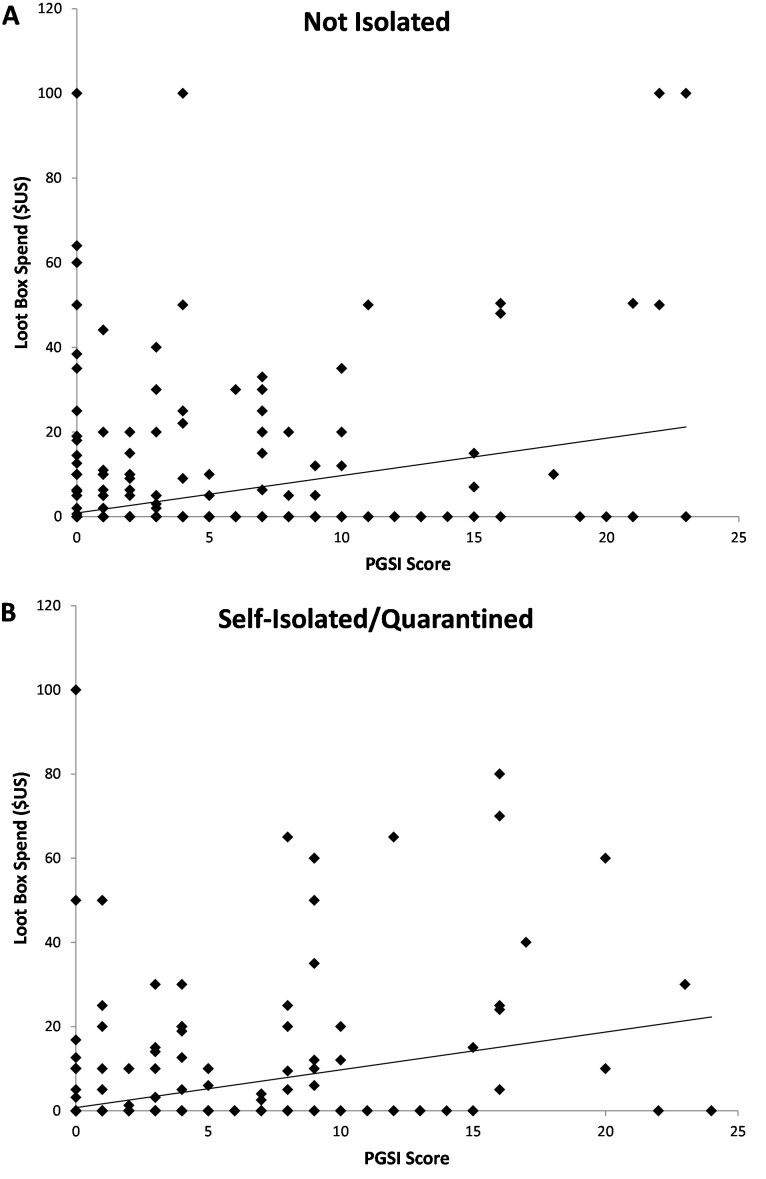
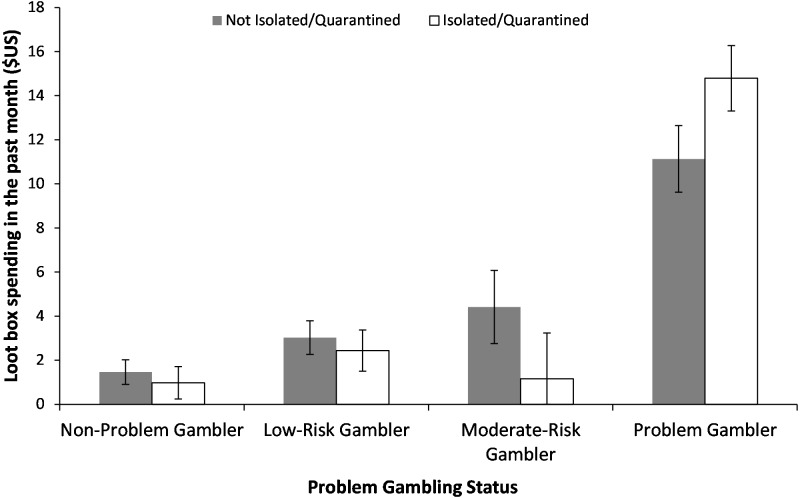
COVID-19 has prompted widespread self-isolation and citywide/countrywide lockdowns. The World Health Organisation (WHO) has encouraged increased digital social activities such as video game play to counteract social isolation during the pandemic. However, there is active debate about the potential for video game overuse, and some video games contain randomised purchases (loot boxes) that may psychologically approximate gambling. In this pre-registered study, we examined the effects of self-isolation and quarantine on excessive gaming and loot box spending. We recruited 1,144 (619 male, 499 female, 26 other) Australian, Aotearoa New Zealand, and US residents who self reported being quarantined or self-isolating ( = 447) or not ( = 619) during the COVID-19 pandemic to a cross-sectional natural experiment. We compared the associations between problem gambling symptomology, excessive gaming and loot box spending for isolated and non-isolated participants. Participants completed the Kessler-10 Psychological Distress Scale, Problem Gambling Severity Index, Internet Gaming Disorder Checklist, a measure of risky engagement with loot boxes, concern about contamination, and reported money spent on loot boxes in the past month, as well as whether they were quarantined or under self-isolation during the pandemic. Although, in our data, excessive gaming and loot box spending were not higher for isolated (self-isolated/ quarantined) compared to non-isolated gamers, the established association between problem gambling symptomology and loot box spending was stronger among isolated gamers than those not isolated. Concerns about being contaminated by germs was also significantly associated with greater excessive gaming and, to a lesser extent, loot box spending irrespective of isolation status. Gamers might be managing concerns about the pandemic with greater video game use, and more problem gamblers may be purchasing loot boxes during the pandemic. It is unclear whether these relationships may represent temporary coping mechanisms which abate when COVID-19 ends. Re-examination as the pandemic subsides may be required. More generally, the results suggest that social isolation during the pandemic may inflate the effect size of some media psychology and gaming effects. We urge caution not to generalise psychological findings from research conducted during the COVID-19 pandemic to be necessarily representative of the magnitude of relationships when not in a pandemic.
新冠疫情引发了广泛的自我隔离以及城市/全国范围的封锁。世界卫生组织(WHO)鼓励增加数字社交活动,如玩电子游戏,以应对疫情期间的社交隔离。然而,对于电子游戏过度使用的可能性存在激烈争论,并且一些电子游戏包含随机购买(开箱),这在心理上可能类似于赌博。在这项预先注册的研究中,我们考察了自我隔离和检疫对过度游戏及开箱消费的影响。我们招募了1144名(619名男性、499名女性、26名其他性别)澳大利亚、新西兰和美国居民,他们自我报告在新冠疫情期间处于检疫或自我隔离状态(n = 447)或未处于该状态(n = 619),参与一项横断面自然实验。我们比较了隔离和未隔离参与者在问题赌博症状、过度游戏和开箱消费之间的关联。参与者完成了凯斯勒10项心理困扰量表、问题赌博严重程度指数、网络游戏障碍检查表、一项关于与开箱有风险互动的测量、对感染的担忧,并报告了过去一个月在开箱上花费的金钱,以及他们在疫情期间是否处于检疫或自我隔离状态。尽管在我们的数据中,与未隔离的玩家相比,隔离(自我隔离/检疫)玩家的过度游戏和开箱消费并不更高,但问题赌博症状与开箱消费之间已确立的关联在隔离玩家中比未隔离玩家更强。对被细菌感染的担忧也与更多的过度游戏显著相关,并且在较小程度上与开箱消费相关,无论隔离状态如何。玩家可能通过更多地玩电子游戏来应对对疫情的担忧,并且更多有问题的赌徒可能在疫情期间购买开箱。尚不清楚这些关系是否可能代表新冠疫情结束后就会减弱的临时应对机制。随着疫情消退,可能需要重新进行考察。更普遍地说,结果表明疫情期间的社交隔离可能会夸大一些媒体心理学和游戏效应的效应量。我们敦促谨慎行事,不要将新冠疫情期间进行的研究中的心理学发现一概而论地视为必然代表非疫情时期关系的强度。