School of Clinical Medicine, University of Cambridge, Cambridge, United Kingdom.
Singapore Eye Research Institute, Singapore National Eye Centre, Singapore, Singapore.
JMIR Public Health Surveill. 2021 Feb 19;7(2):e24445. doi: 10.2196/24445.
The COVID-19 pandemic has led to urgent calls for the adoption of telehealth solutions. However, public interest and demand for telehealth during the pandemic remain unknown.
We used an infodemiological approach to estimate the worldwide demand for telehealth services during COVID-19, focusing on the 50 most affected countries and comparing the demand for such services with the level of information and communications technology (ICT) infrastructure available.
We used Google Trends, the Baidu Index (China), and Yandex Keyword Statistics (Russia) to extract data on worldwide and individual countries' telehealth-related internet searches from January 1 to July 7, 2020, presented as relative search volumes (RSV; range 0-100). Daily COVID-19 cases and deaths were retrieved from the World Health Organization. Individual countries' ICT infrastructure profiles were retrieved from the World Economic Forum Report.
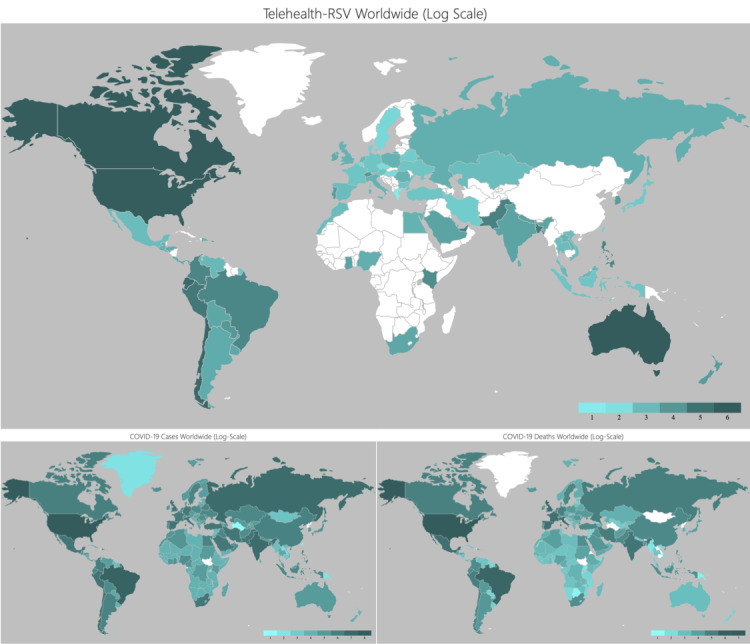
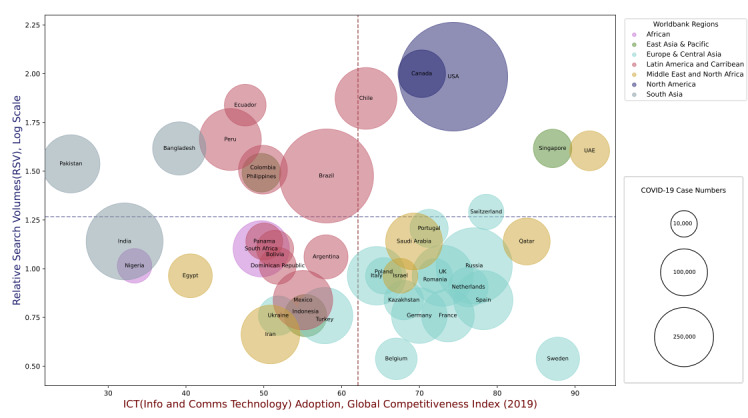
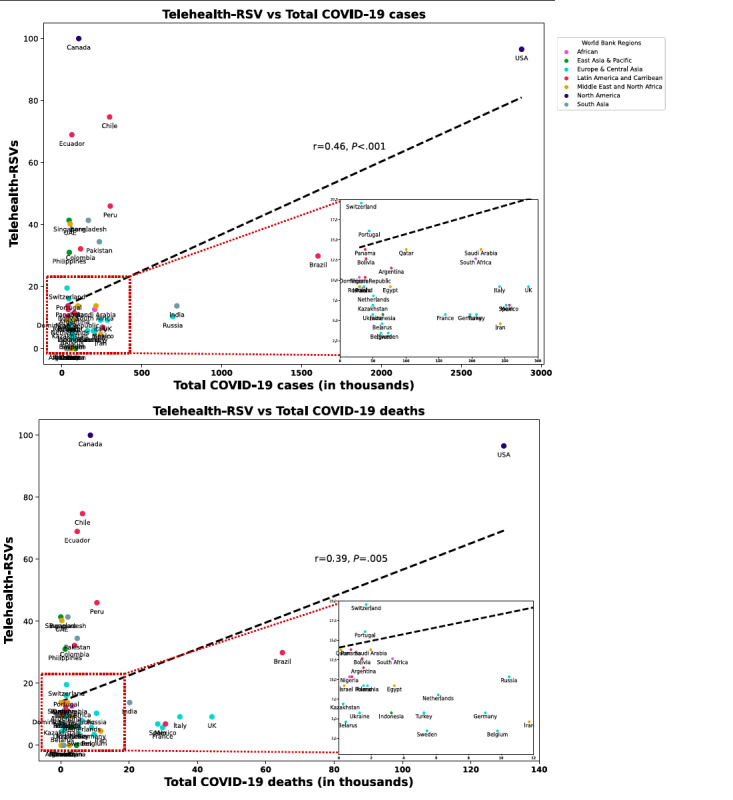
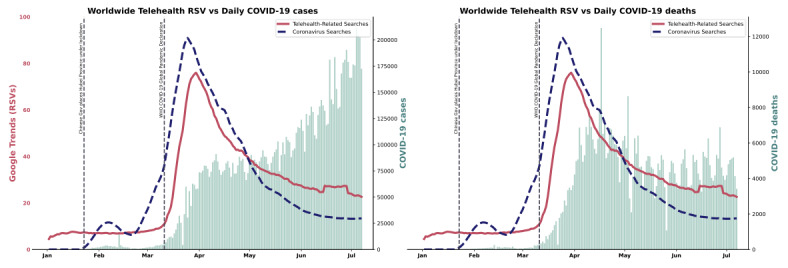
Across the 50 countries, the mean RSV was 18.5 (SD 23.2), and the mean ICT index was 62.1 (SD 15.0). An overall spike in worldwide telehealth-related RSVs was observed from March 11, 2020 (RSV peaked to 76.0), which then tailed off in June-July 2020 (mean RSV for the period was 25.8), but remained higher than pre-March RSVs (mean 7.29). By country, 42 (84%) manifested increased RSVs over the evaluation period, with the highest observed in Canada (RSV=100) and the United States (RSV=96). When evaluating associations between RSV and the ICT index, both the United States and Canada demonstrated high RSVs and ICT scores (≥70.3). In contrast, European countries had relatively lower RSVs (range 3.4-19.5) despite high ICT index scores (mean 70.3). Several Latin American (Brazil, Chile, Colombia) and South Asian (India, Bangladesh, Pakistan) countries demonstrated relatively higher RSVs (range 13.8-73.3) but low ICT index scores (mean 44.6), indicating that the telehealth demand outstrips the current ICT infrastructure.
There is generally increased interest and demand for telehealth services across the 50 countries most affected by COVID-19, highlighting the need to scale up telehealth capabilities, during and beyond the pandemic.
COVID-19 大流行促使人们迫切呼吁采用远程医疗解决方案。然而,公众对大流行期间远程医疗的兴趣和需求尚不清楚。
我们采用信息流行病学方法估计 COVID-19 期间全球对远程医疗服务的需求,重点关注受影响最严重的 50 个国家,并将对这些服务的需求与可用的信息和通信技术(ICT)基础设施水平进行比较。
我们使用 Google Trends、百度指数(中国)和 Yandex 关键字统计(俄罗斯)从 2020 年 1 月 1 日至 7 月 7 日提取全球和各国与远程医疗相关的互联网搜索数据,以相对搜索量(RSV;范围 0-100)表示。从世界卫生组织获取各国每日 COVID-19 病例和死亡人数。从世界经济论坛报告中获取各国的 ICT 基础设施概况。
在这 50 个国家中,平均 RSV 为 18.5(SD 23.2),平均 ICT 指数为 62.1(SD 15.0)。从 2020 年 3 月 11 日开始,全球与远程医疗相关的 RSV 总体呈上升趋势(RSV 达到 76.0),然后在 2020 年 6 月至 7 月期间呈下降趋势(该期间的平均 RSV 为 25.8),但仍高于 3 月前的 RSV(平均 7.29)。就国家而言,42 个(84%)国家在评估期间的 RSV 呈上升趋势,其中加拿大(RSV=100)和美国(RSV=96)的 RSV 增幅最高。在评估 RSV 与 ICT 指数之间的关联时,美国和加拿大的 RSV 和 ICT 评分均较高(≥70.3)。相比之下,欧洲国家的 RSV 相对较低(范围为 3.4-19.5),尽管 ICT 指数评分较高(平均 70.3)。一些拉丁美洲(巴西、智利、哥伦比亚)和南亚(印度、孟加拉国、巴基斯坦)国家的 RSV 相对较高(范围为 13.8-73.3),但 ICT 指数评分较低(平均 44.6),这表明远程医疗需求超过了当前的 ICT 基础设施。
受 COVID-19 影响最严重的 50 个国家对远程医疗服务的兴趣和需求普遍增加,这表明在大流行期间及之后,需要扩大远程医疗能力。