• 文献检索
  • 文档翻译
  • 深度研究
  • 学术资讯
  • Suppr Zotero 插件Zotero 插件
  • 邀请有礼
  • 套餐&价格
  • 历史记录
应用&插件
Suppr Zotero 插件Zotero 插件浏览器插件Mac 客户端Windows 客户端微信小程序
定价
高级版会员购买积分包购买API积分包
服务
文献检索文档翻译深度研究API 文档MCP 服务
关于我们
关于 Suppr公司介绍联系我们用户协议隐私条款
关注我们

Suppr 超能文献

核心技术专利:CN118964589B侵权必究
粤ICP备2023148730 号-1Suppr @ 2026

文献检索

告别复杂PubMed语法,用中文像聊天一样搜索,搜遍4000万医学文献。AI智能推荐,让科研检索更轻松。

立即免费搜索

文件翻译

保留排版,准确专业,支持PDF/Word/PPT等文件格式,支持 12+语言互译。

免费翻译文档

深度研究

AI帮你快速写综述,25分钟生成高质量综述,智能提取关键信息,辅助科研写作。

立即免费体验

日本远程医疗的公共利益与可及性:利用谷歌趋势和国家监测进行的回顾性分析

Public Interest and Accessibility of Telehealth in Japan: Retrospective Analysis Using Google Trends and National Surveillance.

作者信息

Kinoshita Takuya, Matsumoto Takehiro, Taura Naota, Usui Tetsuya, Matsuya Nemu, Nishiguchi Mayumi, Horita Hozumi, Nakao Kazuhiko

机构信息

Department of Medical Informatics, Nagasaki University, Nagasaki, Japan.

Department of Medical Informatics, Nagasaki University Hospital, Nagasaki, Japan.

出版信息

JMIR Form Res. 2022 Sep 14;6(9):e36525. doi: 10.2196/36525.

DOI:10.2196/36525
PMID:36103221
原文链接:https://pmc.ncbi.nlm.nih.gov/articles/PMC9520390/
Abstract

BACKGROUND

Recently, the use of telehealth for patient treatment under the COVID-19 pandemic has gained interest around the world. As a result, many infodemiology and infoveillance studies using web-based sources such as Google Trends were reported, focusing on the first wave of the COVID-19 pandemic. Although public interest in telehealth has increased in many countries during this time, the long-term interest has remained unknown among people living in Japan. Moreover, various mobile telehealth apps have become available for remote areas in the COVID-19 era, but the accessibility of these apps in epidemic versus nonepidemic regions is unknown.

OBJECTIVE

We aimed to investigate the public interest in telehealth during the first pandemic wave and after the wave in the first part of this study, and the accessibility of medical institutions using telehealth in the epidemic and nonepidemic regions, in the second part.

METHODS

We examined and compared the first wave and after the wave with regards to severe cases, number of deaths, relative search volume (RSV) of telehealth and COVID-19, and the correlation between RSV and COVID-19 cases, using open sources such as Google Trends and the Japanese Ministry of Health, Labour and Welfare (JMHLW) data. The weekly mean and the week-over-week change rates of RSV and COVID-19 cases were used to examine the correlation coefficients. In the second part, the prevalence of COVID-19 cases, severe cases, number of deaths, and the telehealth accessibility rate were compared between epidemic regions and nonepidemic regions, using the JMHLW data. We also examined the regional correlation between telehealth accessibility and the prevalence of COVID-19 cases.

RESULTS

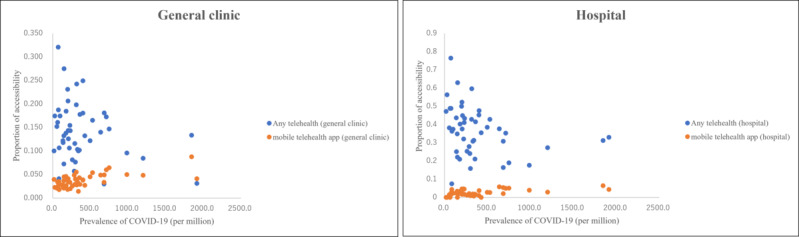
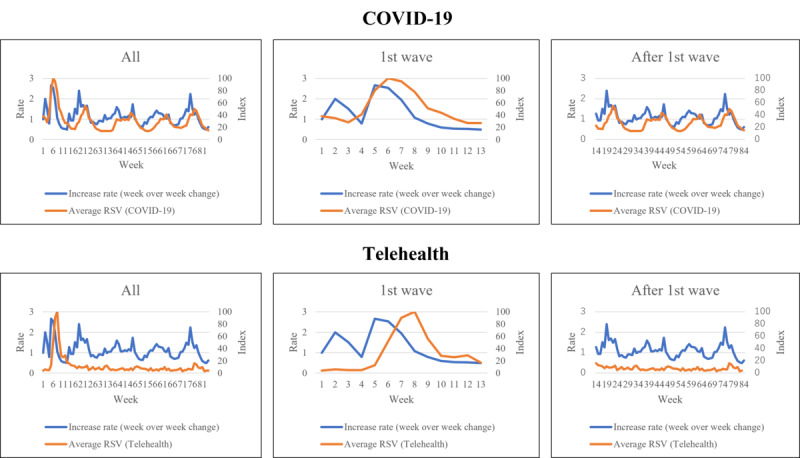
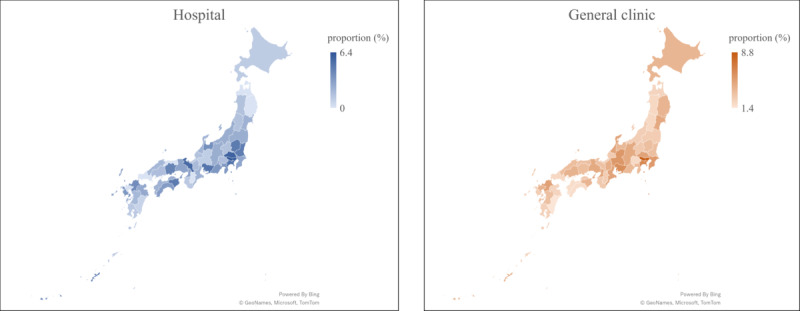
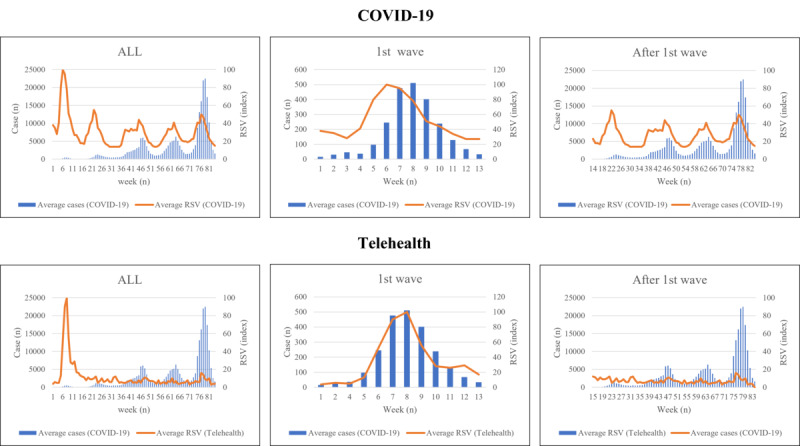
Among the 83 weeks with 5 pandemic waves, the overall mean for the RSV of telehealth and COVID-19 was 11.3 (95% CI 8.0-14.6) and 30.7 (95% CI 27.2-34.2), respectively. The proportion of severe cases (26.54% vs 18.16%; P<.001), deaths (5.33% vs 0.99%; P<.001), RSV of telehealth (mean 33.1, 95% CI 16.2-50.0 vs mean 7.3, 95% CI 6.7-8.0; P<.001), and RSV of COVID-19 (mean 52.1, 95% CI 38.3-65.9 vs mean 26.3, 95% CI 24.4-29.2; P<.001) was significantly higher in the first wave compared to after the wave. In the correlation analysis, the public interest in telehealth was 0.899 in the first wave and -0.300 overall. In Japan, the accessibility of telehealth using mobile apps was significantly higher in epidemic regions compared to nonepidemic regions in both hospitals (3.8% vs 2.0%; P=.004) and general clinics (5.2% vs 3.1%; P<.001). In the regional correlation analysis, telehealth accessibility using mobile apps was 0.497 in hospitals and 0.629 in general clinics.

CONCLUSIONS

Although there was no long-term correlation between the public interest in telehealth and COVID-19, there was a regional correlation between mobile telehealth app accessibility in Japan, especially for general clinics. We also revealed that epidemic regions had higher mobile telehealth app accessibility. Further studies about the actual use of telehealth and its effect after the COVID-19 pandemic are necessary.

摘要

背景

最近,在新冠疫情大流行期间使用远程医疗进行患者治疗在全球范围内受到关注。因此,许多利用谷歌趋势等网络资源进行的信息流行病学和信息监测研究被报道,重点关注新冠疫情的第一波。尽管在此期间许多国家民众对远程医疗的兴趣有所增加,但日本民众的长期兴趣仍不明确。此外,在新冠疫情时代,各种移动远程医疗应用程序已可供偏远地区使用,但这些应用程序在疫情地区与非疫情地区的可及性尚不清楚。

目的

在本研究的第一部分,我们旨在调查疫情第一波期间及之后民众对远程医疗的兴趣;在第二部分,我们旨在调查疫情地区和非疫情地区使用远程医疗的医疗机构的可及性。

方法

我们使用谷歌趋势和日本厚生劳动省(JMHLW)数据等公开来源,检查并比较了第一波及之后的重症病例、死亡人数、远程医疗和新冠的相对搜索量(RSV),以及RSV与新冠病例之间的相关性。使用RSV和新冠病例的每周均值及环比变化率来检查相关系数。在第二部分,利用JMHLW数据比较了疫情地区和非疫情地区的新冠病例患病率、重症病例、死亡人数以及远程医疗可及率。我们还研究了远程医疗可及性与新冠病例患病率之间的区域相关性。

结果

在有5波疫情的83周中,远程医疗和新冠的RSV总体均值分别为11.3(95%CI 8.0 - 14.6)和30.7(95%CI 27.2 - 34.2)。与第一波之后相比,第一波中的重症病例比例(26.54%对18.16%;P<0.001)、死亡比例(5.33%对0.99%;P<0.001)、远程医疗的RSV(均值33.1,95%CI 16.2 - 50.0对均值7.3,95%CI 6.7 - 8.0;P<0.001)以及新冠的RSV(均值52.1,95%CI 38.3 - 65.9对均值26.3,95%CI 24.4 - 29.2;P<0.001)均显著更高。在相关性分析中,第一波中民众对远程医疗的兴趣为0.899,总体为 - 0.300。在日本,无论是医院(3.8%对2.0%;P = 0.004)还是普通诊所(5.2%对3.1%;P<0.001),疫情地区使用移动应用程序的远程医疗可及性均显著高于非疫情地区。在区域相关性分析中,医院使用移动应用程序的远程医疗可及性为0.497,普通诊所为0.629。

结论

尽管民众对远程医疗的兴趣与新冠之间没有长期相关性,但在日本,移动远程医疗应用程序的可及性存在区域相关性,尤其是在普通诊所。我们还发现疫情地区的移动远程医疗应用程序可及性更高。有必要对新冠疫情大流行之后远程医疗的实际使用情况及其效果进行进一步研究。
https://cdn.ncbi.nlm.nih.gov/pmc/blobs/ad92/9520390/d191039a4279/formative_v6i9e36525_fig4.jpg
https://cdn.ncbi.nlm.nih.gov/pmc/blobs/ad92/9520390/0798e87973b2/formative_v6i9e36525_fig1.jpg
https://cdn.ncbi.nlm.nih.gov/pmc/blobs/ad92/9520390/4edfc1b21faa/formative_v6i9e36525_fig2.jpg
https://cdn.ncbi.nlm.nih.gov/pmc/blobs/ad92/9520390/0546482e31a3/formative_v6i9e36525_fig3.jpg
https://cdn.ncbi.nlm.nih.gov/pmc/blobs/ad92/9520390/d191039a4279/formative_v6i9e36525_fig4.jpg
https://cdn.ncbi.nlm.nih.gov/pmc/blobs/ad92/9520390/0798e87973b2/formative_v6i9e36525_fig1.jpg
https://cdn.ncbi.nlm.nih.gov/pmc/blobs/ad92/9520390/4edfc1b21faa/formative_v6i9e36525_fig2.jpg
https://cdn.ncbi.nlm.nih.gov/pmc/blobs/ad92/9520390/0546482e31a3/formative_v6i9e36525_fig3.jpg
https://cdn.ncbi.nlm.nih.gov/pmc/blobs/ad92/9520390/d191039a4279/formative_v6i9e36525_fig4.jpg

相似文献

1
Public Interest and Accessibility of Telehealth in Japan: Retrospective Analysis Using Google Trends and National Surveillance.日本远程医疗的公共利益与可及性:利用谷歌趋势和国家监测进行的回顾性分析
JMIR Form Res. 2022 Sep 14;6(9):e36525. doi: 10.2196/36525.
2
Global Interest in Telehealth During COVID-19 Pandemic: An Analysis of Google Trends™.新冠疫情期间全球对远程医疗的关注:谷歌趋势™分析
Cureus. 2020 Sep 16;12(9):e10487. doi: 10.7759/cureus.10487.
3
Public and Research Interest in Telemedicine From 2017 to 2022: Infodemiology Study of Google Trends Data and Bibliometric Analysis of Scientific Literature.2017 年至 2022 年的远程医疗的公众和研究兴趣:谷歌趋势数据的信息流行病学研究和科学文献的文献计量分析。
J Med Internet Res. 2024 May 16;26:e50088. doi: 10.2196/50088.
4
Telehealth Demand Trends During the COVID-19 Pandemic in the Top 50 Most Affected Countries: Infodemiological Evaluation.新冠疫情期间前 50 个受影响最严重国家的远程医疗需求趋势:信息流行病学评估。
JMIR Public Health Surveill. 2021 Feb 19;7(2):e24445. doi: 10.2196/24445.
5
Understanding Health Communication Through Google Trends and News Coverage for COVID-19: Multinational Study in Eight Countries.通过谷歌趋势和新冠疫情新闻报道理解健康传播:八国跨国研究。
JMIR Public Health Surveill. 2021 Dec 21;7(12):e26644. doi: 10.2196/26644.
6
Low online search interest in teleneurology before and during COVID-19 pandemic: an infodemiological study.新冠疫情前后远程神经学的在线搜索兴趣较低:一项信息流行病学研究。
Neurol Sci. 2022 May;43(5):2929-2934. doi: 10.1007/s10072-022-05902-6. Epub 2022 Jan 24.
7
Explanation of hand, foot, and mouth disease cases in Japan using Google Trends before and during the COVID-19: infodemiology study.在COVID-19疫情之前及期间利用谷歌趋势对日本手足口病病例进行的解释:信息流行病学研究
BMC Infect Dis. 2022 Oct 29;22(1):806. doi: 10.1186/s12879-022-07790-9.
8
Global monitoring of public interest in preventive measures against COVID-19 via analysis of Google Trends: an infodemiology and infoveillance study.通过分析谷歌趋势对 COVID-19 预防措施的公众关注度进行全球监测:一项信息流行病学和信息监测研究。
BMJ Open. 2022 Aug 11;12(8):e060715. doi: 10.1136/bmjopen-2021-060715.
9
Mobile Apps Leveraged in the COVID-19 Pandemic in East and South-East Asia: Review and Content Analysis.移动应用程序在东亚和东南亚 COVID-19 大流行中的应用:综述和内容分析。
JMIR Mhealth Uhealth. 2021 Nov 11;9(11):e32093. doi: 10.2196/32093.
10
The Impact of COVID-19 on Conspiracy Hypotheses and Risk Perception in Italy: Infodemiological Survey Study Using Google Trends.新冠疫情对意大利阴谋论及风险认知的影响:基于谷歌趋势的信息流行病学调查研究
JMIR Infodemiology. 2021 Aug 6;1(1):e29929. doi: 10.2196/29929. eCollection 2021 Jan-Dec.

引用本文的文献

1
Present state and perceived future use of teledentistry in long-term care facilities in Japan: A cross-sectional study.日本长期护理机构中远程牙科的现状及未来应用展望:一项横断面研究。
Digit Health. 2024 Sep 25;10:20552076241282394. doi: 10.1177/20552076241282394. eCollection 2024 Jan-Dec.
2
Public and Research Interest in Telemedicine From 2017 to 2022: Infodemiology Study of Google Trends Data and Bibliometric Analysis of Scientific Literature.2017 年至 2022 年的远程医疗的公众和研究兴趣:谷歌趋势数据的信息流行病学研究和科学文献的文献计量分析。
J Med Internet Res. 2024 May 16;26:e50088. doi: 10.2196/50088.

本文引用的文献

1
Perceptions and Attitudes Toward Telemedicine by Clinicians and Patients in Japan During the COVID-19 Pandemic.COVID-19大流行期间日本临床医生和患者对远程医疗的认知与态度
Telemed Rep. 2021 Jul 19;2(1):197-204. doi: 10.1089/tmr.2021.0012. eCollection 2021.
2
Videoconferencing for Home Care Delivery in Japan: Observational Study.日本居家护理中的视频会议应用:观察性研究。
J Med Internet Res. 2021 Sep 1;23(9):e23539. doi: 10.2196/23539.
3
Age and Social Disparities in the Use of Telemedicine During the COVID-19 Pandemic in Japan: Cross-sectional Study.
年龄与社会差异对日本 COVID-19 大流行期间远程医疗使用的影响:横断面研究。
J Med Internet Res. 2021 Jul 23;23(7):e27982. doi: 10.2196/27982.
4
Accessibility of Telehealth Services During the COVID-19 Pandemic: A Cross-Sectional Survey of Medicare Beneficiaries.COVID-19大流行期间远程医疗服务的可及性:医疗保险受益人的横断面调查
Prev Chronic Dis. 2021 Jul 1;18:E65. doi: 10.5888/pcd18.210056.
5
Retrospective methodology to estimate daily infections from deaths (REMEDID) in COVID-19: the Spain case study.回顾性方法估计 COVID-19 死亡病例中的日感染人数(REMEDID):西班牙案例研究。
Sci Rep. 2021 May 28;11(1):11274. doi: 10.1038/s41598-021-90051-7.
6
The Japanese version of the Fear of COVID-19 scale: Reliability, validity, and relation to coping behavior.《COVID-19 恐惧量表》日语版:信度、效度及与应对行为的关系。
PLoS One. 2020 Nov 5;15(11):e0241958. doi: 10.1371/journal.pone.0241958. eCollection 2020.
7
Use of Telehealth During the COVID-19 Pandemic: Scoping Review.COVID-19大流行期间远程医疗的应用:范围综述
J Med Internet Res. 2020 Dec 1;22(12):e24087. doi: 10.2196/24087.
8
Surveillance of early stage COVID-19 clusters using search query logs and mobile device-based location information.利用搜索查询日志和基于移动设备的位置信息监测 COVID-19 早期集群。
Sci Rep. 2020 Oct 29;10(1):18680. doi: 10.1038/s41598-020-75771-6.
9
Global Interest in Telehealth During COVID-19 Pandemic: An Analysis of Google Trends™.新冠疫情期间全球对远程医疗的关注:谷歌趋势™分析
Cureus. 2020 Sep 16;12(9):e10487. doi: 10.7759/cureus.10487.
10
Digital Health Strategies to Fight COVID-19 Worldwide: Challenges, Recommendations, and a Call for Papers.全球抗击新冠疫情的数字健康策略:挑战、建议及征稿启事
J Med Internet Res. 2020 Jun 16;22(6):e19284. doi: 10.2196/19284.