
在乌干达东部农村地区医院实施新生儿临床决策支持软件(NoviGuide):可行性和可接受性研究。
Implementation of a Newborn Clinical Decision Support Software (NoviGuide) in a Rural District Hospital in Eastern Uganda: Feasibility and Acceptability Study.
机构信息
UCSF Preterm Birth Initiative, University of California San Francisco School of Medicine, San Francisco, CA, United States.
Infectious Diseases Research Collaboration, Kampala, Uganda.
出版信息
JMIR Mhealth Uhealth. 2021 Feb 19;9(2):e23737. doi: 10.2196/23737.
BACKGROUND
Lack of trained health care workers and nonadherence to national guidelines are key barriers to achieving high-quality newborn care in health care facilities in low- and middle-income countries. Traditional didactic approaches addressing these barriers fail to account for high staff turnover rates and result in temporary behavior change. NoviGuide, a clinical decision support software designed to standardize neonatal care through point-of-care assessments, has the potential to align bedside practice to national guidelines in settings lacking subspecialty neonatal providers.
OBJECTIVE
This study aims to determine the adaptation, adoption, feasibility, acceptability, and sustainability of NoviGuide and its impact on nurse-midwives' knowledge in a rural hospital in eastern Uganda.
METHODS
This mixed methods observational study was guided by the Proctor framework. Experts reviewed the clinical content of NoviGuide to ensure fidelity to Uganda guidelines. We enrolled nurses and midwives providing newborn care at Tororo District Hospital, trained them on NoviGuide use, and followed them for 12 months. We assessed adoption, feasibility, acceptability, and sustainability by analyzing NoviGuide use data, comparing it with maternity registry data and administering the System Usability Scale (SUS) and the Center for Health Care Evaluation Provider Satisfaction Questionnaire. We compared the mean knowledge assessment score at baseline, 6 months, and 12 months using a two-tailed t test.
RESULTS
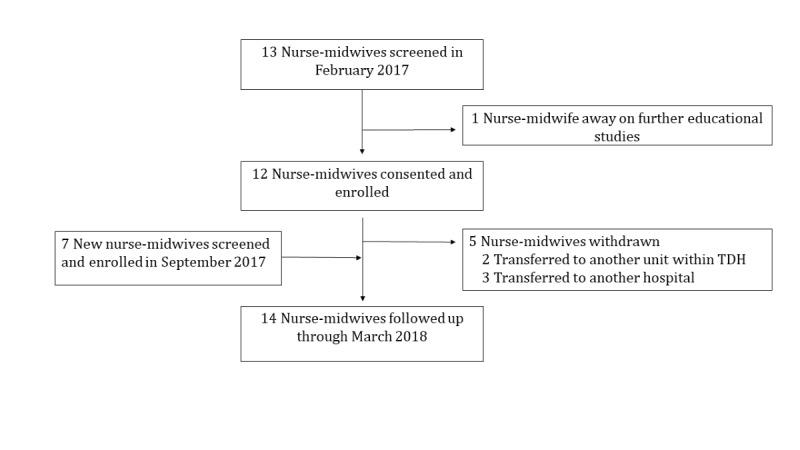
Five Ugandan experts suggested two minor changes to NoviGuide: the inclusion of an unsterile birth environment as an indication for empiric antibiotics and the addition of a reminder to follow-up with newborns with temperatures between 37.7°C and 37.9°C. Of the 19 nurse-midwives enrolled in February 2017, 74% (n=14) completed the follow-up in March 2018. The participants entered a total of 1705 assessments of varying newborn characteristics into NoviGuide throughout the day, evening, and night nursing shifts. The SUS score at the end of the study was very high (93.5, above the average of 68). Participants had a positive perception about NoviGuide, reporting that NoviGuide saved time (mean 5, SD 0) and prevented mistakes (mean 5, SD 0), and that they felt more confident in taking care of newborns when they used NoviGuide (mean 5, SD 0). Participants were highly satisfied with NoviGuide (mean 4.86, SD 0.36), although they lacked medical supplies and materials needed to follow NoviGuide recommendations (mean 3.3, SD 1.22). The participants' knowledge scores improved by a mean change of 3.7 (95% CI 2.6-4.8) at 6 months and 6.7 (95% CI 4.6-8.2) at 12 months (P<.001).
CONCLUSIONS
NoviGuide was easily adapted to the Uganda guidelines. Nurse-midwives used NoviGuide frequently and reported high levels of satisfaction despite challenges with medical supplies and high staff turnover. NoviGuide improved knowledge and confidence in newborn care without in-person didactic training. NoviGuide use has the potential to scale up quality newborn care by facilitating adherence to national guidelines.
背景
在中低收入国家的医疗保健机构中,缺乏经过培训的医疗保健工作者和不遵守国家指南是实现高质量新生儿护理的关键障碍。传统的教学方法无法解决这些障碍,并且无法应对高员工流动率,只能导致暂时的行为改变。NoviGuide 是一种临床决策支持软件,旨在通过床边评估来标准化新生儿护理,它有可能在缺乏新生儿专科医生的环境中将床边实践与国家指南保持一致。
目的
本研究旨在确定在乌干达东部的一家农村医院中,NoviGuide 的适应性、采用情况、可行性、可接受性和可持续性,以及它对助产士知识的影响。
方法
本混合方法观察性研究以 Proctor 框架为指导。专家对 NoviGuide 的临床内容进行了审查,以确保其与乌干达指南的一致性。我们招募了在 Tororo 地区医院提供新生儿护理的护士和助产士,对他们进行了 NoviGuide 使用方面的培训,并对他们进行了 12 个月的随访。我们通过分析 NoviGuide 使用数据、将其与产妇登记数据进行比较,并使用系统可用性量表(SUS)和医疗保健评估提供者满意度问卷来评估采用、可行性、可接受性和可持续性。我们使用双尾 t 检验比较了基线、6 个月和 12 个月的平均知识评估得分。
结果
5 名乌干达专家对 NoviGuide 提出了两项小的更改建议:将不卫生的分娩环境作为使用经验性抗生素的指征,以及添加一个提醒,以跟踪体温在 37.7°C 至 37.9°C 之间的新生儿。2017 年 2 月招募的 19 名助产士中,有 74%(n=14)在 2018 年 3 月完成了随访。参与者在全天、傍晚和夜间的护理班次中,共在 NoviGuide 中输入了 1705 次新生儿特征的评估。研究结束时的 SUS 得分非常高(93.5,高于 68 的平均值)。参与者对 NoviGuide 有积极的看法,报告称 NoviGuide 节省了时间(平均 5,SD 0)并防止了错误(平均 5,SD 0),并且他们在使用 NoviGuide 时对照顾新生儿更有信心(平均 5,SD 0)。参与者对 NoviGuide 非常满意(平均 4.86,SD 0.36),尽管他们缺乏医疗用品和遵循 NoviGuide 建议所需的材料(平均 3.3,SD 1.22)。参与者的知识得分在 6 个月时平均提高了 3.7(95%CI 2.6-4.8),在 12 个月时提高了 6.7(95%CI 4.6-8.2)(P<.001)。
结论
NoviGuide 很容易适应乌干达的指南。尽管存在医疗用品短缺和员工流动率高的挑战,但助产士经常使用 NoviGuide,并报告满意度很高。NoviGuide 提高了新生儿护理的知识和信心,而无需进行面对面的教学培训。NoviGuide 的使用有可能通过促进对国家指南的遵守来提高新生儿护理质量。



 Zotero 插件