Departamento de Física, Universidade Federal de Minas Gerais, Belo Horizonte-MG, Brazil; Programa Interunidades de Pós-Graduação em Bioinformática, Universidade Federal de Minas Gerais, Belo Horizonte, MG, Brazil.
Departamento de Física, Universidade Federal de Minas Gerais, Belo Horizonte-MG, Brazil.
Mol Cell Probes. 2021 Apr;56:101707. doi: 10.1016/j.mcp.2021.101707. Epub 2021 Feb 17.
DNA mismatches can affect the efficiency of PCR techniques if the intended target has mismatches in primer or probe regions. The accepted rule is that mismatches are detrimental as they reduce the hybridization temperatures, yet a more quantitative assessment is rarely performed.
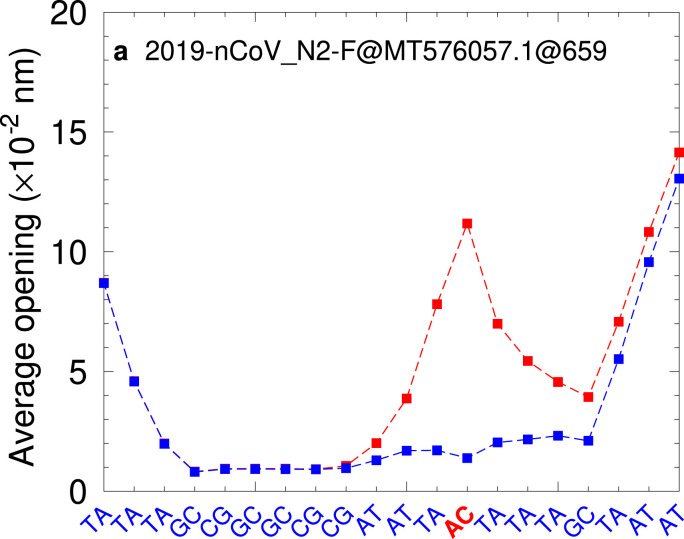
We calculate the hybridization temperatures of primer/probe sets after aligning to SARS-CoV-2, SARS-CoV-1 and non-SARS genomes, considering all possible combinations of single, double and triple consecutive mismatches. We consider the mismatched hybridization temperature within a range of 5 C to the fully matched reference temperature.
We obtained the alignments of 19 PCR primers sets that were recently reported for the detection of SARS-CoV-2 and to 21665 SARS-CoV-2 genomes as well as 323 genomes of other viruses of the coronavirus family of which 10 are SARS-CoV-1. We find that many incompletely aligned primers become fully aligned to most of the SARS-CoV-2 when mismatches are considered. However, we also found that many cross-align to SARS-CoV-1 and non-SARS genomes.
Some primer/probe sets only align substantially to most SARS-CoV-2 genomes if mismatches are taken into account. Unfortunately, by the same mechanism, almost 75% of these sets also align to some SARS-CoV-1 and non-SARS viruses. It is therefore recommended to consider mismatch hybridization for the design of primers whenever possible, especially to avoid undesired cross-reactivity.
如果目标物在引物或探针区域存在错配,DNA 错配可能会影响 PCR 技术的效率。公认的规则是错配是有害的,因为它们会降低杂交温度,但很少进行更定量的评估。
我们在将 SARS-CoV-2、SARS-CoV-1 和非 SARS 基因组对齐后,计算了引物/探针组的杂交温度,考虑了单、双和三连续错配的所有可能组合。我们考虑了与完全匹配参考温度相差 5°C 的错配杂交温度。
我们获得了最近用于检测 SARS-CoV-2 的 19 个 PCR 引物组的比对,以及 21665 个 SARS-CoV-2 基因组和 323 个冠状病毒科其他病毒的基因组,其中 10 个是 SARS-CoV-1。我们发现,考虑到错配时,许多不完全对齐的引物会与大多数 SARS-CoV-2 完全对齐。然而,我们还发现它们也与 SARS-CoV-1 和非 SARS 基因组交叉对齐。
如果考虑错配杂交,一些引物/探针组仅与大多数 SARS-CoV-2 基因组有显著对齐。不幸的是,通过相同的机制,这些组中的近 75%也与一些 SARS-CoV-1 和非 SARS 病毒对齐。因此,建议在设计引物时尽可能考虑错配杂交,特别是为了避免不必要的交叉反应。