Knight Brittany, Otwell Taylor, Coryell Michael P, Stone Jennifer, Davis Phillip, Necciai Bryan, Carlson Paul E, Sozhamannan Shanmuga, Schubert Alyxandria M, Yan Yi H
MRIGlobal, 425 Dr. Martin Luther King Jr. Boulevard, Kansas City, MO, 64110, USA.
Laboratory of Mucosal Pathogens and Cellular Immunology, Division of Bacterial, Parasitic and Allergenic Products, Office of Vaccines Research and Review, Biologics Evaluation and Research, U.S. Food and Drug Administration, Silver Spring, MD, 20993, USA.
Sci Rep. 2025 May 9;15(1):16184. doi: 10.1038/s41598-025-98444-8.
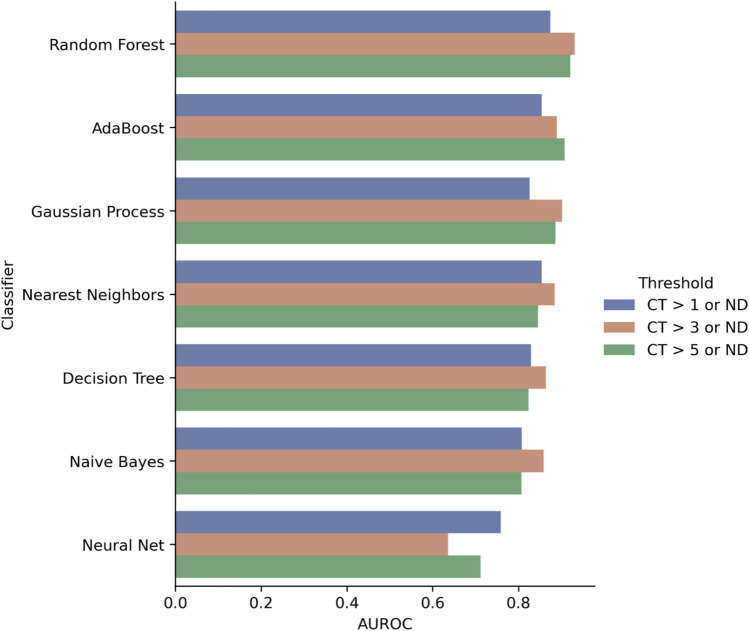
Molecular assays are critical tools for the diagnosis of infectious diseases. These assays have been extremely valuable during the COVID pandemic, used to guide both patient management and infection control strategies. Sustained transmission and unhindered proliferation of the virus during the pandemic resulted in many variants with unique mutations. Some of these mutations could lead to signature erosion, where tests developed using the genetic sequence of an earlier version of the pathogen may produce false negative results when used to detect novel variants. In this study, we assessed the performance changes of 15 molecular assay designs when challenged with a variety of mutations that fall within the targeted region. Using data generated from this study, we trained and assessed the performance of seven different machine learning models to predict whether a specific set of mutations will result in significant change in the performance for a specific test design. The best performing model demonstrated acceptable performance with sensitivity of 82% and specificity of 87% when assessed using tenfold cross validation. Our findings highlighted the potential of using machine learning models to predict the impact of emerging mutations on the performance of specific molecular test designs.
分子检测是诊断传染病的关键工具。在新冠疫情期间,这些检测极为重要,被用于指导患者管理和感染控制策略。疫情期间病毒的持续传播和不受阻碍的增殖导致出现了许多具有独特突变的变体。其中一些突变可能导致特征消失,即使用病原体早期版本的基因序列开发的检测方法,在用于检测新型变体时可能会产生假阴性结果。在本研究中,我们评估了15种分子检测设计在受到靶向区域内各种突变挑战时的性能变化。利用本研究产生的数据,我们训练并评估了七种不同机器学习模型的性能,以预测特定一组突变是否会导致特定检测设计的性能发生显著变化。使用十倍交叉验证进行评估时,表现最佳的模型显示出可接受的性能,灵敏度为82%,特异性为87%。我们的研究结果突出了使用机器学习模型预测新出现的突变对特定分子检测设计性能影响的潜力。