UO Nefrologia, Azienda Ospedaliero-Universitaria Parma, Dipartimento di Medicina e Chirurgia, Università̀ di Parma, Parma, Italy.
UO Nefrologia, Azienda Ospedaliero-Universitaria Parma, Dipartimento di Medicina e Chirurgia, Università̀ di Parma, Parma, Italy; Scuola di Specializzazione in Nefrologia, Dipartimento di Medicina e Chirurgia, Università di Parma, Parma, Italy.
J Crit Care. 2021 Jun;63:22-25. doi: 10.1016/j.jcrc.2021.01.013. Epub 2021 Feb 3.
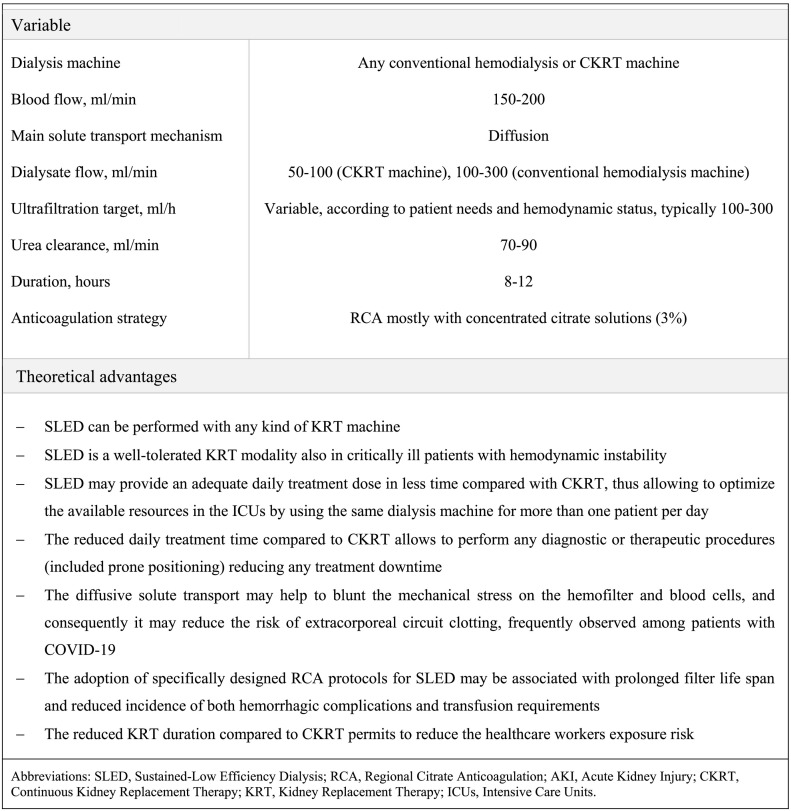
Acute Kidney Injury (AKI) is a frequent complication in critically ill patients with Coronavirus disease 2019 (COVID-19), and it has been associated with worse clinical outcomes, especially when Kidney Replacement Therapy (KRT) is required. A condition of hypercoagulability has been frequently reported in COVID-19 patients, and this very fact may complicate KRT management. Sustained Low Efficiency Dialysis (SLED) is a hybrid dialysis modality increasingly used in critically ill patients since it allows to maintain acceptable hemodynamic stability and to overcome the increased clotting risk of the extracorporeal circuit, especially when Regional Citrate Anticoagulation (RCA) protocols are applied. Notably, given the mainly diffusive mechanism of solute transport, SLED is associated with lower stress on both hemofilter and blood cells as compared to convective KRT modalities. Finally, RCA, as compared with heparin-based protocols, does not further increase the already high hemorrhagic risk of patients with AKI. Based on these premises, we performed a pilot study on the clinical management of critically ill patients with COVID-19 associated AKI who underwent SLED with a simplified RCA protocol. Low circuit clotting rates were observed, as well as adequate KRT duration was achieved in most cases, without any relevant metabolic complication nor worsening of hemodynamic status.
急性肾损伤(AKI)是 2019 年冠状病毒病(COVID-19)危重症患者的常见并发症,与更差的临床结局相关,尤其是需要肾脏替代治疗(KRT)时。COVID-19 患者经常出现高凝状态,这一事实可能使 KRT 管理复杂化。持续低效透析(SLED)是一种混合透析模式,由于它允许维持可接受的血液动力学稳定性,并克服体外回路增加的凝血风险,尤其是在应用区域柠檬酸抗凝(RCA)方案时,因此在危重症患者中越来越多地使用。值得注意的是,鉴于溶质转运的主要弥散机制,与对流 KRT 模式相比,SLED 与血液过滤器和血细胞的压力都较低。最后,与肝素基方案相比,RCA 不会进一步增加 AKI 患者已经很高的出血风险。基于这些前提,我们对接受简化 RCA 方案的 COVID-19 相关 AKI 危重症患者的 SLED 临床管理进行了一项试点研究。观察到低回路凝血率,并且在大多数情况下实现了足够的 KRT 持续时间,没有任何相关的代谢并发症或血液动力学状态恶化。