Jacob Julie, Mangelschots Els, Michez Marine, Sanak Serdal N, Leys Anita
Department of Ophthalmology, Universitair Ziekenhuis Leuven (UZ Leuven), Leuven, Belgium.
Oogartsenpraktijk Alken, Alken, Belgium.
Ophthalmol Ther. 2021 Jun;10(2):299-311. doi: 10.1007/s40123-021-00335-4. Epub 2021 Feb 23.
A prospective study was carried out in Belgium to determine the proportion of subjects with a moderate to high risk of developing age-related macular degeneration (AMD), identified using the STARS (Simplified Théa AMD Risk-Assessment Scale) questionnaire, who were in need of nutritional supplementation, by assessing the vitamin D, zinc oxide and fatty acid profile status.
This multicentre cross-sectional pilot study involved 50 Belgian subjects with no or early AMD, aged > 55 years who were at moderate to high risk for AMD. Subjects were assessed using the STARS questionnaire, visual acuity assessment, an optical coherence tomography scan of the macula and fundus photography. Blood samples were collected, and serum analyses were performed to determine the the omega-6:omega-3 (Ω6:Ω3) ratio and the levels of eicosapentaenoic acid (EPA), docosahexaenoic acid (DHA), zinc and cupric oxides and vitamin D.
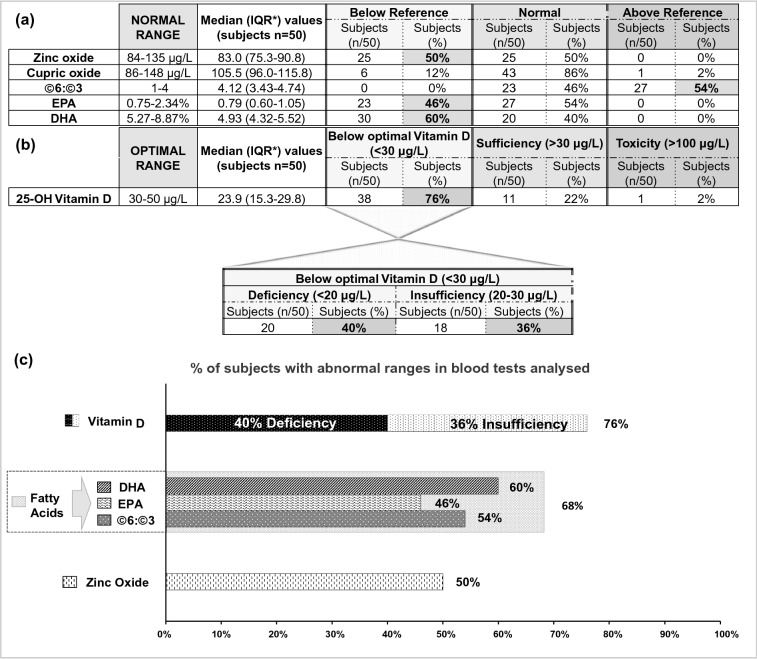
Abnormal serum levels for at least one of the micronutrients was detected in 94% of the subjects. Lower than optimal vitamin D levels were found in 76% of the participants, and 68% of the subjects demonstrated at least one abnormal fatty acid profile. The Ω6:Ω3 ratio was above the reference range for normal values in 54% of the subjects; DHA and EPA levels were below the reference range in 60 and 46% of the subjects, respectively; and zinc oxide concentration was below the reference range in 50% of the subjects. Only 12% of the subjects exhibited cupric oxide deficiency.
In this study, the STARS questionnaire was used for early identification of patients at moderate to high risk of AMD in real life. These patients presented a suboptimal nutritional status. Further research is needed to determine if specific diet modification or micronutrient supplement intake delays the onset or slows down the progression of AMD in these subjects.
Trial registration: ClinicalTrials.Gov, identifier: NCT04482465.
在比利时开展了一项前瞻性研究,通过评估维生素D、氧化锌和脂肪酸谱状况,确定使用STARS(简化的泰阿年龄相关性黄斑变性风险评估量表)问卷识别出的有中度至高度年龄相关性黄斑变性(AMD)发病风险的受试者中需要营养补充的比例。
这项多中心横断面试点研究纳入了50名年龄大于55岁、无AMD或处于AMD早期且有中度至高度AMD风险的比利时受试者。使用STARS问卷、视力评估、黄斑光学相干断层扫描和眼底照相术对受试者进行评估。采集血样并进行血清分析,以确定ω-6:ω-3(Ω6:Ω3)比值以及二十碳五烯酸(EPA)、二十二碳六烯酸(DHA)、锌和氧化铜以及维生素D的水平。
94%的受试者检测到至少一种微量营养素的血清水平异常。76%的参与者维生素D水平低于最佳水平,68%的受试者表现出至少一种异常的脂肪酸谱。54%的受试者Ω6:Ω3比值高于正常参考范围;DHA和EPA水平分别在60%和46%的受试者中低于参考范围;50%的受试者氧化锌浓度低于参考范围。只有12%的受试者表现出氧化铜缺乏。
在本研究中,STARS问卷用于在现实生活中早期识别有中度至高度AMD风险的患者。这些患者的营养状况欠佳。需要进一步研究以确定特定的饮食调整或微量营养素补充剂摄入是否能延缓这些受试者AMD的发病或减缓其进展。
试验注册:ClinicalTrials.Gov,标识符:NCT04482465。