Kobeissi Riham, Badr Sherine By, Osman Essam
Department of Pediatric Dentistry, Faculty of Dentistry, Beirut Arab University, Beirut, Lebanon.
Department of Pediatric Dentistry and Dental Public Health, Cairo University, Giza, Egypt.
Int J Clin Pediatr Dent. 2020 Sep-Oct;13(5):451-456. doi: 10.5005/jp-journals-10005-1804.
Fluoride varnish with therapeutic tricalcium phosphate formulas such as Clinpro™ varnish has shown greater tendency in treating white spot lesions (WSLs) by inhibiting the progression of initial enamel lesions through the mineral exchange. The self-assembling peptide SAP-4 (Curodont Repair, CDR) works on a different scale in treating WSLs by mimicking the enamel matrix and aiming to guided enamel regeneration.
To quantitatively and qualitatively compare the effectiveness of the SAP-4 vs tricalcium posphate fluoride (TCPF) in remineralization of WSLs in young permanent teeth.
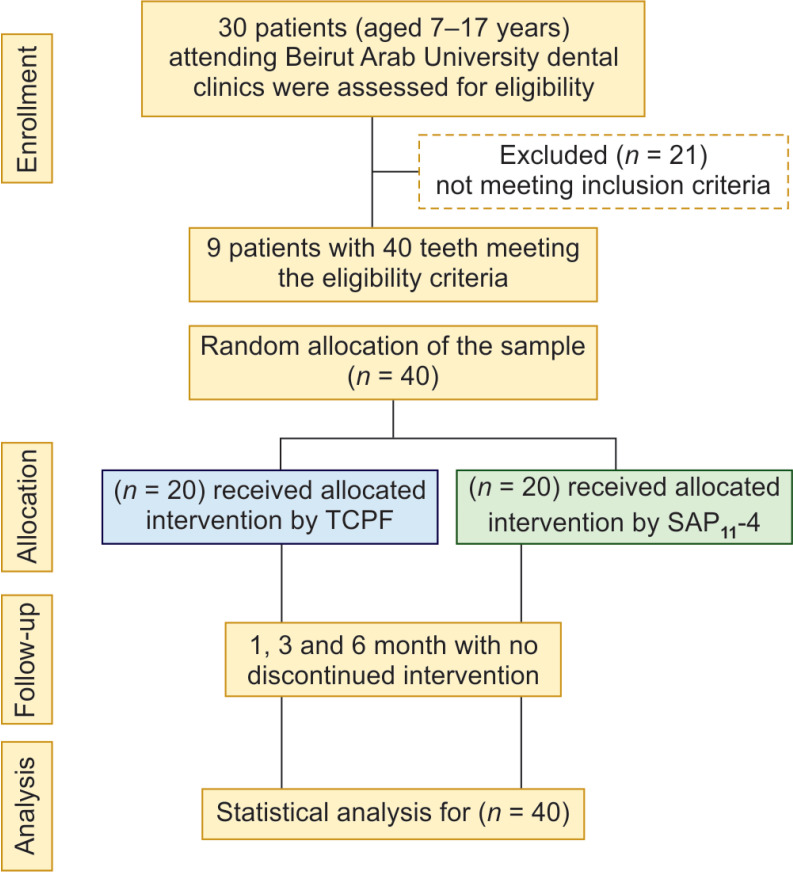
Nine healthy patients were enrolled in this study. The trial was performed on 40 young permanent teeth in the initial demineralization stage. Teeth were randomly assigned to receive either TCPF (group I) or SAP-4 (group II). Lesions were assessed at pretreatment, 3, and 6 months posttreatment quantitatively per laser fluorescence DIAGNOdent pen and qualitatively through the International Caries Detection and Assessment System (ICDAS) II.
The result of the current study revealed a significant quantitative and qualitative increase in remineralization of WSLs in both groups and over time intervals. However, the WSL recovery was significantly better in the self-assembling peptide group, reflecting an excellent remineralization potential of the WSLs by the SAP-4 compared to TCPF varnish.
Both TCPF and SAP-4 were effective in treating WSLs. However, the success of guided enamel regeneration by the SAP-4 through the biomineralization has proven superiority of this material compared to TCPF.
Early detection of WSLs and minimal intervention through remineralizing agents can limit unnecessary tissue loss, further caries progression, and consequently prevent further harm to the patients.
Kobeissi R, Badr SBY, Osman E. Effectiveness of Self-assembling Peptide P-4 Compared to Tricalcium Phosphate Fluoride Varnish in remineralization of White Spot Lesions: A Clinical Randomized Trial. Int J Clin Pediatr Dent 2020;13(5):451-456.
含治疗性磷酸三钙配方的氟化物漆,如Clinpro™ 漆,通过矿物交换抑制初始釉质病变的进展,在治疗白斑病变(WSL)方面显示出更大的倾向。自组装肽SAP-4(Curodont修复剂,CDR)通过模拟釉质基质并旨在引导釉质再生,在治疗WSL方面在不同层面发挥作用。
定量和定性比较SAP-4与磷酸三钙氟化物(TCPF)对年轻恒牙WSL再矿化的有效性。
9名健康患者参与本研究。对40颗处于初始脱矿阶段的年轻恒牙进行试验。牙齿被随机分配接受TCPF(第一组)或SAP-4(第二组)。在治疗前、治疗后3个月和6个月,使用激光荧光DIAGNOdent笔对病变进行定量评估,并通过国际龋病检测和评估系统(ICDAS)II进行定性评估。
本研究结果显示,两组WSL的再矿化在定量和定性方面均有显著增加,且随时间推移而增加。然而,自组装肽组的WSL恢复情况明显更好,这反映出与TCPF漆相比,SAP-4对WSL具有出色的再矿化潜力。
TCPF和SAP-4在治疗WSL方面均有效。然而,与TCPF相比已证明,SAP-4通过生物矿化引导釉质再生取得了成功,这种材料具有优越性。
早期发现WSL并通过再矿化剂进行最小干预,可以限制不必要的组织损失、龋齿的进一步进展,并因此防止对患者造成进一步伤害。
Kobeissi R, Badr SBY, Osman E. 自组装肽P-4与磷酸三钙氟化物漆在白斑病变再矿化中的有效性比较:一项临床随机试验。《国际临床儿科牙科学杂志》2020;13(5):451 - 456。