Ahmad Rani
King Abdulaziz University, King Abdulaziz University Hospital, Jeddah, Saudi Arabia.
Acta Radiol Open. 2021 Feb 9;10(2):2058460121990296. doi: 10.1177/2058460121990296. eCollection 2021 Feb.
The scope and productivity of artificial intelligence applications in health science and medicine, particularly in medical imaging, are rapidly progressing, with relatively recent developments in big data and deep learning and increasingly powerful computer algorithms. Accordingly, there are a number of opportunities and challenges for the radiological community.
To provide review on the challenges and barriers experienced in diagnostic radiology on the basis of the key clinical applications of machine learning techniques.
Studies published in 2010-2019 were selected that report on the efficacy of machine learning models. A single contingency table was selected for each study to report the highest accuracy of radiology professionals and machine learning algorithms, and a meta-analysis of studies was conducted based on contingency tables.
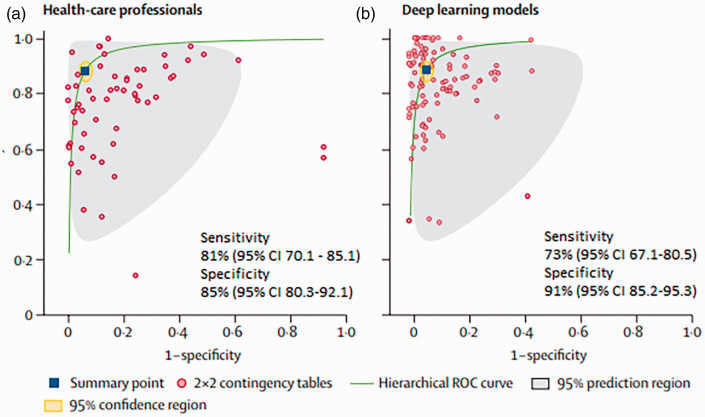
The specificity for all the deep learning models ranged from 39% to 100%, whereas sensitivity ranged from 85% to 100%. The pooled sensitivity and specificity were 89% and 85% for the deep learning algorithms for detecting abnormalities compared to 75% and 91% for radiology experts, respectively. The pooled specificity and sensitivity for comparison between radiology professionals and deep learning algorithms were 91% and 81% for deep learning models and 85% and 73% for radiology professionals (p < 0.000), respectively. The pooled sensitivity detection was 82% for health-care professionals and 83% for deep learning algorithms (p < 0.005).
Radiomic information extracted through machine learning programs form images that may not be discernible through visual examination, thus may improve the prognostic and diagnostic value of data sets.
人工智能在健康科学和医学领域,尤其是医学成像中的应用范围和生产力正在迅速发展,这得益于大数据和深度学习以及日益强大的计算机算法的最新进展。因此,放射学界面临着诸多机遇与挑战。
基于机器学习技术的关键临床应用,对诊断放射学中所经历的挑战和障碍进行综述。
选取2010 - 2019年发表的报告机器学习模型疗效的研究。为每项研究选择一个单一的列联表,以报告放射学专业人员和机器学习算法的最高准确率,并基于列联表对研究进行荟萃分析。
所有深度学习模型的特异性范围为39%至100%,而敏感性范围为85%至100%。与放射学专家分别为75%和91%相比,深度学习算法检测异常的合并敏感性和特异性分别为89%和85%。深度学习模型与放射学专业人员比较的合并特异性和敏感性分别为91%和81%,放射学专业人员分别为85%和73%(p < 0.000)。医疗保健专业人员的合并敏感性检测为82%,深度学习算法为83%(p < 0.005)。
通过机器学习程序从图像中提取的放射组学信息可能无法通过视觉检查辨别,从而可能提高数据集的预后和诊断价值。