Poverty, Health and Nutrition Division, International Food Policy Research Institute, Washington, District of Columbia, USA
Poverty, Health and Nutrition Division, International Food Policy Research Institute, Washington, District of Columbia, USA.
BMJ Glob Health. 2021 Feb;6(2). doi: 10.1136/bmjgh-2020-003717.
Existing health and community nutrition systems have the potential to deliver many nutrition interventions. However, the coverage of nutrition interventions across the delivery platforms of these systems has not been uniform. We (1) examined the opportunity gaps between delivery platforms and corresponding nutrition interventions through the continuum of care in India between 2006 and 2016 and and (2) assessed inequalities in these opportunity gaps.
We used two rounds of the National Family Health Survey data from 2005 to 2006 and 2015-2016 (n=36 850 and 190 898 mother-child dyads, respectively). We examine the opportunity gaps over time for seven nutrition interventions and their associated delivery platforms at national and state levels. We assessed equality and changes in equality between 2006 and 2016 for opportunity gaps by education, residence, socioeconomic status (SES), public and private platforms.
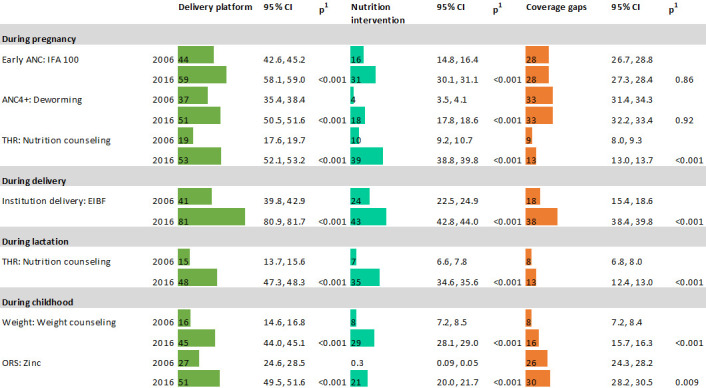
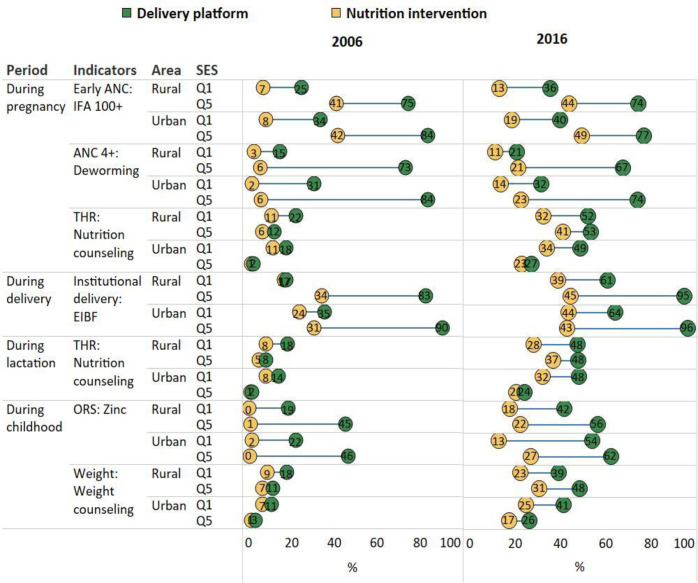
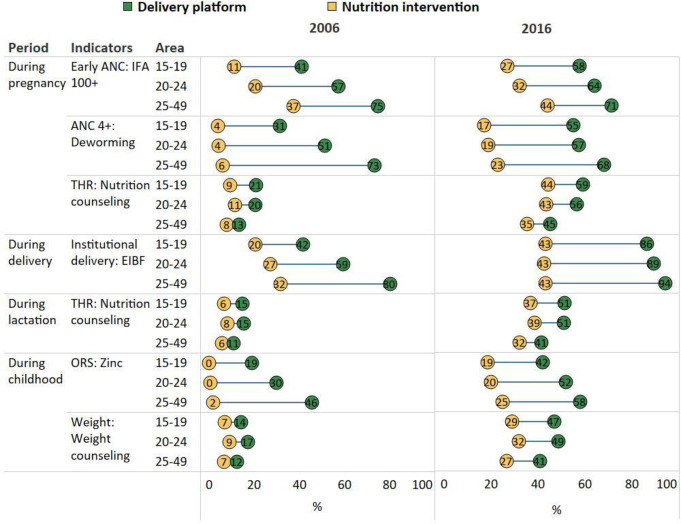
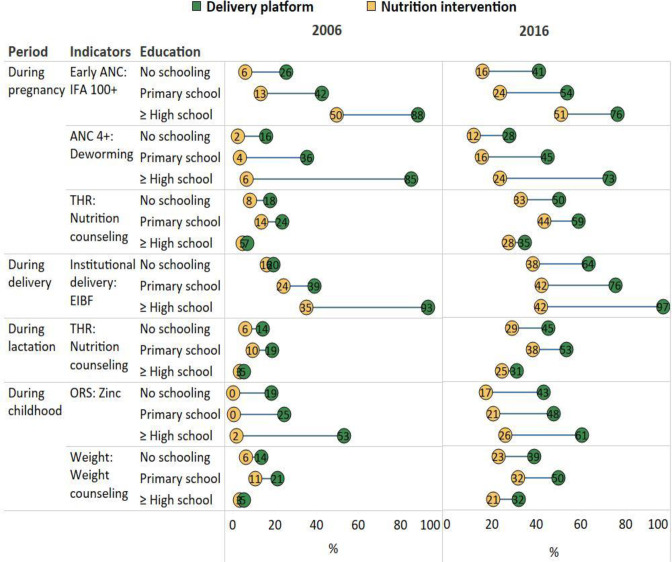
Coverage of nutrition interventions was consistently lower than the reach of their associated delivery platforms; opportunity gaps ranging from 9 to 32 percentage points (pp) during the pregnancy, 17 pp during delivery and 9-26 pp during childhood in 2006. Between 2006 and 2016, coverage improved for most indicators, but coverage increases for nutrition interventions was lower than for associated delivery platforms. The opportunity gaps were larger among women with higher education (22-57 pp in 2016), higher SES status and living in urban areas (23-57 pp), despite higher coverage of most interventions and the delivery platforms among these groups. Opportunity gaps vary tremendously by state with the highest gaps observed in Tripura, Andaman and Nicobar islands, and Punjab for different indicators.
India's progress in coverage of health and nutrition interventions in the last decade is promising, but both opportunity and equality gaps remained. It is critical to close these gaps by addressing policy and programmatic delivery systems bottlenecks to achieve universal coverage for both health and nutrition within the delivery system.
现有的卫生和社区营养系统有潜力实施多项营养干预措施。然而,这些系统的提供平台在营养干预措施的覆盖范围上并不均衡。我们(1)通过印度 2006 年至 2016 年期间的护理连续体,研究了各提供平台与相应营养干预措施之间的机会差距;(2)评估了这些机会差距的不平等程度。
我们使用两轮国家家庭健康调查数据,时间分别为 2005 年至 2006 年和 2015 年至 2016 年(分别为 36850 对和 190898 对母子对)。我们考察了在国家和邦两级,七种营养干预措施及其相关提供平台在不同时期的机会差距。我们评估了 2006 年至 2016 年期间,按教育程度、居住地点、社会经济地位(SES)、公立和私立平台划分的机会差距的平等程度和变化情况。
营养干预措施的覆盖率始终低于其相关提供平台的覆盖范围;在 2006 年怀孕期间的机会差距为 9%至 32%,分娩时为 17%,儿童期为 9%至 26%。在 2006 年至 2016 年期间,大多数指标的覆盖率都有所提高,但营养干预措施的覆盖率增加幅度低于相关提供平台。在受教育程度较高(2016 年为 22%至 57%)、SES 较高和居住在城市地区的妇女中(23%至 57%),机会差距较大,尽管这些群体中大多数干预措施和提供平台的覆盖率都较高。各州之间的机会差距差异巨大,不同指标的机会差距最大的州是特里普拉邦、安达曼和尼科巴群岛以及旁遮普邦。
印度在过去十年中在卫生和营养干预措施的覆盖率方面取得了进展,令人鼓舞,但机会差距和不平等差距仍然存在。通过解决政策和方案提供系统的瓶颈问题,为提供系统内的卫生和营养服务实现普遍覆盖,缩小这些差距至关重要。