Division of Maternal Fetal Medicine, Department of Gynecology and Obstetrics, Emory University School of Medicine, Atlanta, Georgia, USA.
Bill and Melinda Gates Foundation, Seattle, Washington, USA.
J Glob Health. 2020 Jun;10(1):010501. doi: 10.7189/jogh.10.010501.
Reductions in neonatal mortality remain stagnant, despite gains in health care access and utilization. Nutrition interventions during antenatal care (ANC) and in the immediate postpartum period are associated with improved neonatal outcomes. Adjusting coverage estimates for the quality of care provided yields greater insight into health system performance and potential population health benefits of accessing care. In this cross-sectional study, we adjust maternity care coverage measures for quality of nutrition interventions to determine the impact on infant birth weight and breastfeeding.
We used household data from the Malawi 2013-2014 Multiple Indicator Cluster Survey to assess use of maternal health services and direct observations of ANC and delivery from the 2013 Service Provision Assessment to measure nutrition interventions provided. We adjusted coverage measures combining self-reported utilization of care with the likelihood of receipt of nutrition interventions. Using adjusted log-linear regression, we estimated the associations of these nutrition quality-adjusted metrics with infant birthweight and immediate breastfeeding.
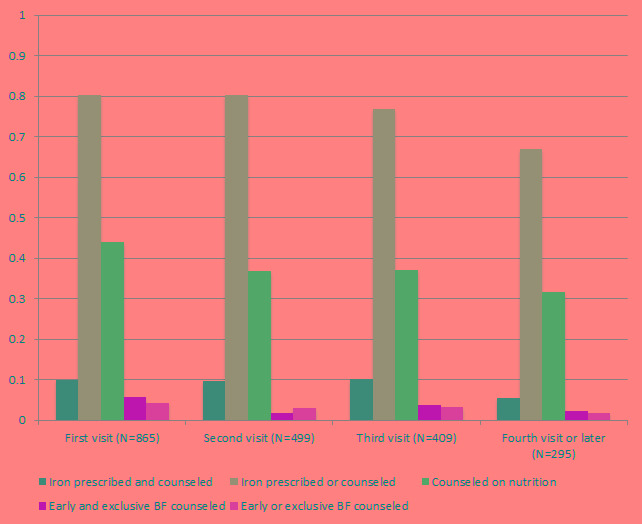
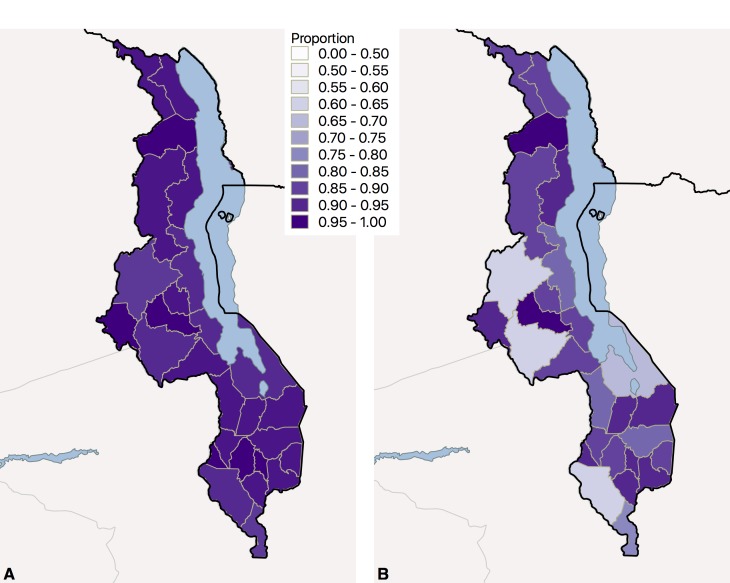
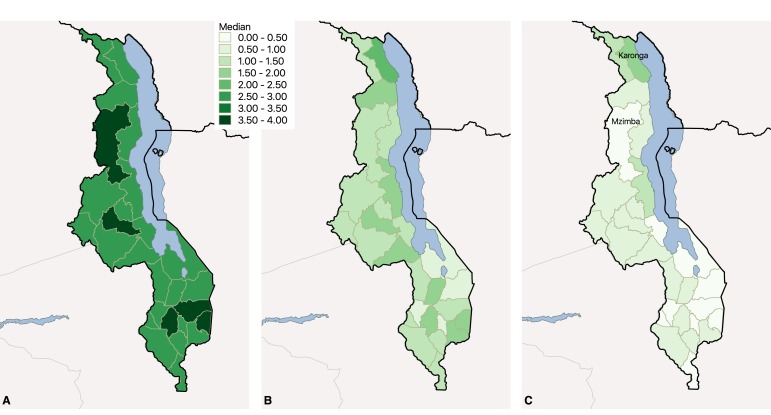
Health facility data provided over 2500 directly observed clinical encounters and household data provided 7385 individual reports of health care utilization and outcomes. Utilization of ANC and facility-delivery was high. Women received nutrition-related interventions considerably less often than they sought care: over the course of ANC women received a median of 1.6 interventions on iron, 1 instance of nutrition counseling, and 0.06 instances of breastfeeding counseling. Nutrition quality-adjusted ANC coverage was associated with a reduced risk of low birthweight (adjusted relative risk [ARR] 0.87, 95% confidence interval (CI) = 0.79, 0.96) and increased likelihood of immediate breastfeeding (ARR = 1.04, 95% CI = 1.02, 1.07); nutrition quality-adjusted post-delivery care was also associated with greater uptake of immediate breastfeeding (ARR = 1.08, 95% CI = 1.02, 1.14). Based on these models, delivering nutrition interventions consistently within the existing level of coverage would decrease population prevalence of low birthweight from 13.7% to 10.8% and increase population prevalence of immediate breastfeeding from 75.9% to 86.0%.
Linking household survey data to health service provision assessments demonstrates that despite high utilization of maternal health services in Malawi, low provision of nutrition interventions is undermining infant health. Substantial gains in newborn health are possible in Malawi if quality of existing services is strengthened.
尽管在获得医疗保健方面取得了进展,但新生儿死亡率仍停滞不前。产前护理(ANC)和产后立即进行的营养干预与改善新生儿结局有关。调整提供的护理质量覆盖估计数,可以更深入地了解卫生系统绩效以及获得护理的潜在人群健康益处。在这项横断面研究中,我们调整了产妇保健覆盖范围措施中的营养干预质量,以确定其对婴儿出生体重和母乳喂养的影响。
我们使用来自马拉维 2013-2014 年多指标类集调查的家庭数据,评估了产妇保健服务的使用情况,并通过 2013 年服务提供评估进行了 ANC 和分娩的直接观察,以衡量提供的营养干预措施。我们调整了覆盖范围措施,将自我报告的护理使用情况与获得营养干预的可能性结合起来。使用调整后的对数线性回归,我们估计了这些营养质量调整指标与婴儿出生体重和即时母乳喂养之间的关联。
卫生机构数据提供了 2500 多次直接观察到的临床接触,家庭数据提供了 7385 个个人报告的保健服务利用情况和结果。ANC 和医疗机构分娩的利用率很高。妇女接受营养相关干预的频率远低于她们寻求护理的频率:在 ANC 期间,妇女平均接受了 1.6 次铁干预、1 次营养咨询和 0.06 次母乳喂养咨询。营养质量调整后的 ANC 覆盖率与降低低出生体重的风险相关(调整后的相对风险 [ARR]0.87,95%置信区间 [CI]0.79,0.96),并增加了即时母乳喂养的可能性(ARR1.04,95%CI1.02,1.07);产后护理的营养质量调整后也与即时母乳喂养的接受度增加相关(ARR1.08,95%CI1.02,1.14)。根据这些模型,如果在现有覆盖率水平内持续提供营养干预措施,将使马拉维的低出生体重人口比例从 13.7%下降到 10.8%,并使即时母乳喂养的人口比例从 75.9%增加到 86.0%。
将家庭调查数据与卫生服务提供评估联系起来表明,尽管马拉维的产妇保健服务利用率很高,但营养干预措施的提供不足正在破坏婴儿的健康。如果加强现有服务的质量,马拉维的新生儿健康可以取得实质性的进展。