L'Espérance Audrey, O'Brien Nadia, Grégoire Alexandre, Abelson Julia, Canfield Carolyn, Del Grande Claudio, Dogba Maman Joyce, Fancott Carol, Levasseur Mary Anne, Loignon Christine, Majnemer Annette, Pomey Marie-Pascale, Rasiah Jananee, Salsberg Jon, Santana Maria, Tremblay Marie-Claude, Urquhart Robin, Boivin Antoine
Center of Excellence for Partnership with patients and the public, University of Montreal Hospital Research Center (CRCHUM), Montreal, Canada.
Canada Research Chair in Partnership with Patients and the Public, University of Montreal Hospital Research Center, Montreal, Canada.
Res Involv Engagem. 2021 Feb 25;7(1):10. doi: 10.1186/s40900-021-00255-4.
Patient and public engagement (PPE) in research is growing internationally, and with it, the interest for its evaluation. In Canada, the Strategy for Patient-Oriented Research has generated national momentum and opportunities for greater PPE in research and health-system transformation. As is the case with most countries, the Canadian research community lacks a common evaluation framework for PPE, thus limiting our capacity to ensure integrity between principles and practices, learn across projects, identify common areas for improvement, and assess the impacts of engagement.
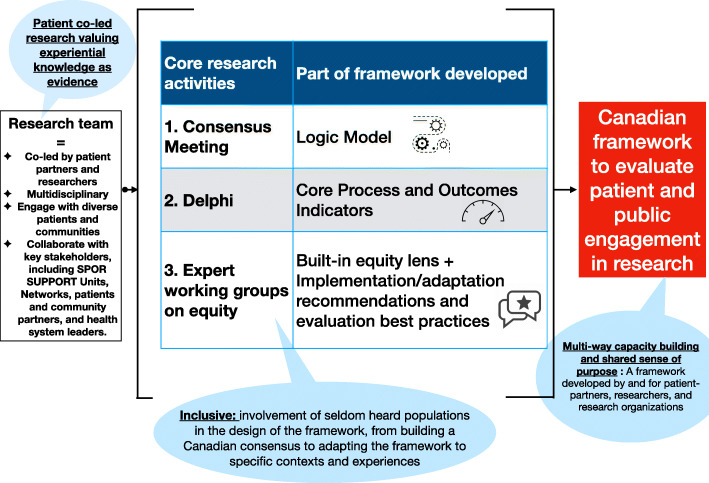
This project aims to build a national adaptable framework for the evaluation of PPE in research, by: 1. Building consensus on common evaluation criteria and indicators for PPE in research; 2. Defining recommendations to implement and adapt the framework to specific populations.
Using a collaborative action-research approach, a national coalition of patient-oriented research leaders, (patient and community partners, engagement practitioners, researchers and health system leaders) will co-design the evaluation framework. We will develop core evaluation domains of the logic model by conducting a series of virtual consensus meetings using a nominal group technique with 50 patient partners and engagement practitioners, identified through 18 national research organizations. We will then conduct two Delphi rounds to prioritize process and impact indicators with 200 participants purposely recruited to include respondents from seldom-heard groups. Six expert working groups will define recommendations to implement and adapt the framework to research with specific populations, including Indigenous communities, immigrants, people with intellectual and physical disabilities, caregivers, and people with low literacy. Each step of framework development will be guided by an equity, diversity and inclusion approach in an effort to ensure that the participants engaged, the content produced, and the adaptation strategies proposed are relevant to diverse PPE.
The potential contributions of this project are threefold: 1) support a national learning environment for engagement by offering a common blueprint for collaborative evaluation to the Canadian research community; 2) inform the international research community on potential (virtual) methodologies to build national consensus on common engagement evaluation frameworks; and 3) illustrate a shared attempt to engage patients and researchers in a strategic national initiative to strengthen evaluation capacity for PPE.
患者及公众参与研究(PPE)在国际上日益普遍,随之而来的是对其进行评估的兴趣。在加拿大,以患者为导向的研究战略为研究及卫生系统转型中更大程度的患者及公众参与创造了全国性的动力和机遇。与大多数国家一样,加拿大研究界缺乏一个用于患者及公众参与的通用评估框架,因此限制了我们确保原则与实践之间的一致性、跨项目学习、确定共同改进领域以及评估参与影响的能力。
本项目旨在构建一个全国性的、可适应的研究中患者及公众参与评估框架,具体方式如下:1. 就研究中患者及公众参与的通用评估标准和指标达成共识;2. 确定实施该框架并使其适应特定人群的建议。
采用合作行动研究方法,由以患者为导向的研究领导者组成的全国联盟(患者和社区伙伴、参与从业者、研究人员和卫生系统领导者)将共同设计评估框架。我们将通过与50名患者伙伴和参与从业者进行一系列虚拟共识会议,采用名义群体技术,开发逻辑模型的核心评估领域,这50名人员是通过18个全国性研究组织确定的。然后,我们将进行两轮德尔菲法,对过程和影响指标进行优先排序,特意招募200名参与者,包括来自很少被倾听群体的受访者。六个专家工作组将确定实施该框架并使其适应针对特定人群(包括原住民社区、移民、智力和身体残疾者、护理人员以及低识字率人群)的研究的建议。框架开发的每一步都将以公平、多样性和包容性方法为指导,以确保参与的人员、产生的内容以及提出的适应策略与多样化的患者及公众参与相关。
本项目的潜在贡献有三个方面:1)通过为加拿大研究界提供合作评估的通用蓝图,支持全国性的参与学习环境;2)向国际研究界介绍在通用参与评估框架上建立全国共识的潜在(虚拟)方法;3)展示让患者和研究人员参与一项战略性国家倡议以加强患者及公众参与评估能力的共同尝试。