Chudyk Anna Maria, Kullman Sasha, Pool Donna, Duhamel Todd Ashley, Ashe Maureen, Strachan Shaelyn
College of Pharmacy, Rady Faculty of Health Sciences, University of Manitoba, Winnipeg, MB, Canada.
Faculty of Kinesiology and Recreation Management, University of Manitoba, Winnipeg, MB, Canada.
Res Involv Engagem. 2024 May 1;10(1):42. doi: 10.1186/s40900-024-00577-z.
Participatory research approaches systematically integrate the perspectives of individuals, organizations, or communities that have a direct interest in a study's processes and outcomes (i.e., stakeholders) in research design and implementation. This supports interventions that are developed "by, not for" end-users, thereby increasing acceptability, uptake, and adherence. However, participatory approaches are relatively under-utilized in intervention development and behavioral change intervention research, in part, due to inadequate reporting of methodology. Therefore, to improve transparency in planning and reporting, we (a) describe how we engaged patients and community organizations (i.e., patient and community partners) in grant development for a self-compassion and physical activity behaviour change intervention for women with cardiovascular risk factors and (b) present a protocol for engaging patient and community partners in the optimization and implementation of the intervention moving forward.
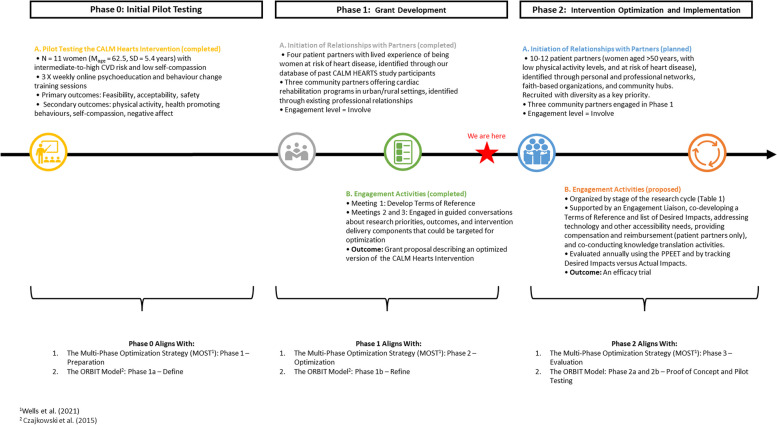
Our participatory research approach was guided by the Strategy for Patient-Oriented Research patient engagement framework and our prior stakeholder engagement work. Four patients and three community partners were engaged at the level of Involve, meaning their perspectives informed directions, processes, and decisions at major project milestones. Specifically, patient and community partners engaged in three separate meetings during grant development wherein they: (a) established a Terms of Reference to guide engagement activities and expectations; (b) shaped the grant through guided conversations about research priorities, outcomes, and intervention delivery components that could be targeted for optimization and (c) co-developed a protocol that specifies how relationships will be initiated with future patient partners, proposes engagement activities across the research cycle, and includes plans for formal evaluation of engagement processes.
Participatory research approaches provide valuable insights into the development of behavioural interventions, especially when stakeholders can partner early and have a meaningful impact. By detailing our engagement activities to date, we hope to model an approach to engaging stakeholders in behavioral intervention development and demonstrate the impacts of doing so.
参与式研究方法系统地整合了对研究过程和结果有直接兴趣的个人、组织或社区(即利益相关者)的观点,用于研究设计和实施。这有助于开发“由最终用户而非为最终用户”设计的干预措施,从而提高可接受性、采用率和依从性。然而,参与式方法在干预开发和行为改变干预研究中相对未得到充分利用,部分原因是方法报告不足。因此,为了提高规划和报告的透明度,我们(a)描述了我们如何让患者和社区组织(即患者和社区合作伙伴)参与为有心血管危险因素的女性开展的自我同情和身体活动行为改变干预的拨款申请开发过程,以及(b)提出了一项让患者和社区合作伙伴参与干预措施优化和实施的方案。
我们的参与式研究方法以患者导向研究患者参与框架和我们之前的利益相关者参与工作为指导。四名患者和三名社区合作伙伴参与到“参与”层面,这意味着他们的观点为主要项目里程碑的方向、过程和决策提供了参考。具体而言,患者和社区合作伙伴在拨款申请开发过程中参加了三次单独会议,在会议中他们:(a)制定了一份职权范围,以指导参与活动和预期;(b)通过关于研究重点、结果以及可针对优化的干预实施组成部分的引导性对话来塑造拨款申请;(c)共同制定了一项方案,该方案规定了如何与未来的患者合作伙伴建立关系,提出了整个研究周期的参与活动,并包括对参与过程进行正式评估的计划。
参与式研究方法为行为干预的开发提供了有价值的见解,特别是当利益相关者能够早期参与并产生有意义的影响时。通过详细介绍我们迄今为止的参与活动,我们希望为利益相关者参与行为干预开发树立一个榜样,并展示这样做的影响。