Department of Internal Medicine, Seoul National University Hospital, 101 Daehak-ro, Jongno-gu, Seoul, 03080, Republic of Korea.
Graduate School of Medical Science and Engineering, Korea Advanced Institute of Science and Technology, Daejeon, Republic of Korea.
Sci Rep. 2021 Feb 25;11(1):4676. doi: 10.1038/s41598-021-84307-5.
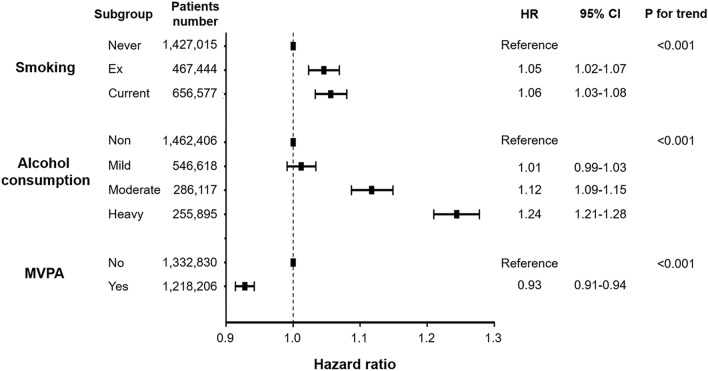
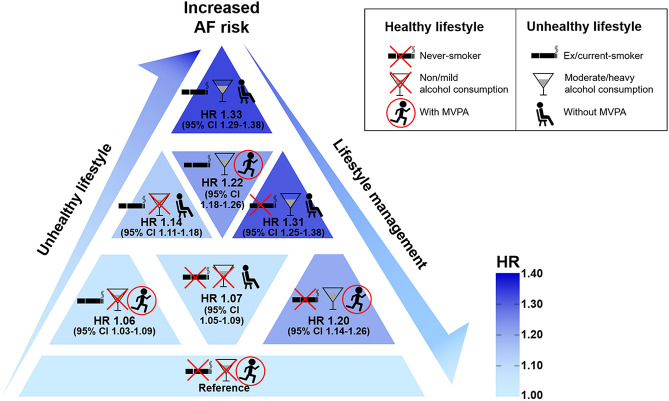
We evaluated the impacts of lifestyle behaviors, namely smoking, alcohol consumption, and physical activity, on the development of new-onset AF in patients with DM. Using the Korean Nationwide database, we identified subjects diagnosed with type 2 DM and without previous history of AF between 2009 and 2012. Self-reported lifestyle behaviors were analyzed. Among 2,551,036 included subjects, AF was newly diagnosed in 73,988 patients (median follow-up 7.1 years). Both ex-smokers (hazard ratio [HR] 1.05, 95% confidence interval [CI] 1.02-1.07) and current smokers (HR 1.06, 95% CI 1.03-1.08) demonstrated a higher risk of AF than never smokers. Patients with moderate (15-29 g/day) (HR 1.12, 95% CI 1.09-1.15) and heavy (≥ 30 g/day) (HR 1.24, 95% CI 1.21-1.28) alcohol consumption exhibited an increased risk of AF, while subjects with mild alcohol consumption (< 15 g/day) (HR 1.01, 95% CI 0.99-1.03) had an AF risk similar to that of non-drinkers. Patients who engaged in moderate-to-vigorous physical activity showed a lower risk of AF (HR 0.93, 95% CI 0.91-0.94) than those who did not. This study suggests that smoking, alcohol consumption, and physical activity are associated with new-onset AF in patients with DM, and lifestyle management might reduce the risk of AF in this population.
我们评估了生活方式行为,即吸烟、饮酒和体力活动,对糖尿病患者新发房颤的影响。我们使用韩国全国数据库,确定了 2009 年至 2012 年间诊断为 2 型糖尿病且无房颤既往史的患者。分析了自我报告的生活方式行为。在纳入的 2551036 名患者中,有 73988 名患者新诊断为房颤(中位随访 7.1 年)。与从不吸烟者相比,既往吸烟者(风险比 [HR] 1.05,95%置信区间 [CI] 1.02-1.07)和当前吸烟者(HR 1.06,95% CI 1.03-1.08)发生房颤的风险更高。中量(15-29g/天)(HR 1.12,95% CI 1.09-1.15)和大量(≥30g/天)(HR 1.24,95% CI 1.21-1.28)饮酒者发生房颤的风险增加,而轻度饮酒者(<15g/天)(HR 1.01,95% CI 0.99-1.03)发生房颤的风险与不饮酒者相似。进行中等到剧烈体力活动的患者发生房颤的风险较低(HR 0.93,95% CI 0.91-0.94)。本研究表明,吸烟、饮酒和体力活动与糖尿病患者新发房颤相关,生活方式管理可能降低该人群房颤风险。