Nikon Imaging Center, University of Heidelberg, Heidelberg, 69120, Germany.
Centre for Molecular and Cellular Imaging, EMBL, Heidelberg, 69117, Germany.
F1000Res. 2020 Dec 21;9:1494. doi: 10.12688/f1000research.27171.1. eCollection 2020.
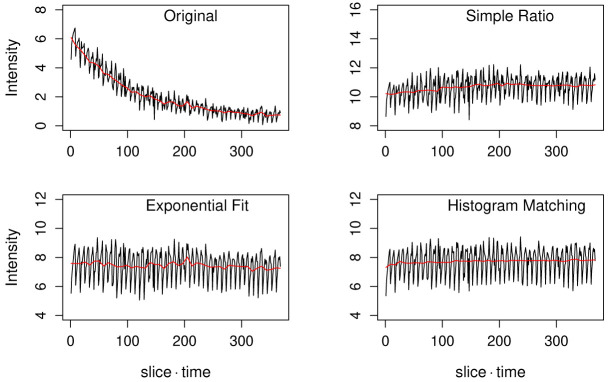
During the capturing of the time-lapse sequence of fluorescently labeled samples, fluorescence intensity exhibits decays. This phenomenon is known as 'photobleaching' and is a widely known problem in imaging in life sciences. The photobleaching can be attenuated by tuning the imaging set-up, but when such adjustments only partially work, the image sequence can be corrected for the loss of intensity in order to precisely segment the target structure or to quantify true intensity dynamics. We implemented an ImageJ plugin that allows the user to compensate for the photobleaching to estimate the non-bleaching condition with choice of three different algorithms: simple ratio, exponential fitting, and histogram matching methods. The histogram matching method is a novel algorithm for photobleaching correction. This article presents details and characteristics of each algorithm based on application to actual image sequences.
在拍摄荧光标记样本的延时序列时,荧光强度会衰减。这种现象被称为“光漂白”,是生命科学成像中一个广为人知的问题。通过调整成像设置可以减轻光漂白,但当这种调整只能部分起作用时,可以对图像序列进行校正以补偿强度损失,从而精确分割目标结构或量化真实强度动态。我们实现了一个 ImageJ 插件,允许用户补偿光漂白,以选择三种不同算法之一来估计非漂白条件:简单比率、指数拟合和直方图匹配方法。直方图匹配方法是一种用于光漂白校正的新算法。本文根据实际图像序列的应用介绍了每种算法的细节和特点。