Clinical Department of Laboratory Medicine and National Reference Center for Respiratory Pathogens, University Hospitals Leuven, Leuven, Belgium.
Clinical Department of Laboratory Medicine, Ghent University Hospital, Ghent, Belgium.
J Clin Virol. 2021 Mar;136:104765. doi: 10.1016/j.jcv.2021.104765. Epub 2021 Feb 18.
Most SARS-CoV-2 infected patients develop IgG antibodies within 2-3 weeks after symptom onset. Antibody levels have been shown to gradually decrease in the first months after infection, but few data are available at six months or later.
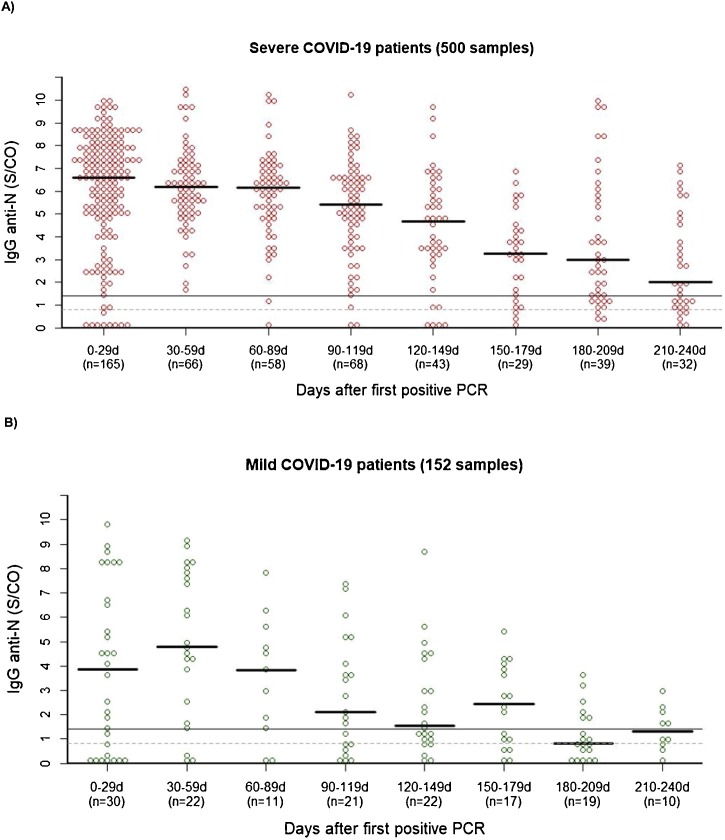
A retrospective multi-center study was performed using 652 samples of 236 PCR-confirmed SARS-CoV-2 infected patients from 2 Belgian University hospitals. Patients were included if at least two samples were available (range 2-7 samples); including at least one sample collected 30 days or later after first positive PCR (range 0-240 days). Of those 236 patients, 19.1 % were classified as mild/asymptomatic (mild) and 80.9 % as moderate to critical (severe). IgG anti-nucleocapsid antibodies (anti-N) were measured using the Abbott Architect immunoassay.
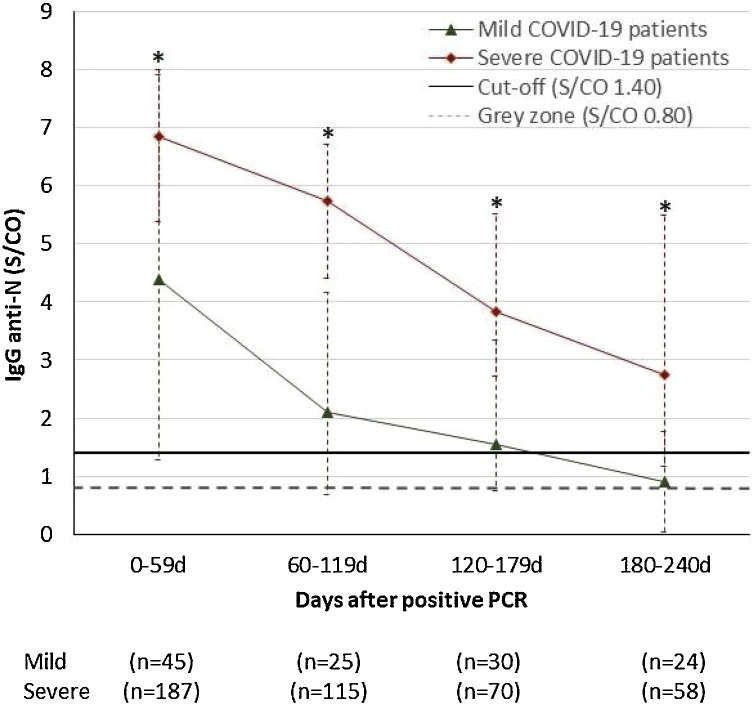
22.2 % of mild and 2.6 % of severe COVID-19 cases never seroconverted (p < 0.001). Of the mild patients who seroconverted 0-59 days after PCR; 18.8 %, 40.0 % and 61.1 % were seronegative in the windows 60-119 days, 120-179 days and 180-240 days after PCR, respectively. In severe patients, these numbers were 1.9 %, 10.8 % and 29.4 % respectively (p < 0.05 each). Antibody levels were significantly higher in severe patients compared to mild patients in each 60 day window (p < 0.001 each).
SARS-CoV-2 anti-N IgG antibody levels steadily decreased after 2 months up to 8 months post PCR. Of severe COVID-19 patients, 70.6 % remained positive up to eight months after infection. Antibody levels were significantly lower in mild SARS-CoV-2 infected patients and 61.1 % became seronegative within 6 months after the first positive PCR.
大多数 SARS-CoV-2 感染患者在症状出现后 2-3 周内会产生 IgG 抗体。感染后,抗体水平在最初几个月逐渐下降,但六个月或更长时间后的数据很少。
采用回顾性多中心研究,对来自比利时两所大学医院的 236 例经 PCR 确诊的 SARS-CoV-2 感染患者的 652 份样本进行分析。如果至少有两份样本可供使用(范围 2-7 份);包括至少一份在首次阳性 PCR 后 30 天或更长时间采集的样本(范围 0-240 天),则将患者纳入研究。在这 236 例患者中,19.1%为轻症/无症状(轻症),80.9%为中至重症(重症)。使用 Abbott Architect 免疫分析法检测 IgG 抗核衣壳抗体(抗-N)。
22.2%的轻症和 2.6%的重症 COVID-19 患者从未出现血清转化(p<0.001)。在 PCR 后 0-59 天血清转化的轻症患者中,分别有 18.8%、40.0%和 61.1%在 PCR 后 60-119 天、120-179 天和 180-240 天的窗口期内为阴性。在重症患者中,这些数字分别为 1.9%、10.8%和 29.4%(p<0.05 各)。在每个 60 天的窗口期内,重症患者的抗体水平均显著高于轻症患者(p<0.001 各)。
在 PCR 后 2 个月至 8 个月,SARS-CoV-2 抗-N IgG 抗体水平稳步下降。在重症 COVID-19 患者中,70.6%的患者在感染后 8 个月仍为阳性。轻症 SARS-CoV-2 感染患者的抗体水平显著较低,并且在首次阳性 PCR 后 6 个月内有 61.1%的患者转为阴性。