Valadão Pedro, Piitulainen Harri, Haapala Eero A, Parviainen Tiina, Avela Janne, Finni Taija
Neuromuscular Research Center, Faculty of Sport and Health Sciences, University of Jyväskylä, Jyväskylä, Finland.
Department of Neuroscience and Biomedical Engineering, Aalto University, Espoo, Finland.
BMC Sports Sci Med Rehabil. 2021 Feb 26;13(1):17. doi: 10.1186/s13102-021-00242-y.
Individuals with cerebral palsy (CP) have problems in everyday tasks such as walking and climbing stairs due to a combination of neuromuscular impairments such as spasticity, muscle weakness, reduced joint flexibility and poor coordination. Development of evidence-based interventions are in pivotal role in the development of better targeted rehabilitation of CP, and thus in maintaining their motor function and wellbeing. Our aim is to investigate the efficacy of an individually tailored, multifaceted exercise intervention (EXECP) in children and young adults with CP. EXECP is composed of strength, flexibility and gait training. Furthermore, this study aims to verify the short-term retention of the adaptations three months after the end of the EXECP intervention.
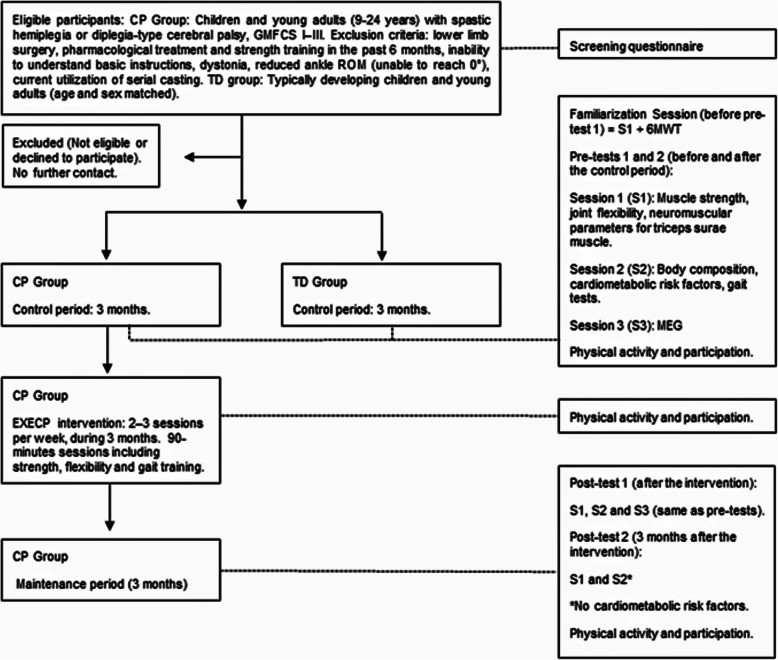
Twenty-four children and young adults with spastic CP will be recruited to participate in a 9-month research project with a 3-month training intervention, consisting of two to three 90-min sessions per week. In each session, strength training for the lower limbs and trunk muscles, flexibility training for the lower limbs and inclined treadmill gait training will be performed. We will evaluate muscle strength, joint flexibility, neuromuscular and cardiometabolic parameters. A nonconcurrent multiple baseline design with two pre-tests and two post-tests all interspaced by three months is used. In addition to the CP participants, 24 typically developing age and sex-matched participants will perform the two pre-tests (i.e. no intervention) to provide normative data.
This study has a comprehensive approach examining longitudinal effects of wide variety of variables ranging from physical activity and gross motor function to sensorimotor functions of the brain and neuromuscular and cardiometabolic parameters, providing novel information about the adaptation mechanisms in cerebral palsy. To the best of our knowledge, this is the first intervention study providing supervised combined strength, flexibility and gait training for young individuals with CP.
ISRCTN69044459, prospectively registered (21/04/2017).
由于痉挛、肌肉无力、关节灵活性降低和协调性差等多种神经肌肉损伤的综合作用,脑瘫(CP)患者在诸如行走和爬楼梯等日常活动中存在困难。基于证据的干预措施的开发在脑瘫更有针对性的康复发展中起着关键作用,从而有助于维持他们的运动功能和健康状况。我们的目的是研究针对脑瘫儿童和青年的个性化多方面运动干预(EXECP)的效果。EXECP包括力量、灵活性和步态训练。此外,本研究旨在验证EXECP干预结束三个月后这些适应性变化的短期保持情况。
将招募24名痉挛型脑瘫儿童和青年参加一个为期9个月的研究项目,其中包括为期3个月的训练干预,每周进行两到三次90分钟的训练课程。在每次训练中,将进行下肢和躯干肌肉的力量训练、下肢的灵活性训练以及倾斜跑步机步态训练。我们将评估肌肉力量、关节灵活性、神经肌肉和心脏代谢参数。采用非同期多重基线设计,进行两次预测试和两次后测试,每次测试间隔三个月。除了脑瘫参与者外,24名年龄和性别匹配的发育正常的参与者将进行两次预测试(即不进行干预)以提供标准数据。
本研究采用综合方法,研究从身体活动和粗大运动功能到大脑感觉运动功能以及神经肌肉和心脏代谢参数等各种变量的纵向影响,提供有关脑瘫适应机制的新信息。据我们所知,这是第一项为患有脑瘫的年轻人提供有监督的综合力量、灵活性和步态训练的干预研究。
ISRCTN69044459,前瞻性注册(2017年4月21日)。