First Affiliated Hospital, Sun Yat-sen University, Guangzhou, China.
First Affiliated Hospital, Sun Yat-sen University, Guangzhou, China
BMJ Open. 2021 Feb 26;11(2):e043935. doi: 10.1136/bmjopen-2020-043935.
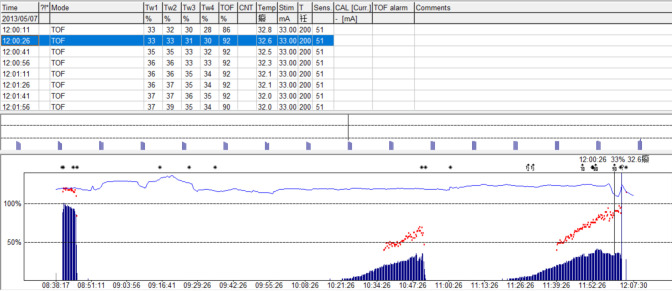
Despite the use of quantitative neuromuscular monitoring together with the administration of reversal drugs (neostigmine or sugammadex), the incidence of residual neuromuscular blockade defined as a train-of-four ratio (TOFr) <0.9 remains high. Even TOFr >0.9 cannot ensure adequate recovery of neuromuscular function when T1 height is not recovered completely. Thus, a mathematical correction of TOFr needs to be applied because the return of a normal TOFr can precede the return of a normal T1 twitch height. On the other hand, different muscles have different sensitivities to neuromuscular blockade agents; thus, complete recovery of one specific muscle group does not represent complete recovery of all other muscles. Therefore, our study aims to assess the muscle strength recovery of respiratory-related muscle groups by ultrasound and evaluate global strength using handgrip dynamometry in the early postoperative period when TOFr=0.9 and corrected TOFr (cTOFr)=0.9 with comparison of neostigmine versus sugammadex as reversal drugs.
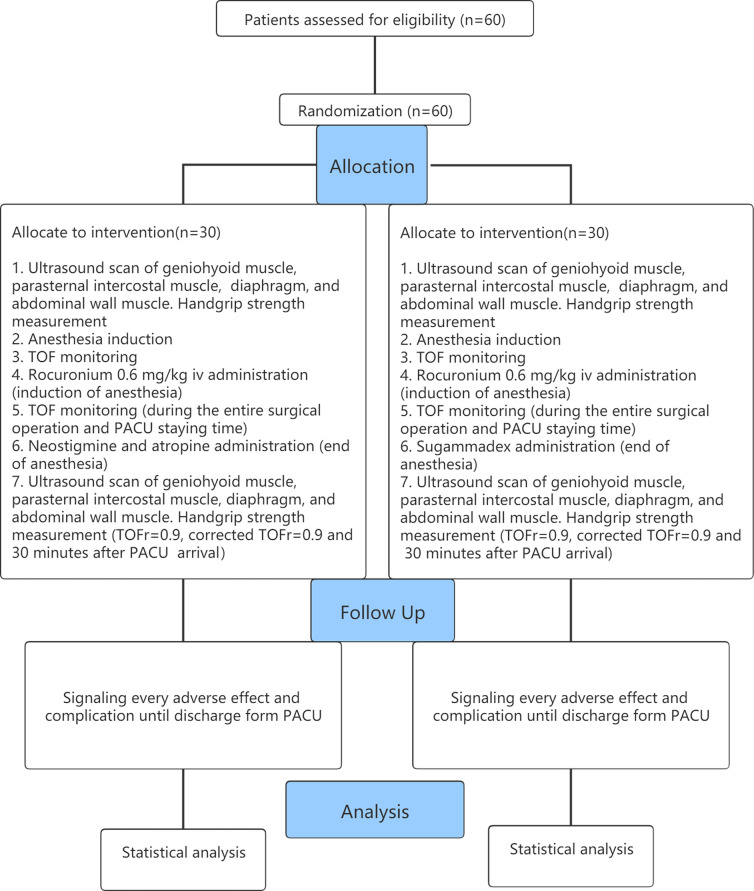
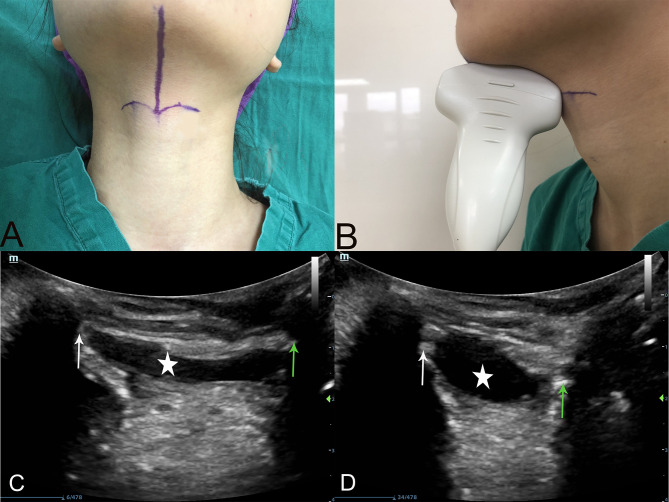
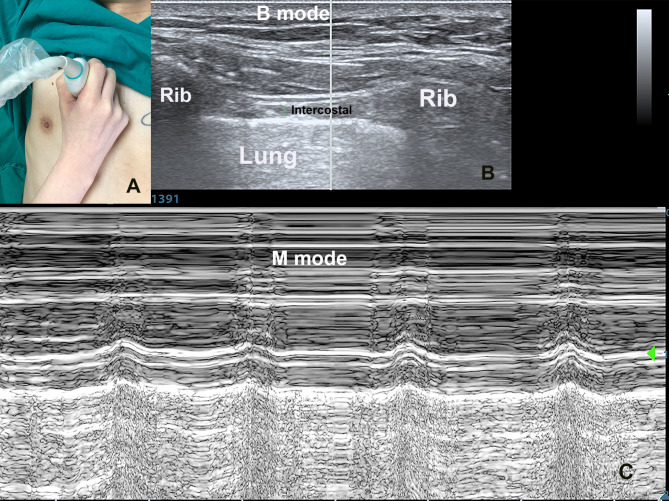
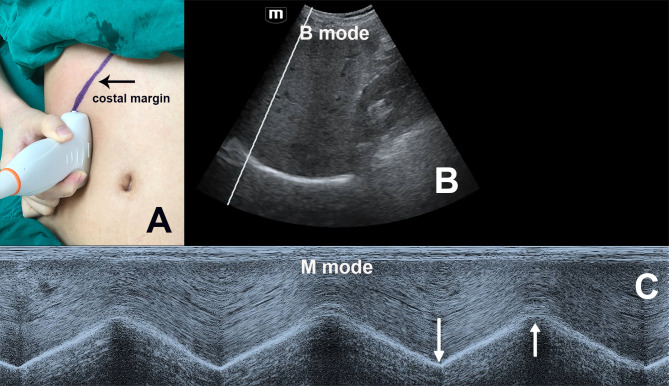
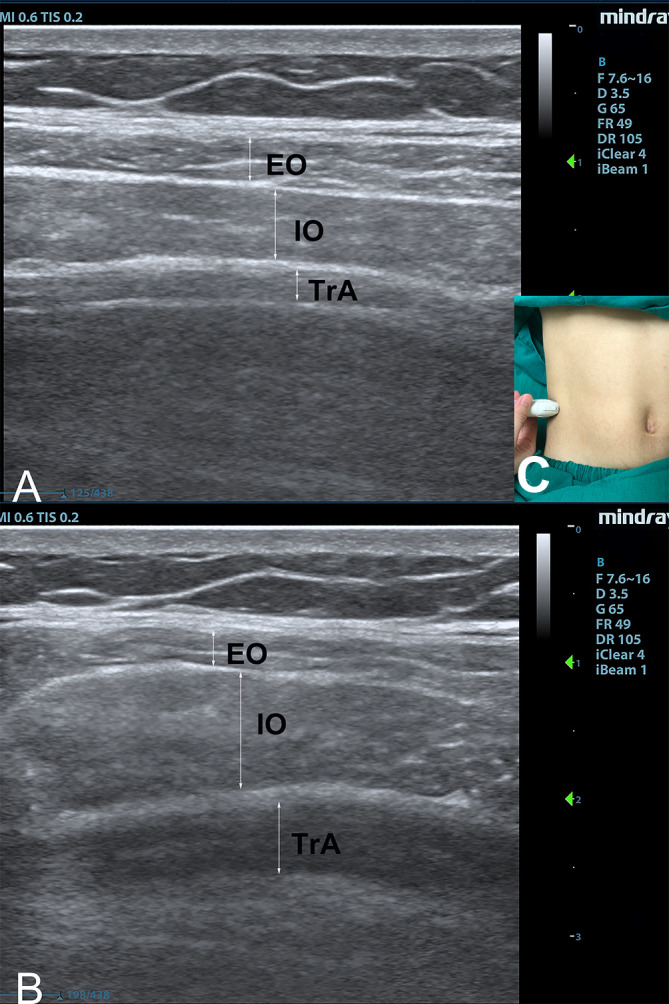
This study will be a prospective, single-blinded, randomised controlled trial involving 60 patients with American Society of Anesthesiologists physical status I-II and aged between 18 and 65 years, who will undergo microlaryngeal surgery. We will assess geniohyoid muscle, parasternal intercostal muscle, diaphragm, abdominal wall muscle and handgrip strength at four time points: before anaesthesia, TOFr=0.9, cTOFr=0.9 and 30 min after admission to the post anaesthesia care unit. Our primary objective will be to compare the effects of neostigmine and sugammadex on the recovery of muscle strength of different muscle groups in the early postoperative period when TOFr=0.9 and cTOFr=0.9. The secondary objective will be to observe the difference of muscle strength between the time points of TOFr=0.9 and cTOFr=0.9 to find out the clinical significance of cTOFr >0.9.
The protocol was reviewed and approved by the Ethics Committee of The First Affiliated Hospital, Sun Yat-sen University. The findings will be disseminated to the public through peer-reviewed scientific journals.
ChiCTR2000033832.
尽管使用定量神经肌肉监测并给予逆转药物(新斯的明或琥珀酰明碱),但仍有很高的残余神经肌肉阻滞发生率,定义为四个成串刺激(TOFr)<0.9。即使 TOFr>0.9,当 T1 高度未完全恢复时,也不能确保神经肌肉功能完全恢复。因此,需要对 TOFr 进行数学校正,因为正常 TOFr 的恢复可能先于正常 T1 搐搦高度的恢复。另一方面,不同的肌肉对神经肌肉阻滞药物的敏感性不同;因此,特定肌肉群的完全恢复并不代表所有其他肌肉的完全恢复。因此,我们的研究旨在通过超声评估与呼吸相关的肌肉群的肌力恢复情况,并在手握力计评估术后早期 TOFr=0.9 和校正 TOFr(cTOFr)=0.9 时的整体肌力,比较新斯的明与琥珀酰明碱作为逆转药物。
这是一项前瞻性、单盲、随机对照试验,涉及 60 名美国麻醉医师协会身体状况 I-II 级和年龄在 18 至 65 岁之间的患者,他们将接受显微喉镜手术。我们将在四个时间点评估颏舌骨肌、胸骨旁肋间肌、膈肌、腹壁肌和握力:麻醉前、TOFr=0.9、cTOFr=0.9 和进入麻醉后恢复室后 30 分钟。我们的主要目的是比较新斯的明和琥珀酰明碱对术后早期 TOFr=0.9 和 cTOFr=0.9 时不同肌肉群肌力恢复的影响。次要目的是观察 TOFr=0.9 和 cTOFr=0.9 时间点之间肌力的差异,以找出 cTOFr>0.9 的临床意义。
方案经中山大学附属第一医院伦理委员会审查和批准。研究结果将通过同行评议的科学期刊向公众传播。
ChiCTR2000033832。