Institute for Macromolecular Chemistry, University of Freiburg, Freiburg, Germany.
Freiburg Materials Research Center, University of Freiburg, Freiburg, Germany.
Nat Commun. 2021 Feb 26;12(1):1312. doi: 10.1038/s41467-021-21599-1.
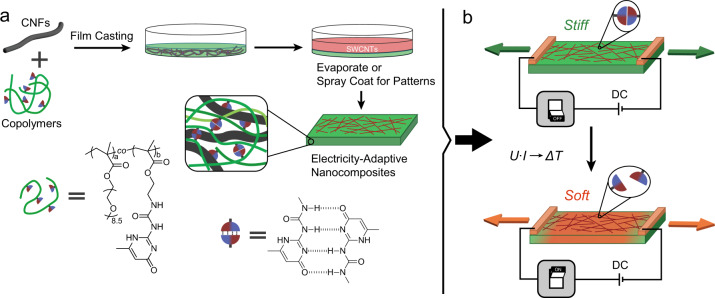
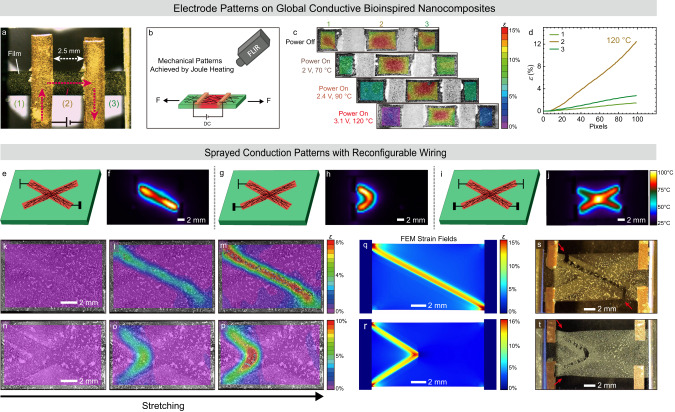
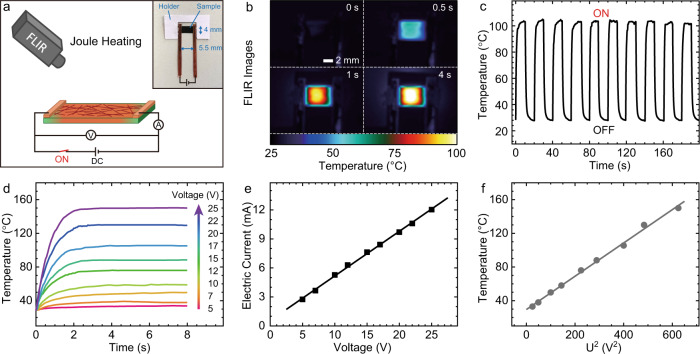
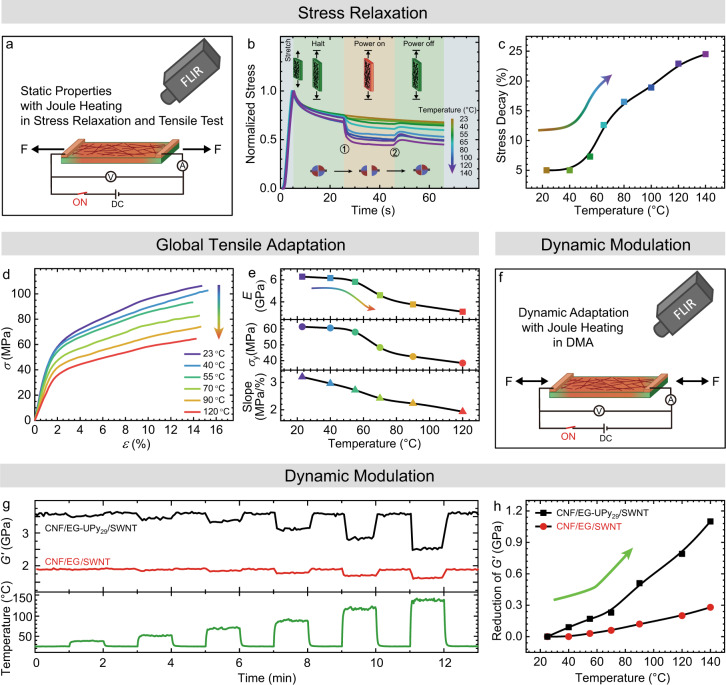
Nature fascinates with living organisms showing mechanically adaptive behavior. In contrast to gels or elastomers, it is profoundly challenging to switch mechanical properties in stiff bioinspired nanocomposites as they contain high fractions of immobile reinforcements. Here, we introduce facile electrical switching to the field of bioinspired nanocomposites, and show how the mechanical properties adapt to low direct current (DC). This is realized for renewable cellulose nanofibrils/polymer nanopapers with tailor-made interactions by deposition of thin single-walled carbon nanotube electrode layers for Joule heating. Application of DC at specific voltages translates into significant electrothermal softening via dynamization and breakage of the thermo-reversible supramolecular bonds. The altered mechanical properties are reversibly switchable in power on/power off cycles. Furthermore, we showcase electricity-adaptive patterns and reconfiguration of deformation patterns using electrode patterning techniques. The simple and generic approach opens avenues for bioinspired nanocomposites for facile application in adaptive damping and structural materials, and soft robotics.
自然界中的生物体表现出机械适应性行为,这令人着迷。与凝胶或弹性体不同,在含有高比例不可移动增强材料的刚性仿生纳米复合材料中,机械性能的切换极具挑战性。在这里,我们将简便的电切换引入仿生纳米复合材料领域,并展示了机械性能如何适应低直流(DC)。这是通过沉积薄的单壁碳纳米管电极层来实现的,用于焦耳加热,从而为可再生纤维素纳米纤维/聚合物纳米纸实现了定制的相互作用。在特定电压下施加直流会导致热可逆超分子键的动态化和断裂,从而产生显著的电热软化。机械性能的改变可以在电源开/关循环中可逆切换。此外,我们还展示了使用电极图案化技术的自适应图案和变形模式的重新配置。这种简单而通用的方法为仿生纳米复合材料在自适应阻尼和结构材料以及软机器人领域的简便应用开辟了道路。