Department of Radiology, Ankara City Hospital, Turkey.
Department of Emergency Medicine, Ankara City Hospital, Turkey.
Saudi J Gastroenterol. 2021 Mar-Apr;27(2):105-110. doi: 10.4103/sjg.sjg_540_20.
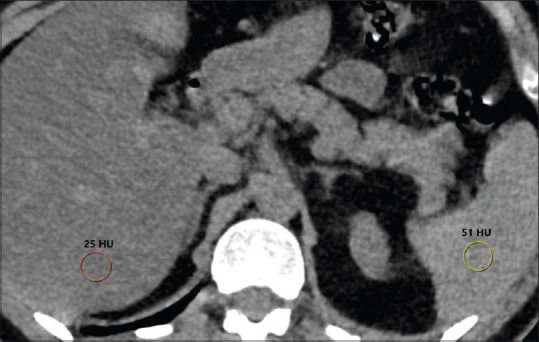
The objective of our study was to investigate the location, extension and type of novel coronavirus-induced disease 2019 (COVID-19) infection involvement and hepatic steatosis on initial chest computed tomography (CT). The relationship between fatty liver and severity of the disease was also investigated by measuring the liver attenuation index (LAI).
This study evaluated the chest CT images of 343 patients (201 male, mean age 48.43 years) who were confirmed to have COVID-19, using nasopharyngeal swab. The chest CTs were analyzed for laterality, number of involved lobes, diffuseness, number of lesions, and lesion types. The CT attenuation values of liver and spleen were measured, and LAI was calculated for the detection of hepatic steatosis. Univariate and multivariate logistic regression analysis were used to identify the independent early predictors for severe COVID-19.
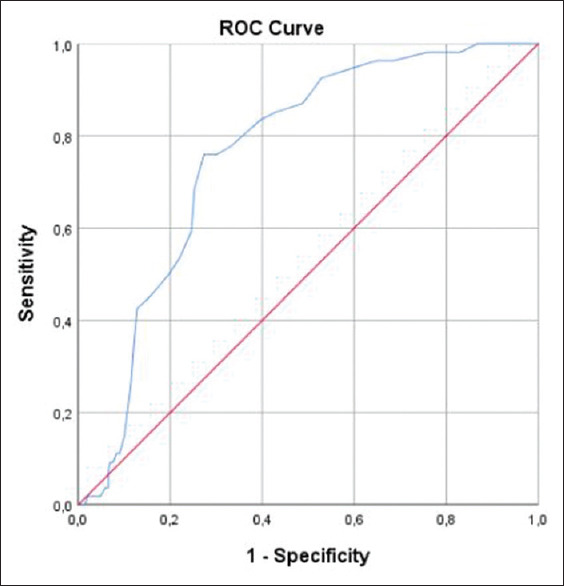
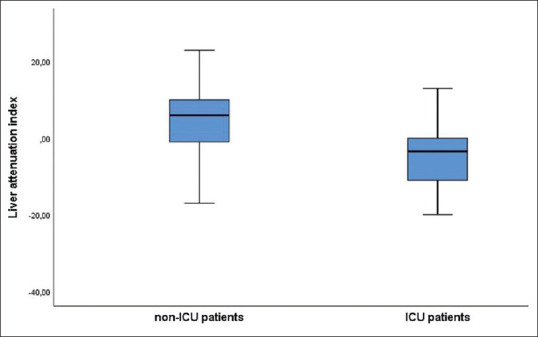
There was no significant difference between genders in terms of clinical course. Liver density and LAI were significantly lower in the intensive care unit (ICU) patients. The prevalence of severe disease was higher in the patients with hepatic steatosis than in the non-steatotic group (odds ratio [OR] 3.815, 95% confidence interval [CI] 1.97-7.37, P < 0.001). After adjusting for age and comorbidities including hypertension, diabetes mellitus, coronary artery disease, chronic obstructive pulmonary disease, and chronic kidney disease, multivariate logistic regression analysis showed that non-alcoholic fatty liver disease (NAFLD) was an independent risk factor for COVID-19 severity (OR 3.935, 95% CI 1.77-8.70, P = 0.001). The optimal cut-off value for LAI was calculated as 0.5 for predicting patients who required ICU treatment.
On the initial chest CT images of COVID-19 patients, presence of fatty liver is a strong predictor for severe disease.
本研究旨在探讨 2019 年新型冠状病毒(COVID-19)感染引起的疾病在初始胸部计算机断层扫描(CT)中的位置、范围和类型,以及肝脂肪变性与疾病严重程度的关系,并通过测量肝脏衰减指数(LAI)来评估。
本研究共评估了 343 例经鼻咽拭子确诊为 COVID-19 的患者的胸部 CT 图像(男 201 例,平均年龄 48.43 岁)。分析了病变的侧别、受累肺叶数、弥漫性、病变数和病变类型。测量了肝脏和脾脏的 CT 衰减值,并计算了 LAI 以检测肝脂肪变性。采用单因素和多因素逻辑回归分析确定严重 COVID-19 的独立早期预测因素。
在临床病程方面,男女之间无显著性差异。在重症监护病房(ICU)患者中,肝脏密度和 LAI 显著降低。与非脂肪变性组相比,肝脂肪变性患者发生严重疾病的比例更高(比值比[OR] 3.815,95%置信区间[CI] 1.97-7.37,P <0.001)。在调整年龄和高血压、糖尿病、冠状动脉疾病、慢性阻塞性肺疾病和慢性肾脏病等合并症后,多因素逻辑回归分析显示,非酒精性脂肪性肝病(NAFLD)是 COVID-19 严重程度的独立危险因素(OR 3.935,95%CI 1.77-8.70,P = 0.001)。LAI 的最佳截断值为 0.5,可预测需要 ICU 治疗的患者。
在 COVID-19 患者的初始胸部 CT 图像上,存在脂肪肝是疾病严重程度的一个强烈预测因素。