Norwitz Nicholas G, Naidoo Uma
Department of Physiology, Anatomy and Genetics, University of Oxford, Oxford, United Kingdom.
Harvard Medical School, Boston, MA, United States.
Front Psychiatry. 2021 Feb 12;12:598119. doi: 10.3389/fpsyt.2021.598119. eCollection 2021.
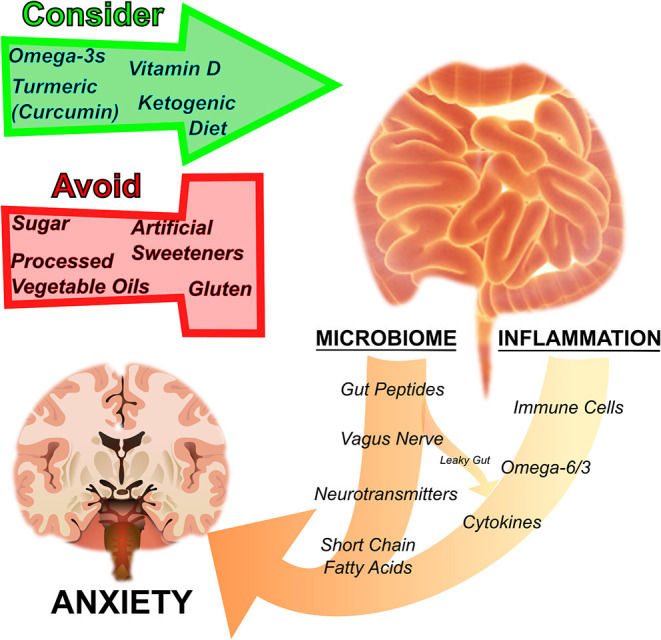
Despite the overwhelming prevalence of anxiety disorders in modern society, medications and psychotherapy often fail to achieve complete symptom resolution. A complementary approach to medicating symptoms is to address the underlying metabolic pathologies associated with mental illnesses and anxiety. This may be achieved through nutritional interventions. In this perspectives piece, we highlight the roles of the microbiome and inflammation as influencers of anxiety. We further discuss the evidence base for six specific nutritional interventions: avoiding artificial sweeteners and gluten, including omega-3 fatty acids and turmeric in the diet, supplementation with vitamin D, and ketogenic diets. We attempt to integrate insights from the nutrition science-literature in order to highlight some practices that practitioners may consider when treating individual patients. Notably, this piece is not meant to serve as a comprehensive review of the literature, but rather argue our perspective that nutritional interventions should be more widely considered among clinical psychiatrists. Nutritional psychiatry is in its infancy and more research is needed in this burgeoning low-risk and potentially high-yield field.
尽管焦虑症在现代社会极为普遍,但药物治疗和心理治疗往往无法完全消除症状。治疗症状的一种补充方法是解决与精神疾病和焦虑相关的潜在代谢病理问题。这可以通过营养干预来实现。在这篇观点文章中,我们强调了微生物群和炎症作为焦虑影响因素的作用。我们进一步讨论了六种特定营养干预措施的证据基础:避免食用人工甜味剂和麸质、在饮食中摄入omega-3脂肪酸和姜黄、补充维生素D以及生酮饮食。我们试图整合营养科学文献中的见解,以突出从业者在治疗个体患者时可能考虑的一些做法。值得注意的是,这篇文章并非旨在对文献进行全面综述,而是阐述我们的观点,即临床精神科医生应更广泛地考虑营养干预措施。营养精神病学尚处于起步阶段,在这个新兴的低风险且可能高收益的领域还需要更多研究。