Torabian Kakhki Maryam, Sedaghat Naser, Mohsenzadeh Mohammad
Department of Food Hygiene and Aquaculture, Faculty of Veterinary Medicine, Ferdowsi University of Mashhad, Mashhad, Iran.
Department of Food Science, Faculty of Agriculture, Ferdowsi University of Mashhad, Mashhad, Iran.
Vet Res Forum. 2020 Fall;11(4):339-346. doi: 10.30466/vrf.2018.91902.2223. Epub 2020 Dec 15.
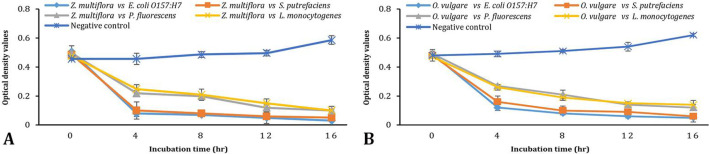
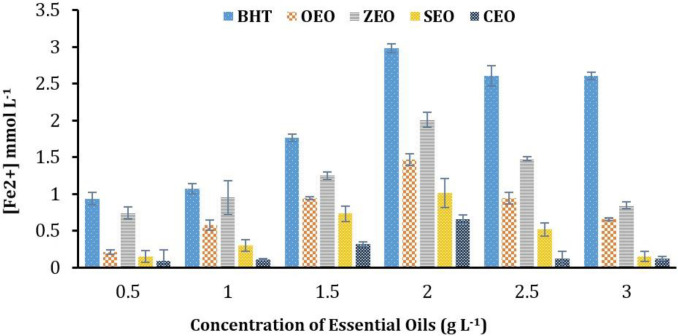
Essential oils (EOs) have been utilized as a growth inhibitor of microorganisms. This study was aimed to recognize the composition, antioxidative, antibacterial, and time-kill activities of , , ; and EOs against O157:H7, and . Gas chromatography-mass spectrometry was used to determine the chemical composition of EOs. Disc diffusion, minimum inhibitory concentration, minimum bactericidal concentration, and time-kill methods were used to determine the antibacterial activity of EOs. The antioxidative activity of EOs were determined by 2, 20-diphenyl-1-picrylhydrazyl radical scavenging and ferric reducing antioxidative power methods. All EOs exhibited antibacterial activity, however, EO was the most effective followed by EO The lowest antibacterial activity was observed in EO. The most sensitive among tested bacteria to and EOs was O157:H7 and to ; and EOs were and , respectively and EOs were able to kill 85.00% and 80.00% of the O157: H7 and cells in 4 hr, respectively. The highest antioxidative activity was observed in EO. The tested EOs showed the highest antioxidative activity at a concentration of 2.00 g L. Ferric reducing antioxidant power value of , and was 2.01 ± 0.03, 1.47 ± 0.04, 1.01 ± 0.03, and 0.66 ± 0.34, respectively. High concentrations of tested EOs showed a decrease in antioxidative activity.
香精油(EOs)已被用作微生物的生长抑制剂。本研究旨在识别、、;和EOs对O157:H7、和的成分、抗氧化、抗菌及杀菌活性。采用气相色谱-质谱联用仪测定EOs的化学成分。采用纸片扩散法、最低抑菌浓度、最低杀菌浓度和杀菌时间法测定EOs的抗菌活性。采用2,2-二苯基-1-苦基肼自由基清除法和铁还原抗氧化能力法测定EOs的抗氧化活性。所有EOs均表现出抗菌活性,然而,EO最有效,其次是EO,EO的抗菌活性最低。受试细菌中对和EOs最敏感的分别是O157:H7,对;和EOs最敏感的分别是和。和EOs分别能够在4小时内杀死85.00%和80.00%的O157:H7和细胞。EO的抗氧化活性最高。受试EOs在浓度为2.00 g/L时表现出最高的抗氧化活性。、、和的铁还原抗氧化能力值分别为2.01±0.03、1.47±0.04、1.01±0.03和0.66±0.34。高浓度受试EOs的抗氧化活性降低。