White Kristie, Qualtieri Julianne, Courville Elizabeth L, Beck Rose C, Alobeid Bachir, Czuchlewski David R, Teruya-Feldstein Julie, Soma Lorinda A, Prakash Sonam, Gratzinger Dita
Department of Laboratory Medicine, University of California at San Francisco School of Medicine, San Francisco, CA, USA.
Department of Pathology and Laboratory Medicine, University of Pennsylvania School of Medicine, Philadelphia, PA, USA.
Acad Pathol. 2021 Feb 17;8:2374289521990823. doi: 10.1177/2374289521990823. eCollection 2021 Jan-Dec.
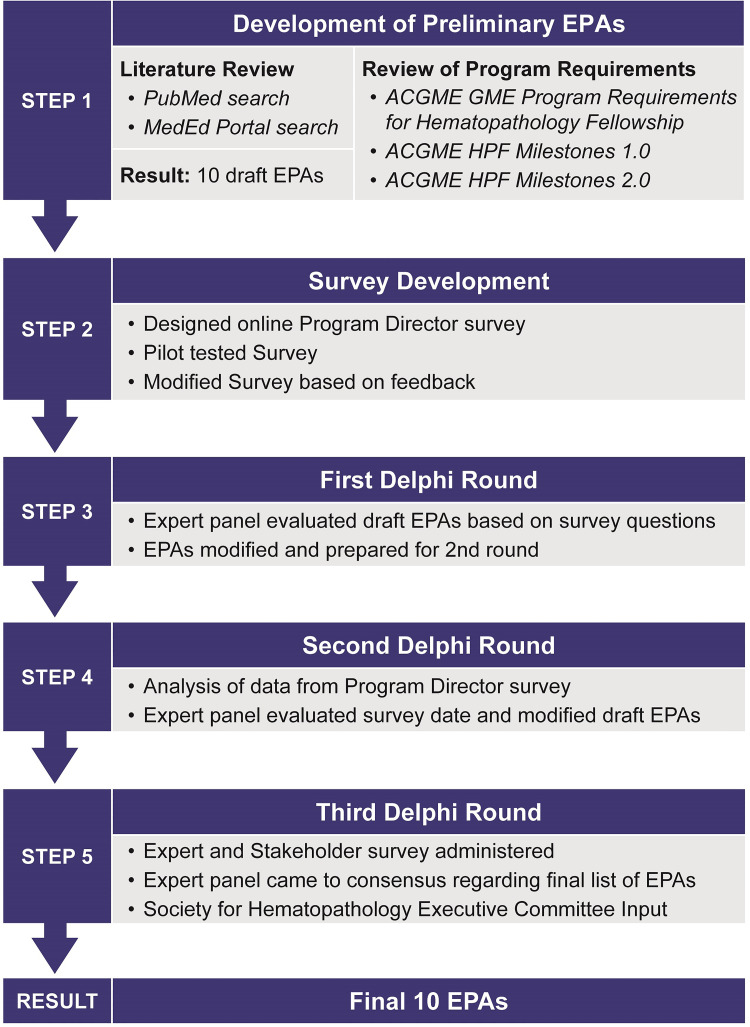
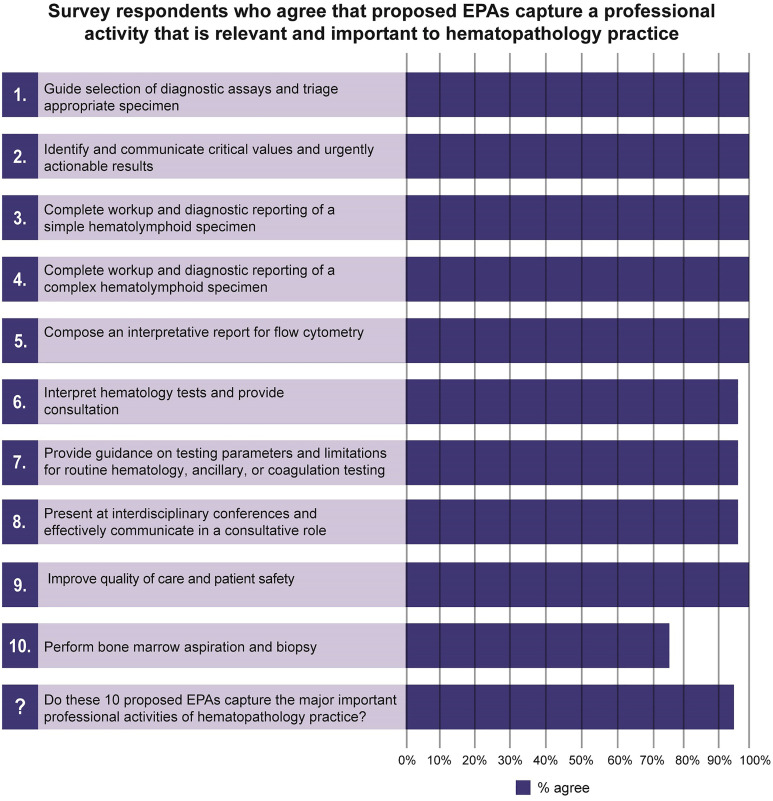
Hematopathology fellowship education has grown in complexity as patient-centered treatment plans have come to depend on integration of clinical, morphologic, immunophenotypic, molecular, and cytogenetic variables. This complexity is in competition with the need for timely hematopathology care with stewardship of patient, laboratory, and societal resources. Accreditation Council for Graduate Medical Education Milestones provide a guidance document for hematopathology training, but fellows and their educators are in need of a simple framework that allows assessment and feedback of growth toward independent hematopathology practice. Entrustable professional activities provide one such framework, and herein, we provide proposed Hematopathology Fellowship Entrustable Professional Activities based on review of pertinent guidelines and literature, with multiple rounds of expert and stakeholder input utilizing a modified mini-Delphi approach. Ten core entrustable professional activities deemed essential for graduating hematopathology fellows were developed together with skills and knowledge statements, example scenarios, and corresponding Accreditation Council for Graduate Medical Education Milestones. Application of these entrustable professional activities in program design, fellow evaluation, and decisions regarding level of supervision is discussed with consideration of benefits and barriers to implementation. These entrustable professional activities may be used by hematopathology fellowship directors and faculty to provide fellows with timely constructive feedback, determine entrustment decisions, provide the Clinical Competency Committee with granular data to support Milestone evaluations, and provide insight into areas of potential improvement in fellowship training. Fellows will benefit from a clear roadmap to independent hematopathology practice with concrete and timely feedback.
随着以患者为中心的治疗方案开始依赖于临床、形态学、免疫表型、分子和细胞遗传学变量的整合,血液病理学 fellowship 教育的复杂性日益增加。这种复杂性与及时提供血液病理学护理以及管理患者、实验室和社会资源的需求相互竞争。研究生医学教育认证委员会的里程碑为血液病理学培训提供了一份指导文件,但学员及其教育者需要一个简单的框架,以便对独立血液病理学实践的成长进行评估和反馈。可托付专业活动提供了这样一个框架,在此,我们在审查相关指南和文献的基础上,通过使用改良的小型德尔菲法进行多轮专家和利益相关者的意见征集,提出了血液病理学 fellowship 可托付专业活动。制定了十项被认为对毕业的血液病理学学员至关重要的核心可托付专业活动,并附带技能和知识说明、示例场景以及相应的研究生医学教育认证委员会里程碑。讨论了这些可托付专业活动在项目设计、学员评估以及监督级别决策中的应用,并考虑了实施的益处和障碍。这些可托付专业活动可被血液病理学 fellowship 主任和教员用于向学员提供及时的建设性反馈、确定托付决策、向临床能力委员会提供详细数据以支持里程碑评估,并深入了解 fellowship 培训中潜在改进的领域。学员将受益于一条清晰的独立血液病理学实践路线图以及具体且及时的反馈。