Chou Chris A, Toedebusch Cristina D, Redrick Tiara, Freund David, McLeland Jennifer S, Morris John C, Holtzman David M, Lucey Brendan P
Department of Neurology, Washington University School of Medicine, St Louis, MO.
Hope Center for Neurological Disorders, Washington University School of Medicine, St Louis, MO.
Sleep Adv. 2020 Oct 24;1(1):zpaa006. doi: 10.1093/sleepadvances/zpaa006. eCollection 2020.
Multiple methods for monitoring sleep-wake activity have identified sleep disturbances as risk factors for Alzheimer disease (AD). In order to identify the level of agreement between different methods, we compared sleep parameters derived from single-channel EEG (scEEG), actigraphy, and sleep diaries in cognitively normal and mildly impaired older adults.
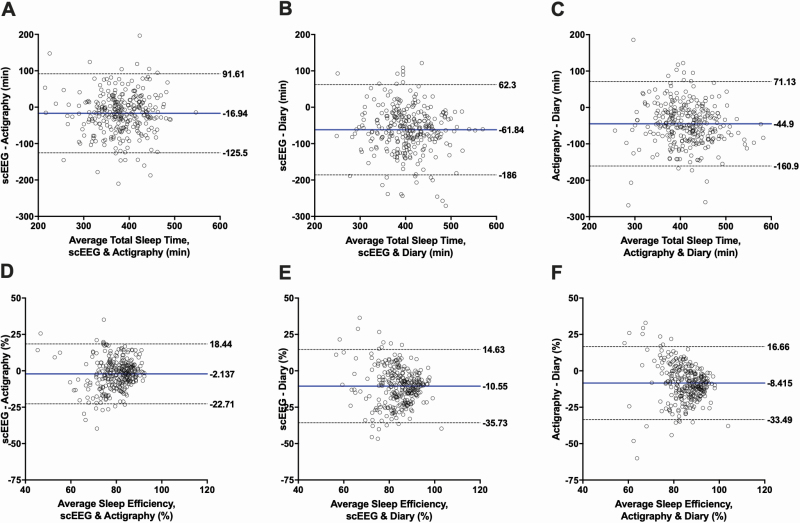
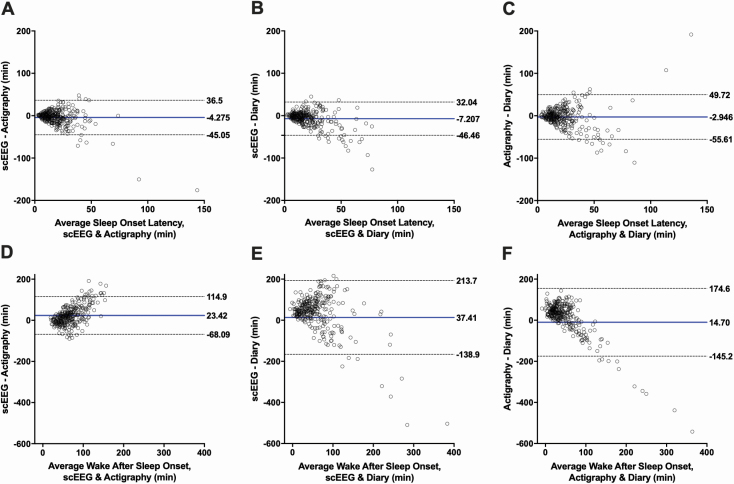
Two hundred ninety-three participants were monitored at home for up to six nights with scEEG, actigraphy, and sleep diaries. Total sleep time (TST), sleep efficiency (SE), sleep onset latency (SOL), and wake after sleep onset (WASO) were calculated using each of these methods. In 109 of the 293 participants, the ratio of cerebrospinal fluid concentrations of phosphorylated tau (p-tau) and amyloid-β-42 (Aβ42) was used as a biomarker for AD pathology.
Agreement was highest for TST across instruments, especially in cognitively normal older adults. Overall, scEEG and actigraphy appeared to have greater agreement for multiple sleep parameters than for scEEG and diary or actigraphy and diary. Levels of agreement between scEEG and actigraphy overall decreased in mildly impaired participants and those with biomarker evidence of AD pathology, especially for measurements of TST.
Caution should be exercised when comparing scEEG and actigraphy in individuals with mild cognitive impairment or with AD pathology. Sleep diaries may capture different aspects of sleep compared to scEEG and actigraphy. Additional studies comparing different methods of measuring sleep-wake activity in older adults are necessary to allow for comparison between studies using different methods.
多种监测睡眠-清醒活动的方法已将睡眠障碍确定为阿尔茨海默病(AD)的风险因素。为了确定不同方法之间的一致性水平,我们比较了认知正常和轻度受损的老年人通过单通道脑电图(scEEG)、活动记录仪和睡眠日记得出的睡眠参数。
293名参与者在家中接受scEEG、活动记录仪和睡眠日记监测,最长达六个晚上。使用这些方法分别计算总睡眠时间(TST)、睡眠效率(SE)、入睡潜伏期(SOL)和睡眠中觉醒时间(WASO)。在293名参与者中的109名中,脑脊液中磷酸化tau蛋白(p-tau)和淀粉样β-蛋白42(Aβ42)的浓度比值被用作AD病理的生物标志物。
各仪器测量的TST一致性最高,尤其是在认知正常的老年人中。总体而言,scEEG和活动记录仪在多个睡眠参数上的一致性似乎高于scEEG与睡眠日记或活动记录仪与睡眠日记之间的一致性。在轻度受损参与者以及有AD病理生物标志物证据的参与者中,scEEG和活动记录仪之间的一致性水平总体下降,尤其是在TST测量方面。
在比较轻度认知障碍个体或有AD病理的个体的scEEG和活动记录仪时应谨慎。与scEEG和活动记录仪相比,睡眠日记可能捕捉到睡眠的不同方面。有必要进行更多研究比较老年人测量睡眠-清醒活动的不同方法,以便不同方法的研究之间能够进行比较。