Sun Yamei, Xue Ziqian, Liu Qinglin, Jia Yaling, Li Yinle, Liu Kang, Lin Yiyang, Liu Min, Li Guangqin, Su Cheng-Yong
MOE Laboratory of Bioinorganic and Synthetic Chemistry, Lehn Institute of Functional Materials, School of Chemistry, Sun Yat-Sen University, Guangzhou, China.
School of Physics and Electronics, Central South University, Changsha, Hunan, China.
Nat Commun. 2021 Mar 1;12(1):1369. doi: 10.1038/s41467-021-21595-5.
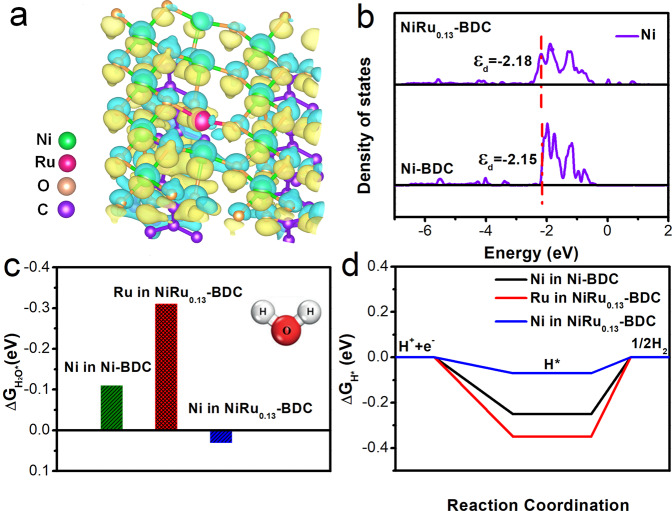
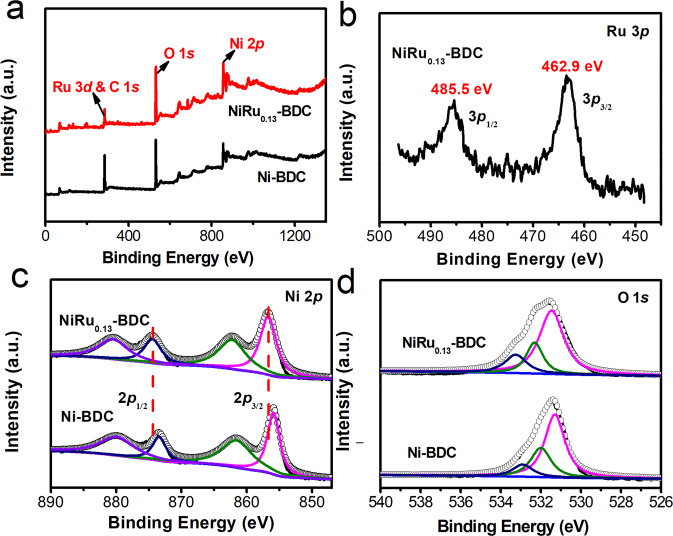
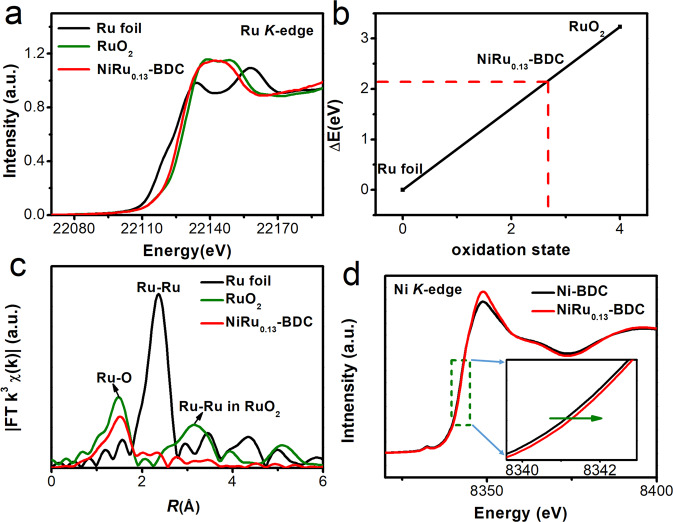
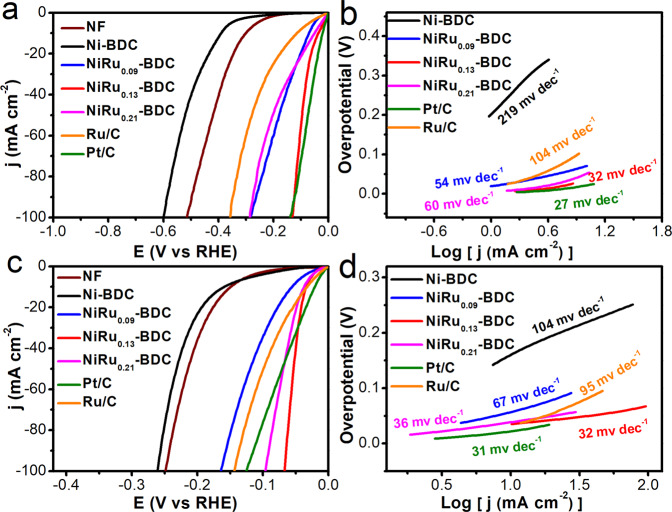
Developing high-performance electrocatalysts toward hydrogen evolution reaction is important for clean and sustainable hydrogen energy, yet still challenging. Herein, we report a single-atom strategy to construct excellent metal-organic frameworks (MOFs) hydrogen evolution reaction electrocatalyst (NiRu-BDC) by introducing atomically dispersed Ru. Significantly, the obtained NiRu-BDC exhibits outstanding hydrogen evolution activity in all pH, especially with a low overpotential of 36 mV at a current density of 10 mA cm in 1 M phosphate buffered saline solution, which is comparable to commercial Pt/C. X-ray absorption fine structures and the density functional theory calculations reveal that introducing Ru single-atom can modulate electronic structure of metal center in the MOF, leading to the optimization of binding strength for HO and H*, and the enhancement of HER performance. This work establishes single-atom strategy as an efficient approach to modulate electronic structure of MOFs for catalyst design.
开发用于析氢反应的高性能电催化剂对于清洁和可持续的氢能至关重要,但仍然具有挑战性。在此,我们报告了一种单原子策略,通过引入原子分散的钌来构建优异的金属有机框架(MOF)析氢反应电催化剂(NiRu-BDC)。值得注意的是,所获得的NiRu-BDC在所有pH值下均表现出出色的析氢活性,特别是在1 M磷酸盐缓冲盐溶液中,在电流密度为10 mA cm时具有36 mV的低过电位,这与商业Pt/C相当。X射线吸收精细结构和密度泛函理论计算表明,引入Ru单原子可以调节MOF中金属中心的电子结构,从而优化对HO和H*的结合强度,并提高析氢性能。这项工作确立了单原子策略作为一种调节MOF电子结构以进行催化剂设计的有效方法。