Department of Preventive and Social Medicine, University of Otago, Dunedin, New Zealand.
The EuroQol Group, Version Management Committee, Rotterdam, Netherlands.
Patient. 2021 Sep;14(5):591-600. doi: 10.1007/s40271-021-00496-1. Epub 2021 Mar 2.
The beta EQ-5D-Y-5L is a new patient-reported outcome measure (PROM) for children aged 8-15 years that is currently under development by the EuroQol Group. The EQ-5D-Y-5L is similar to the EQ-5D-Y but has five levels of severity per dimension rather than three. The increased number of levels increases the granularity of the responses but possibly has also increased the difficulty of distinguishing between levels. The EuroQoL's Version Management Committee (VMC) required a robust method to determine how well children distinguish between the five EQ-5D-Y-5L ordinal severity qualifiers (i.e. 'no problems' through to 'extreme problems'), which are a critical aspect of both health measurement and the valuation of health states.
This paper describes the development, testing, selection, and piloting of such a method.
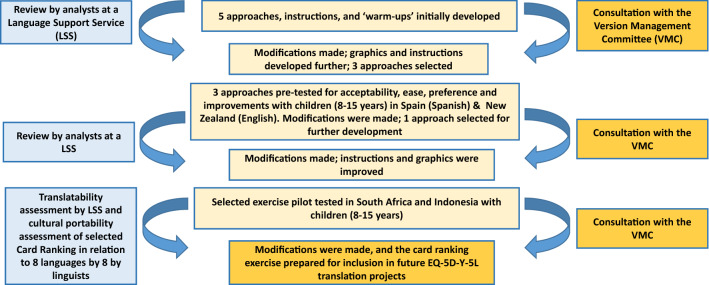
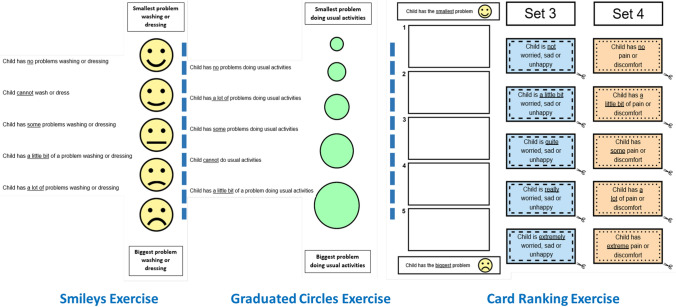
Following a literature review and consultation with the wider VMC and a Language Support Services agency, a range of exercises were developed to assess the ordering and comprehension of the five severity qualifiers. Three exercises were pre-tested with children in Spain and New Zealand. One exercise, preferred and understood by children, was then piloted.
Five children in Spain and 11 in New Zealand tested the three exercises. In both countries, all children found the three exercises easy to understand and complete. Of the 12 children who expressed a preference, nine said they preferred the card ranking. Card ranking also allowed the interviewer to observe difficult choices being made as the children physically rearranged the card order until they settled on their final order. Following rigorous assessment of translatability and cultural portability by an independent Language Support Service, card ranking was piloted in South Africa (n = 9) and in Indonesia (n = 10), where it highlighted severity qualifier order inversions that would otherwise not have been detected.
The card ranking exercise was found to be a preferred and acceptable means of testing the ordering of translations of severity qualifiers among children. Additional formal testing of the exercise in other countries and languages is now underway. The approach developed and tested by the VMC for cognitive debriefing of beta EQ-5D-Y-5L language/country versions may also be useful in determining the adequacy of translated qualifiers in debriefing of adult EQ-5D-5L versions and other PROMs.
β EQ-5D-Y-5L 是欧洲质量生活指数(EuroQol)组织正在开发的一种新的儿童自评健康测量量表,适用于 8-15 岁的儿童。EQ-5D-Y-5L 与 EQ-5D-Y 相似,但每个维度有五个严重程度级别,而不是三个。更多的级别增加了反应的粒度,但也可能增加了区分级别的难度。欧洲质量生活指数的版本管理委员会(VMC)需要一种可靠的方法来确定儿童对五个 EQ-5D-Y-5L 顺序严重程度限定词(即“无问题”到“极度问题”)的区分程度,这是健康测量和健康状态估值的关键方面。
本文介绍了该方法的开发、测试、选择和试点情况。
在进行文献回顾和与更广泛的 VMC 以及语言支持服务机构协商后,制定了一系列练习来评估五个严重程度限定词的排序和理解。在西班牙和新西兰,对三项练习进行了预测试。在这两个国家,所有的孩子都认为这三个练习很容易理解和完成。在表示偏好的 12 名儿童中,有 9 名表示更喜欢卡片排序。卡片排序还允许访谈者观察到孩子们在物理上重新排列卡片顺序直到他们确定最终顺序时做出的困难选择。经过独立的语言支持服务机构对可翻译性和文化可移植性进行严格评估后,卡片排序在南非(n=9)和印度尼西亚(n=10)进行了试点,在这些国家发现了严重程度限定词顺序反转,如果不进行检测,这些反转将不会被发现。
卡片排序练习被认为是一种测试儿童对严重程度限定词翻译排序的可接受的方法。目前正在其他国家和语言中对该练习进行进一步的正式测试。VMC 为 beta EQ-5D-Y-5L 语言/国家版本的认知性测试开发和测试的方法也可能有助于确定在成人 EQ-5D-5L 版本和其他 PROMs 的认知性测试中翻译限定词的充分性。