Department of Emergency Medicine, Chaim Sheba Medical Center, 52621, Ramat-Gan, Tel Hashomer, Israel.
Sackler Faculty of Medicine, Tel-Aviv University, Tel-Aviv, Israel.
Intern Emerg Med. 2021 Nov;16(8):2261-2268. doi: 10.1007/s11739-021-02680-5. Epub 2021 Mar 1.
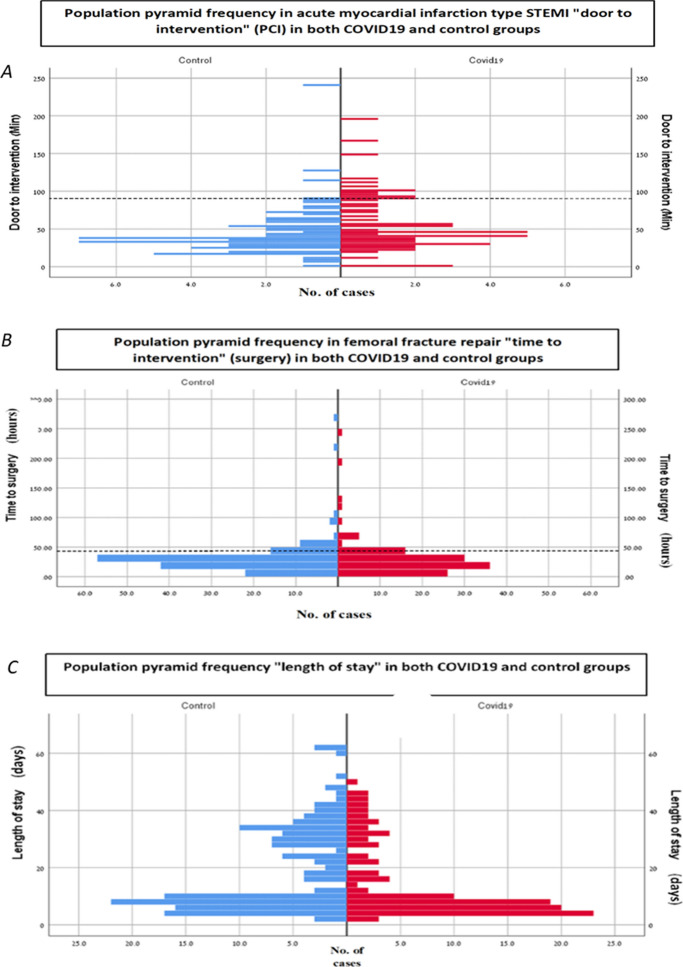
The emergence of Covid-19 has caused a pandemic and is a major public health concern. Covid-19 has fundamentally challenged the global health care system in all aspects. However, there is a growing concern for the subsequent detrimental effects of continuing delays or adjustments on time-dependent treatments for Covid-19 negative patients. Patients arriving to the ED with STEMIs and acute CVA are currently presumed to have delays due to Covid-19 related concerns. The objective of this paper is to evaluate the implications of the Covid-19 pandemic on non-Covid19 patients in emergency care settings. We conducted a retrospective study from February 2020 to April 2020 and compared this to a parallel period in 2019 to assess the impact of the Covid-19 pandemic on three distinct non-Covid-19 ED diagnosis that require immediate intervention. Our primary outcome measures were time to primary PCI in acute STEMI, time to fibrinolysis in acute CVA, and time to femoral hip fracture correction surgery. Our secondary outcome measure included a composite outcome of length of stay in hospital and mortality. From 1 February 2020 to 30 April 2020, the total referrals to ED diagnosed with STEMI, Hip fracture and CVA of which required intervention were 197 within Covid-19 group 2020 compared to 250 in the control group 2019. Mean duration to intervention (PCI, surgery and tPA, respectively) did not differ between COVID-19 group and 2019 group. Among femoral hip fracture patients', the referral numbers to ED were significantly lower in Covid-19 era (p = 0.040) and the hospitalization stay was significantly shorter (p = 0.003). Among CVA patients', we found statistical differences among the number of referrals and the patients' age. Coping with the Covid-19 pandemic presents a challenge for the general healthcare system. Our results suggest that with proper management, despite the obstacles of isolation policies and social distancing, any negative impact on the quality of health care for the non-Covid-19 patients can be minimized in the emergency department setting.
Covid-19 的出现引发了一场大流行,是一个主要的公共卫生关注点。Covid-19 从根本上挑战了全球医疗保健系统的各个方面。然而,人们越来越担心,对于新冠病毒阴性患者的时间依赖性治疗,如果继续延迟或调整,会产生后续的不利影响。目前,因新冠病毒相关问题,急诊科(ED)收治的 ST 段抬高型心肌梗死(STEMI)和急性卒中和急性缺血性卒中等患者被认为存在延迟。本文的目的是评估新冠疫情对急诊非新冠患者的影响。我们进行了一项回顾性研究,时间为 2020 年 2 月至 4 月,并与 2019 年同期进行了比较,以评估新冠疫情对三种需要立即干预的非新冠 ED 诊断的影响。我们的主要结局指标是急性 STEMI 患者行直接经皮冠状动脉介入治疗(PCI)的时间、急性卒中和急性缺血性卒中介入溶栓的时间以及股骨髋关节骨折矫正手术的时间。我们的次要结局指标包括住院时间和死亡率的复合结局。从 2020 年 2 月 1 日至 2020 年 4 月 30 日,共向 ED 转诊了 197 例诊断为 STEMI、髋关节骨折和需要干预的卒中等患者,其中新冠组为 2020 年,对照组为 2019 年。COVID-19 组和对照组的干预措施(PCI、手术和 tPA)时间之间没有差异。股骨髋关节骨折患者的 ED 转诊数量在新冠组显著减少(p=0.040),住院时间明显缩短(p=0.003)。在卒中和急性缺血性卒中患者中,我们发现转诊数量和患者年龄存在统计学差异。应对新冠疫情对一般医疗保健系统提出了挑战。我们的研究结果表明,通过适当的管理,尽管存在隔离政策和社会隔离的障碍,但在急诊科环境中,可以将对非新冠患者的医疗保健质量的任何负面影响降到最低。