Laboratory Pharmacology of Synaptic Plasticity, European Brain Research Institute, 00161 Rome, Italy.
Department of Physiology and Pharmacology "V.Erspamer", Sapienza University of Rome, 00185 Rome, Italy.
Int J Mol Sci. 2021 Feb 26;22(5):2342. doi: 10.3390/ijms22052342.
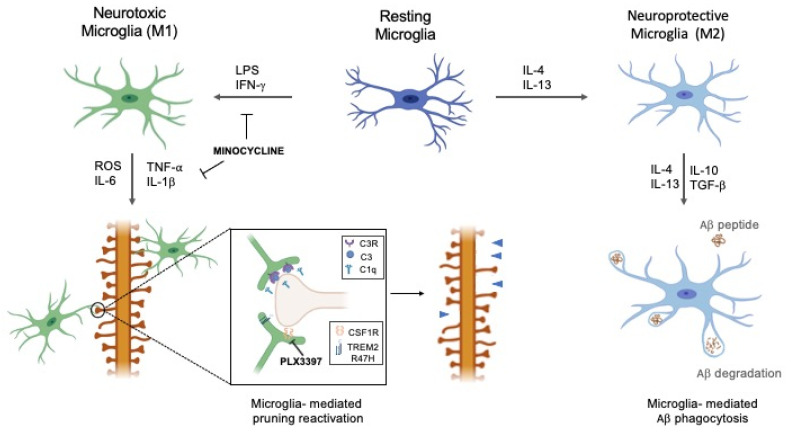
In this review, we focus on the emerging roles of microglia in the brain, with particular attention to synaptic plasticity in health and disease. We present evidence that ramified microglia, classically believed to be "resting" (i.e., inactive), are instead strongly implicated in dynamic and plastic processes. Indeed, there is an intimate relationship between microglia and neurons at synapses which modulates activity-dependent functional and structural plasticity through the release of cytokines and growth factors. These roles are indispensable to brain development and cognitive function. Therefore, approaches aimed at maintaining the ramified state of microglia might be critical to ensure normal synaptic plasticity and cognition. On the other hand, inflammatory signals associated with Alzheimer's disease are able to modify the ramified morphology of microglia, thus leading to synapse loss and dysfunction, as well as cognitive impairment. In this context, we highlight microglial TREM2 and CSF1R as emerging targets for disease-modifying therapy in Alzheimer's disease (AD) and other neurodegenerative disorders.
在这篇综述中,我们重点关注小胶质细胞在大脑中的新作用,特别关注健康和疾病中的突触可塑性。我们提出证据表明,以前被认为是“静止”(即不活跃)的分支状小胶质细胞实际上强烈参与动态和可塑性过程。实际上,小胶质细胞和突触处的神经元之间存在密切关系,通过释放细胞因子和生长因子来调节活动依赖性功能和结构可塑性。这些作用对于大脑发育和认知功能是不可或缺的。因此,旨在维持小胶质细胞分支状态的方法对于确保正常的突触可塑性和认知功能可能至关重要。另一方面,与阿尔茨海默病相关的炎症信号能够改变小胶质细胞的分支形态,从而导致突触丧失和功能障碍以及认知障碍。在这种情况下,我们强调小胶质细胞的 TREM2 和 CSF1R 作为阿尔茨海默病(AD)和其他神经退行性疾病的疾病修饰治疗的新靶点。