Chang Yeonho, Kim Do-Hyeon, Zhou Kai, Jeong Min Gyu, Park Soyeon, Kwon Yonghoon, Hong Triet Minh, Noh Jungeun, Ryu Sung Ho
Department of Life Sciences, Pohang University of Science and Technology, Pohang, 37673, Republic of Korea.
Integrative Biosciences and Biotechnology, Pohang University of Science and Technology, Pohang, 37673, Republic of Korea.
Exp Mol Med. 2021 Mar;53(3):384-392. doi: 10.1038/s12276-021-00572-4. Epub 2021 Mar 2.
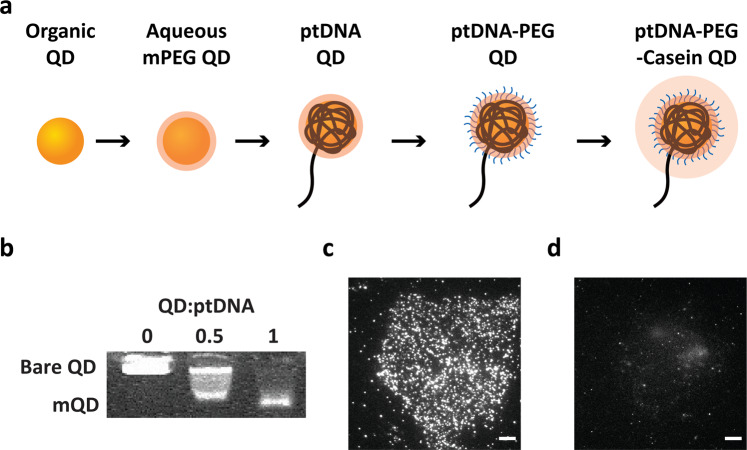
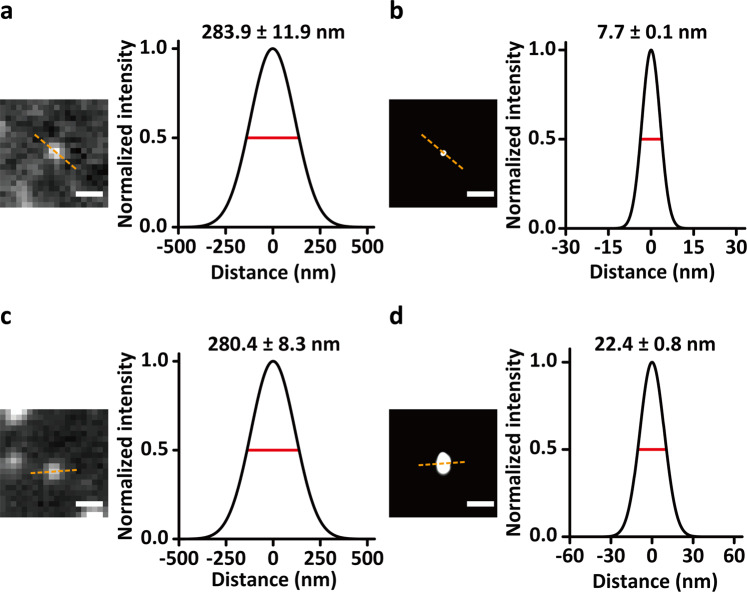
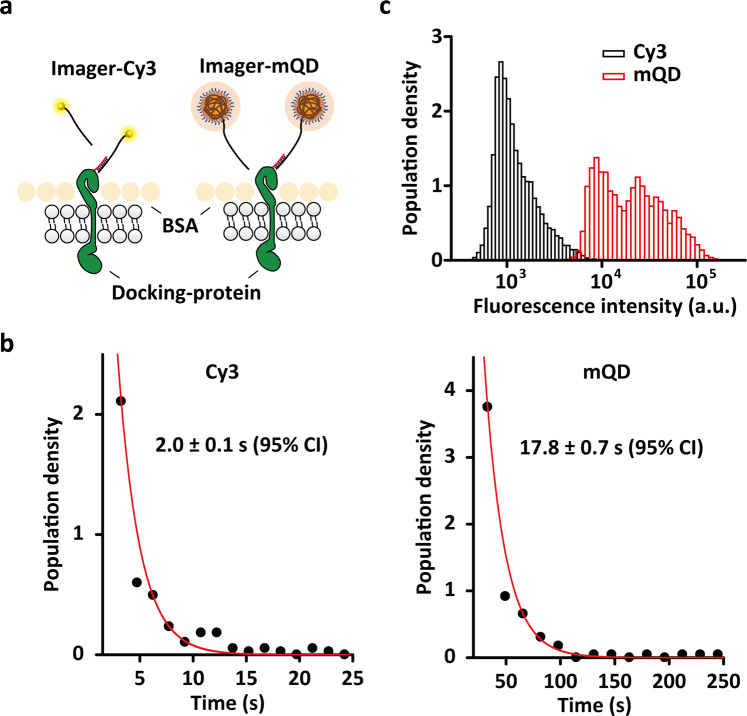
Single-molecule localization microscopy (SMLM) has allowed the observation of various molecular structures in cells beyond the diffraction limit using organic dyes. In principle, the SMLM resolution depends on the precision of photoswitching fluorophore localization, which is inversely correlated with the square root of the number of photons released from the individual fluorophores. Thus, increasing the photon number by using highly bright fluorophores, such as quantum dots (QDs), can theoretically fundamentally overcome the current resolution limit of SMLM. However, the use of QDs in SMLM has been challenging because QDs have no photoswitching property, which is essential for SMLM, and they exhibit nonspecificity and multivalency, which complicate their use in fluorescence imaging. Here, we present a method to utilize QDs in SMLM to surpass the resolution limit of the current SMLM utilizing organic dyes. We confer monovalency, specificity, and photoswitchability on QDs by steric exclusion via passivation and ligand exchange with ptDNA, PEG, and casein as well as by DNA point accumulation for imaging in nanoscale topography (DNA-PAINT) via automatic thermally driven hybridization between target-bound docking and dye-bound complementary imager strands. QDs are made monovalent and photoswitchable to enable SMLM and show substantially better photophysical properties than Cy3, with higher fluorescence intensity and an improved resolution factor. QD-PAINT displays improved spatial resolution with a narrower full width at half maximum (FWHM) than DNA-PAINT with Cy3. In summary, QD-PAINT shows great promise as a next-generation SMLM method for overcoming the limited resolution of the current SMLM.
单分子定位显微镜(SMLM)使得利用有机染料在衍射极限之外观察细胞中的各种分子结构成为可能。原则上,SMLM的分辨率取决于光开关荧光团定位的精度,这与单个荧光团释放的光子数的平方根成反比。因此,通过使用高亮度荧光团(如量子点(QD))增加光子数,理论上可以从根本上克服当前SMLM的分辨率限制。然而,在SMLM中使用量子点一直具有挑战性,因为量子点没有光开关特性(这是SMLM所必需的),并且它们表现出非特异性和多价性,这使得它们在荧光成像中的应用变得复杂。在这里,我们提出了一种在SMLM中利用量子点的方法,以超越当前利用有机染料的SMLM的分辨率限制。我们通过钝化和与ptDNA、PEG和酪蛋白进行配体交换的空间排斥,以及通过靶标结合的对接链和染料结合的互补成像链之间的自动热驱动杂交进行纳米级形貌成像的DNA点积累(DNA-PAINT),赋予量子点单价性、特异性和光开关能力。量子点被制成单价且可光开关以实现SMLM,并且显示出比Cy3更好的光物理性质,具有更高的荧光强度和改进的分辨率因子。与使用Cy3的DNA-PAINT相比,QD-PAINT具有更窄的半高宽(FWHM),显示出更高的空间分辨率。总之,QD-PAINT作为一种克服当前SMLM分辨率限制的下一代SMLM方法具有很大的潜力。